Why E2E Testing Breaks at Scale
End-to-end testing is the most valuable form of testing and the hardest to maintain. It validates that the entire application works together — frontend, backend, integrations, and user flows. When E2E tests pass, you have real confidence that the system works.
The problem is that E2E tests are brittle. A button moves, a selector changes, a timing assumption breaks, and the test fails — not because the application is broken, but because the test is fragile. Teams spend more time maintaining tests than writing them. Tests get skipped or deleted because they are unreliable. And the confidence that E2E testing should provide erodes.
The scale of the problem grows with application complexity. A simple app with 20 E2E tests is manageable. A complex application with 500 E2E tests across multiple platforms becomes a maintenance burden that consumes engineering capacity.
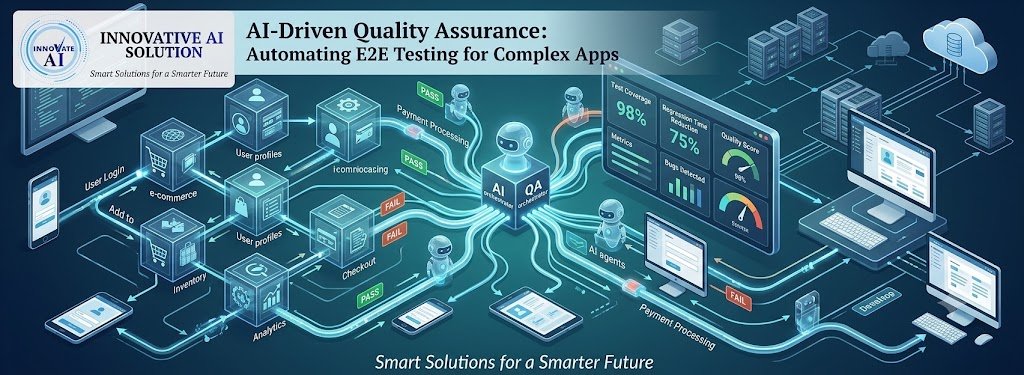
AI is changing this. Self-healing tests adapt to UI changes automatically. AI-generated tests cover scenarios teams would not write manually. Flaky test detection identifies unreliable tests before they erode confidence. Visual regression testing catches changes humans miss.
This guide covers AI-driven quality assurance for E2E testing in 2026. It addresses the tools, the strategies, the costs in India, and the practices that make AI-driven testing work.
Why E2E Testing Is Hard
The Seven Challenges
| Challenge | Why It Matters |
|---|---|
| Brittleness | Tests break on unrelated changes |
| Maintenance burden | High effort to keep tests passing |
| Flakiness | Tests pass and fail inconsistently |
| Slow feedback | E2E tests take time to run |
| Coverage gaps | Hard to know what is untested |
| Environment complexity | Tests need realistic environments |
| Cross-platform complexity | Web, mobile, different browsers |
The Cost of Poor E2E Testing
| Cost | Impact |
|---|---|
| Engineering time | Maintenance consumes capacity |
| Missed bugs | Production issues reach users |
| Slow releases | Teams hesitate to deploy |
| Low confidence | Teams do not trust tests |
| Manual testing | Expensive regression testing |
How AI Changes E2E Testing
AI Capabilities in Testing
| Capability | Application |
|---|---|
| Test generation | Generate tests from specifications |
| Self-healing | Adapt tests to UI changes |
| Flaky test detection | Identify unreliable tests |
| Visual regression | Detect visual changes |
| Test prioritisation | Run most important tests first |
| Failure analysis | Diagnose why tests failed |
| Coverage analysis | Identify untested paths |
What Changes
| Before AI | With AI |
|---|---|
| Tests written manually | Tests generated from specs |
| Tests break on UI changes | Tests self-heal |
| Flaky tests erode confidence | Flaky tests detected and fixed |
| Manual visual review | Automated visual regression |
| All tests run every time | Prioritised test execution |
| Manual failure diagnosis | AI-assisted diagnosis |
AI Test Generation
How It Works
AI generates test cases from multiple sources: specifications, existing code, user flows, and production behaviour.
| Source | What AI Generates |
|---|---|
| Requirements | Tests validating specified behaviour |
| Existing code | Tests covering code paths |
| User flows | Tests simulating user journeys |
| Production data | Tests based on real usage patterns |
| API specs | Tests for API contracts |
Test Generation Workflow
text Requirements / specifications / user flows ↓ AI analyses and generates test cases ↓ Human reviews for correctness and completeness ↓ Tests added to suite ↓ Continuous execution and validation
What AI Generates Well
| Test Type | AI Capability |
|---|---|
| Happy path tests | High — straightforward flows |
| Form validation tests | High — pattern-based |
| API contract tests | High — from specs |
| Regression tests | High — from existing tests |
| Edge case tests | Moderate — needs guidance |
| Complex workflow tests | Moderate — needs human design |
What Humans Still Design
| Test Type | Why Human Judgment Matters |
|---|---|
| Critical business flows | Requires domain knowledge |
| Edge cases | Requires creative thinking |
| Security testing | Requires adversarial mindset |
| Performance testing | Requires system understanding |
| Accessibility testing | Requires accessibility expertise |
Self-Healing Tests
The Brittleness Problem
Traditional E2E tests rely on selectors, positions, and timing assumptions. When the UI changes — a button moves, an ID changes, a layout shifts — tests break even though functionality is unchanged.
How Self-Healing Works
AI-powered self-healing tests use multiple signals to identify elements: text content, visual appearance, relative position, and semantic meaning. When one signal changes, the test adapts using others.
| Signal | Example |
|---|---|
| Text content | "Submit" button text |
| Visual appearance | Button colour and shape |
| Position | Relative to other elements |
| Semantics | Element role and purpose |
| Accessibility attributes | ARIA labels |
What Self-Healing Delivers
| Metric | Improvement |
|---|---|
| Test maintenance | 50–80% reduction |
| False failures | Significant reduction |
| Test reliability | Higher pass rate |
| Engineering time | Freed for other work |
Self-Healing Caveats
| Caveat | Why It Matters |
|---|---|
| May mask real bugs | Test adapts when it should fail |
| Requires review | Healed tests need validation |
| Not infallible | Complex changes still break tests |
| Setup complexity | Requires proper tooling |
Flaky Test Detection
The Flakiness Problem
Flaky tests pass and fail inconsistently without code changes. They erode confidence in the test suite and waste engineering time investigating non-issues.
Causes of Flakiness
| Cause | Example |
|---|---|
| Timing issues | Waiting for elements that load variably |
| Test interdependence | Tests affecting each other |
| Environment differences | Tests behaving differently across environments |
| Resource contention | Tests competing for resources |
| Non-deterministic code | Randomness in application |
AI Flaky Test Detection
AI identifies flaky tests by analysing historical results, execution patterns, and failure characteristics.
| Analysis | What It Reveals |
|---|---|
| Historical pass/fail patterns | Tests that fail inconsistently |
| Timing analysis | Tests sensitive to timing |
| Environment correlation | Tests failing in specific environments |
| Failure clustering | Related tests failing together |
Responding to Flaky Tests
| Response | When to Use |
|---|---|
| Fix the test | Test has a fixable issue |
| Quarantine | Test is unreliable, needs investigation |
| Rewrite | Test approach is fundamentally flawed |
| Delete | Test provides no value |
Visual Regression Testing
What It Does
Visual regression testing captures screenshots of the application and compares them over time, detecting visual changes that functional tests miss.
| Change Type | Functional Test | Visual Test |
|---|---|---|
| Broken layout | May pass | Detects |
| Misaligned elements | May pass | Detects |
| Colour changes | May pass | Detects |
| Missing images | May pass | Detects |
| Overlapping text | May pass | Detects |
AI-Enhanced Visual Testing
AI improves visual testing by distinguishing meaningful changes from noise.
| Traditional Visual Testing | AI-Enhanced |
|---|---|
| Detects any pixel change | Distinguishes meaningful changes |
| High false positive rate | Lower false positives |
| Requires manual review | AI-assisted triage |
| Brittle to minor rendering | Tolerant of rendering differences |
Test Prioritisation and Execution
The Execution Problem
Running all E2E tests on every change is slow. Teams either accept slow feedback or run subsets, risking missed regressions.
AI Test Prioritisation
AI prioritises tests based on change impact, historical failure patterns, and risk assessment.
| Prioritisation Signal | What It Indicates |
|---|---|
| Code change analysis | Which tests are affected |
| Historical failures | Which tests find bugs |
| Business criticality | Which flows matter most |
| Risk assessment | Where bugs are likely |
Execution Strategies
| Strategy | When to Use |
|---|---|
| Full suite | Before release |
| Prioritised subset | On every commit |
| Smoke tests | On every build |
| Affected tests | Based on code changes |
What AI-Driven E2E Testing Costs in India
Implementation Cost Benchmarks
| Scope | Implementation Cost (INR) | Implementation Cost (USD) | Timeline |
|---|---|---|---|
| Basic AI test generation | ₹1,50,000–₹4,00,000 | $1,800–$4,800 | 4–6 weeks |
| Self-healing test framework | ₹3,00,000–₹8,00,000 | $3,600–$9,600 | 8–12 weeks |
| Full AI QA platform | ₹8,00,000–₹20,00,000 | $9,600–$24,000 | 12–20 weeks |
| Enterprise QA transformation | ₹20,00,000–₹50,00,000+ | $24,000–$60,000+ | 20–36 weeks |
Cost by Component
| Component | Cost Range (INR) | Cost Range (USD) |
|---|---|---|
| Test generation | ₹1,00,000–₹3,00,000 | $1,200–$3,600 |
| Self-healing framework | ₹1,50,000–₹4,00,000 | $1,800–$4,800 |
| Flaky test detection | ₹75,000–₹2,50,000 | $900–$3,000 |
| Visual regression | ₹1,00,000–₹3,00,000 | $1,200–$3,600 |
| Test prioritisation | ₹75,000–₹2,50,000 | $900–$3,000 |
Ongoing Costs
| Cost Category | Monthly Range (INR) | Monthly Range (USD) |
|---|---|---|
| AI testing tools | ₹10,000–₹50,000 | $120–$600 |
| Test infrastructure | ₹15,000–₹80,000 | $180–$960 |
| Maintenance and review | ₹20,000–₹1,00,000 | $240–$1,200 |
| Monitoring and reporting | ₹5,000–₹25,000 | $60–$300 |
ROI Calculation
| Factor | Impact |
|---|---|
| Test maintenance reduction | 50–80% less effort |
| Engineering time freed | Significant capacity recovery |
| Bug detection improvement | Earlier detection, lower cost |
| Release confidence | Faster, more frequent releases |
For a team spending 40% of QA time on test maintenance, AI-driven self-healing can recover most of that time.
India-Specific Considerations
Device Diversity Testing
India's device landscape is diverse. E2E tests must validate across budget Android devices, mid-range phones, and premium devices.
| Testing Need | Approach |
|---|---|
| Device farm | Cloud device farms for broad coverage |
| Network conditions | Test on variable network speeds |
| Screen sizes | Validate across common resolutions |
| OS versions | Test across Android versions in use |
Language Testing
Applications serving Indian users must be tested in multiple languages.
| Language Testing Need | Approach |
|---|---|
| Hindi, English, Hinglish | Test UI in all supported languages |
| Regional languages | Validate text rendering and layout |
| RTL support | Test if applicable |
CI/CD Integration
AI-driven testing must integrate with CI/CD pipelines for continuous execution.
| Integration Point | Purpose |
|---|---|
| Commit triggers | Run affected tests on commit |
| Build triggers | Run smoke tests on build |
| Pre-release | Run full suite before release |
| Reporting | Surface results to developers |
Decision Framework: AI QA Readiness
Readiness Scorecard
| Criteria | Weight | Score (1–5) | Weighted Score |
|---|---|---|---|
| Existing test suite | 20% | ||
| Test maintenance burden | 20% | ||
| CI/CD maturity | 20% | ||
| Team capability | 15% | ||
| Budget for implementation | 15% | ||
| Tooling infrastructure | 10% | ||
| Total | 100% | /5 |
Implementation Priority Matrix
| Priority | Action | Impact |
|---|---|---|
| Immediate | Flaky test detection | Restore test confidence |
| High | Self-healing tests | Reduce maintenance |
| High | Test prioritisation | Faster feedback |
| Medium | AI test generation | Expand coverage |
| Medium | Visual regression | Catch visual bugs |
Phased Implementation Plan
| Phase | What to Build | Timeline | Cost (INR) |
|---|---|---|---|
| Phase 1 | Flaky test detection, prioritisation | 4–6 weeks | ₹1,50,000–₹4,00,000 |
| Phase 2 | Self-healing framework | +4–6 weeks | ₹1,50,000–₹4,00,000 |
| Phase 3 | AI test generation | +4–6 weeks | ₹1,50,000–₹3,00,000 |
| Phase 4 | Visual regression, full platform | +4–8 weeks | ₹2,00,000–₹6,00,000 |
Frequently Asked Questions
1. What is AI-driven quality assurance?
AI-driven QA uses AI to generate tests, heal broken tests, detect flaky tests, prioritise execution, and analyse failures. It addresses the maintenance burden that makes E2E testing unsustainable at scale.
2. How does self-healing testing work?
Self-healing tests use multiple signals — text content, visual appearance, position, semantics, accessibility attributes — to identify elements. When one signal changes, the test adapts using others, reducing false failures from UI changes.
3. How much does AI-driven E2E testing cost in India?
Basic AI test generation costs ₹1,50,000–₹4,00,000 ($1,800–$4,800). Self-healing frameworks cost ₹3,00,000–₹8,00,000 ($3,600–$9,600). Full AI QA platforms cost ₹8,00,000–₹20,00,000 ($9,600–$24,000).
4. Can AI generate all my E2E tests?
AI generates happy path tests, form validation tests, and API contract tests well. Complex workflows, edge cases, security testing, and accessibility testing still require human design. AI expands coverage; humans design strategy.
5. What are flaky tests and how does AI detect them?
Flaky tests pass and fail inconsistently without code changes. AI detects them by analysing historical pass/fail patterns, timing sensitivity, environment correlation, and failure clustering.
6. How much time does self-healing save?
Self-healing typically reduces test maintenance by 50–80%. For a team spending 40% of QA time on maintenance, this recovers most of that capacity.
7. Can AI testing replace manual testing?
No. AI automates repetitive testing, regression testing, and visual validation. Manual testing remains essential for exploratory testing, usability evaluation, and complex scenario validation.
8. What is visual regression testing?
Visual regression testing captures screenshots and compares them over time, detecting visual changes that functional tests miss — broken layouts, misaligned elements, colour changes, missing images.
9. How do I handle device diversity in Indian E2E testing?
Use cloud device farms for broad coverage across budget Android devices, mid-range phones, and premium devices. Test on variable network speeds and common screen resolutions.
10. How does AI testing integrate with CI/CD?
AI testing integrates at commit triggers (run affected tests), build triggers (run smoke tests), and pre-release (run full suite). Results surface to developers through CI/CD reporting.
11. What is test prioritisation?
Test prioritisation runs the most important tests first based on code change analysis, historical failures, business criticality, and risk assessment. It provides faster feedback without running the entire suite.
12. How can Innovative AI Solutions help?
Innovative AI Solutions is a Delhi-based AI development company specialising in AI-driven quality assurance. We implement self-healing test frameworks, AI test generation, flaky test detection, visual regression, and CI/CD integration — designed for Indian device diversity and language requirements. Learn more at https://innovativeais.com.
Contact Innovative AI Solutions
Ready to transform your E2E testing with AI?
We help Indian engineering teams implement AI-driven QA with self-healing tests, test generation, and flaky test detection.
Contact Information
Innovative AI Solutions
📍 Netaji Subhash Place, Pitampura, Delhi – 110034
🌐 Website: https://innovativeais.com 📧 Email: info@innovativeais.com
📞 Phone: +91 7464 099 059 / +91 96899 67356
Business Services
• AI Automation • AI Development • AI Consulting • Machine Learning Solutions • Deep Learning Solutions • Generative AI Services • NLP Solutions • AI Agents • AI Chatbots • Voice AI • CRM Development • Custom Software Development • Website Development • Mobile App Development
About the Author
Abhishek Kumar
Founder & CEO, Innovative AI Solutions
5+ years building production AI systems for Indian businesses. Based in Delhi, serving clients across India.
Ready to build AI solutions for your business?
Innovative AI Solutions — Delhi's leading AI development company. Free consultation available.
Get Free Consultation →
A complete 2026 guide to AI-driven quality assurance and automated E2E testing for complex applications, with costs and practices for Indian engineering teams.
#AIQualityAssurance #E2ETesting #TestAutomation #2026 #SelfHealingTests #AITestGeneration #QAAutomation #ContinuousTesting #VisualRegression #FlakyTests #TestMaintenance #SoftwareQuality #AITestingTools #India #DelhiNCRTech #StartupEngineering #EnterpriseEngineering #QAStrategy #TestFrameworks #TechIndia #DigitalProducts #SoftwareTesting #EngineeringProductivity #QAAutomationCost #InnovativeAISolutions
Copyright ©️ 2015–2026 Innovative AI Solutions. All Rights Reserved. | Privacy Policy | Terms & Conditions