



The MVP Service Question That Determines Your Launch
Every startup building software faces the same constraint: limited time, limited money, and a market that will not wait. The MVP exists to resolve this tension — build the smallest thing that proves the idea works, then invest further only if it does.
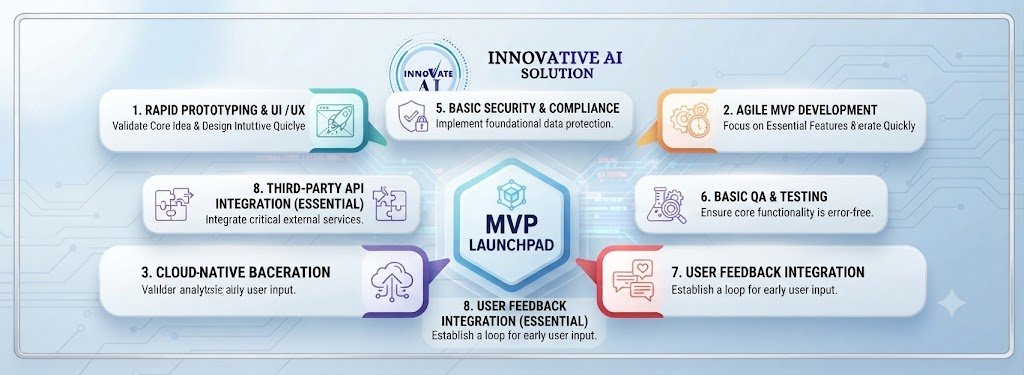
But "custom software development services" is a broad category. It includes discovery, architecture, design, frontend, backend, integration, testing, deployment, and ongoing support. Not all of these matter equally for an MVP. Some are essential from day one. Others can wait until after validation.
Choosing the wrong services wastes runway on work that does not move the needle. Choosing the right ones gets you to market fast with enough quality to learn from real users.
This guide helps Indian startups choose custom software development services for an MVP launch in 2026. It covers what an MVP actually needs, which services matter most, what to defer, what it costs in India, and how to select a vendor.
What an MVP Actually Needs
The MVP Definition
An MVP is the smallest version of a product that lets you test your most important assumption with real users. It is not a demo, not a prototype, and not a scaled-down version of your full vision.
| MVP Is | MVP Is Not |
|---|---|
| Smallest thing that validates an assumption | A demo that looks impressive |
| Production-quality in core areas | A throwaway prototype |
| Real users, real data | Internal testing only |
| Fast to build, fast to learn | Feature-complete, polished |
| Focused on one core value | Everything you eventually want |
The MVP Priority Hierarchy
| Priority | What It Means |
|---|---|
| Core value delivery | The one thing users come for |
| Reliable enough to trust | Does not break under normal use |
| Fast enough to use | Acceptable performance |
| Secure enough to protect data | Basic security, not enterprise-grade |
| Measurable | Analytics to learn from usage |
Everything else is secondary at the MVP stage.
What to Defer
| Deferred Item | Why It Can Wait |
|---|---|
| Advanced analytics | Basic analytics suffice |
| Automation of edge cases | Handle manually first |
| Admin panels | Use direct database access initially |
| Multi-language support | Add after validation |
| Advanced security features | Basic security first |
| Scale infrastructure | Scale when you need to |
| Polished UI | Functional first, beautiful later |
| Integrations with every tool | Integrate what is essential |
Custom Software Services That Matter for an MVP
Service 1: Discovery and Scoping
| What It Does | Why It Matters for MVP |
|---|---|
| Defines the problem precisely | Prevents building the wrong thing |
| Prioritises features | Keeps scope minimal |
| Identifies risks | Catches problems early |
| Defines success metrics | Enables learning |
Recommendation: Essential. Discovery prevents expensive mistakes. It should be short and focused, not a multi-month exercise.
Typical Cost: ₹50,000–₹2,00,000 ($600–$2,400) | Timeline: 1–3 weeks
Service 2: MVP Architecture and Technical Design
| What It Does | Why It Matters for MVP |
|---|---|
| Defines the technical approach | Prevents rebuilding later |
| Chooses the stack | Affects speed and cost |
| Designs for evolution | Avoids throwaway work |
| Identifies integration points | Prevents surprises |
Recommendation: Essential, but lightweight. Design for evolution, not for scale you do not have yet.
Typical Cost: ₹75,000–₹2,50,000 ($900–$3,000) | Timeline: 1–2 weeks
Service 3: UX and UI Design
| What It Does | Why It Matters for MVP |
|---|---|
| Designs user flows | Ensures usability |
| Creates screens | Enables development |
| Validates with prototypes | Catches issues early |
Recommendation: Essential, but not polished. Functional design that enables development. Avoid expensive design systems at MVP stage.
Typical Cost: ₹75,000–₹3,00,000 ($900–$3,600) | Timeline: 2–4 weeks
Service 4: Core Development
| What It Does | Why It Matters for MVP |
|---|---|
| Builds the core feature | This is the product |
| Implements user flows | Makes the product usable |
| Connects to backend | Enables data flow |
Recommendation: Essential. This is where most of the budget goes. Focus on the core value, not peripheral features.
Typical Cost: ₹2,00,000–₹6,00,000 ($2,400–$7,200) | Timeline: 6–12 weeks
Service 5: Backend and Data
| What It Does | Why It Matters for MVP |
|---|---|
| Provides APIs | Enables frontend functionality |
| Stores data | Enables the product to work |
| Handles authentication | Enables user accounts |
Recommendation: Essential, but use managed services where possible. Firebase, Supabase, and similar tools reduce backend development time significantly.
Typical Cost: ₹1,00,000–₹4,00,000 ($1,200–$4,800) | Timeline: 3–6 weeks
Service 6: Essential Integrations
| What It Does | Why It Matters for MVP |
|---|---|
| Payments | Enables transactions |
| Notifications | Enables engagement |
| Analytics | Enables learning |
| Authentication | Enables access |
Recommendation: Only what is essential. Payments and analytics are usually required. Everything else can wait.
Typical Cost: ₹50,000–₹2,00,000 ($600–$2,400) | Timeline: 1–3 weeks
Service 7: Testing
| What It Does | Why It Matters for MVP |
|---|---|
| Validates functionality | Ensures it works |
| Catches bugs | Prevents embarrassment |
| Validates flows | Ensures usability |
Recommendation: Essential, but not exhaustive. Test the core flows thoroughly. Do not build comprehensive test suites for everything.
Typical Cost: ₹50,000–₹2,00,000 ($600–$2,400) | Timeline: 1–3 weeks
Service 8: Deployment and Launch
| What It Does | Why It Matters for MVP |
|---|---|
| Deploys to production | Makes it available |
| Sets up monitoring | Catches issues |
| Enables updates | Supports iteration |
Recommendation: Essential. Use managed deployment (Vercel, Railway, similar) to reduce complexity.
Typical Cost: ₹25,000–₹1,00,000 ($300–$1,200) | Timeline: 1–2 weeks
Services You Can Defer
| Service | When to Add |
|---|---|
| Advanced analytics | After validating core usage |
| Admin panels | When manual management becomes painful |
| Automation | When manual processes slow you down |
| Multi-language support | When expanding to new markets |
| Advanced security | When handling sensitive data at scale |
| Scale infrastructure | When you have traffic that needs it |
| Design systems | When design consistency matters |
| Comprehensive test suites | When the product stabilises |
| Integrations with every tool | When specific tools become essential |
What an MVP Costs in India
Cost by MVP Complexity
| MVP Complexity | Cost Range (INR) | Cost Range (USD) | Timeline |
|---|---|---|---|
| Simple MVP | ₹3,00,000–₹6,00,000 | $3,600–$7,200 | 8–12 weeks |
| Standard MVP | ₹6,00,000–₹12,00,000 | $7,200–$14,400 | 12–18 weeks |
| Complex MVP | ₹12,00,000–₹25,00,000 | $14,400–$30,000 | 18–28 weeks |
Cost by Service
| Service | Cost Range (INR) | Cost Range (USD) |
|---|---|---|
| Discovery and scoping | ₹50,000–₹2,00,000 | $600–$2,400 |
| Architecture and design | ₹75,000–₹2,50,000 | $900–$3,000 |
| UX/UI design | ₹75,000–₹3,00,000 | $900–$3,600 |
| Core development | ₹2,00,000–₹6,00,000 | $2,400–$7,200 |
| Backend and data | ₹1,00,000–₹4,00,000 | $1,200–$4,800 |
| Essential integrations | ₹50,000–₹2,00,000 | $600–$2,400 |
| Testing | ₹50,000–₹2,00,000 | $600–$2,400 |
| Deployment | ₹25,000–₹1,00,000 | $300–$1,200 |
Ongoing Costs After MVP Launch
| Cost Category | Monthly Range (INR) | Monthly Range (USD) |
|---|---|---|
| Cloud hosting | ₹3,000–₹30,000 | $36–$360 |
| Third-party APIs | Variable | Variable |
| Monitoring | ₹2,000–₹10,000 | $24–$120 |
| Maintenance | ₹10,000–₹50,000 | $120–$600 |
How to Scope an MVP
The Scoping Framework
| Step | Activity |
|---|---|
| 1. Define the assumption | What are you trying to prove? |
| 2. Identify the core value | What do users come for? |
| 3. List required features | What is the minimum to deliver that value? |
| 4. Cut ruthlessly | Remove everything not required |
| 5. Define success metrics | How will you know it worked? |
| 6. Set a time box | How long will you give it? |
The Feature Prioritisation Matrix
| Feature | User Value | Effort | Priority |
|---|---|---|---|
| Core value delivery | High | Variable | Must have |
| Enables core value | High | Low | Must have |
| Improves core value | Moderate | Low | Should have |
| Nice to have | Low | Variable | Cut |
| Future vision | Variable | High | Defer |
The MVP Anti-Patterns
| Anti-Pattern | Why It Fails |
|---|---|
| Building the full vision | Takes too long, costs too much |
| Polishing before validating | Wastes time on unvalidated features |
| Skipping discovery | Builds the wrong thing |
| Ignoring architecture | Requires rebuilding later |
| No success metrics | Cannot learn from launch |
| Open-ended timeline | MVP never ships |
Vendor Selection for MVP Development
What to Look For
| Criteria | Why It Matters |
|---|---|
| MVP experience | Understands scope discipline |
| Speed | Can ship in weeks, not months |
| Fixed-scope pricing | Predictable cost |
| Source code ownership | No lock-in |
| Post-launch support | MVP needs iteration |
| Startup fit | Understands constraints |
Questions to Ask MVP Vendors
| Question | What It Reveals |
|---|---|
| How do you scope an MVP? | Scope discipline |
| What would you cut from our feature list? | Ruthless prioritisation |
| How long to first working version? | Speed |
| What happens after launch? | Support approach |
| Who owns the code? | IP terms |
| How do you handle scope changes? | Change management |
The MVP Vendor Scorecard
| Criteria | Weight | Score (1–5) | Weighted Score |
|---|---|---|---|
| MVP experience | 25% | ||
| Speed to launch | 20% | ||
| Scope discipline | 20% | ||
| Source code ownership | 15% | ||
| Post-launch support | 10% | ||
| Cost alignment | 10% | ||
| Total | 100% | /5 |
Decision Framework: MVP Services Selection
Service Priority Matrix
| Service | MVP Priority | When to Add |
|---|---|---|
| Discovery and scoping | Essential | Immediately |
| Architecture | Essential | Immediately |
| UX/UI design | Essential | Immediately |
| Core development | Essential | Immediately |
| Backend | Essential | Immediately |
| Essential integrations | Essential | Immediately |
| Testing | Essential | Immediately |
| Deployment | Essential | Immediately |
| Advanced analytics | Deferred | After validation |
| Admin panels | Deferred | When manual management hurts |
| Automation | Deferred | When manual processes slow you |
| Multi-language | Deferred | When expanding markets |
| Scale infrastructure | Deferred | When traffic demands it |
MVP Readiness Scorecard
| Criteria | Weight | Score (1–5) | Weighted Score |
|---|---|---|---|
| Assumption defined | 20% | ||
| Core value identified | 20% | ||
| Scope prioritised | 20% | ||
| Success metrics defined | 15% | ||
| Budget allocated | 15% | ||
| Vendor selected | 10% | ||
| Total | 100% | /5 |
Frequently Asked Questions
1. Which custom software development services are best for an MVP launch?
Essential services: discovery and scoping, lightweight architecture, functional UX/UI design, core development, backend, essential integrations, testing, and deployment. Defer advanced analytics, admin panels, automation, multi-language support, and scale infrastructure.
2. How much does MVP development cost in India?
Simple MVPs cost ₹3,00,000–₹6,00,000 ($3,600–$7,200). Standard MVPs cost ₹6,00,000–₹12,00,000 ($7,200–$14,400). Complex MVPs cost ₹12,00,000–₹25,00,000 ($14,400–$30,000).
3. How long does it take to build an MVP?
Simple MVPs take 8–12 weeks. Standard MVPs take 12–18 weeks. Complex MVPs take 18–28 weeks. Timeline depends on scope and team.
4. Should I build an MVP or a full product?
Build an MVP. Launch with the smallest version that validates your assumption. Invest in the full product only after validation. Building the full vision first wastes runway on unvalidated features.
5. What features should an MVP include?
Only features required to deliver the core value. Everything else is deferred. Use the feature prioritisation matrix: must-have, should-have, cut, defer.
6. Should I use managed services for MVP backend?
Yes. Firebase, Supabase, and similar managed services reduce backend development time significantly. Migration to custom backend can follow once the product is validated.
7. What is the biggest mistake in MVP development?
Building the full vision instead of the minimum. Scope creep, polishing before validating, and skipping discovery are the most common MVP failures.
8. How do I scope an MVP?
Define the assumption, identify the core value, list required features, cut ruthlessly, define success metrics, and set a time box. Ruthless prioritisation is essential.
9. What should I look for in an MVP development vendor?
MVP experience, speed, fixed-scope pricing, source code ownership, post-launch support, and startup fit. Ask how they scope, what they would cut, and how long to first working version.
10. How do I measure MVP success?
Define success metrics before building — conversion, engagement, retention, or task completion. Measure against baseline. Learn from real usage. Iterate based on evidence.
11. What happens after MVP launch?
Iterate based on user feedback. Add features that serve validated needs. Optimise what works. Consider platform investment once you have product-market fit.
12. How can Innovative AI Solutions help?
Innovative AI Solutions is a Delhi-based custom software development company specialising in MVPs for Indian startups. We provide discovery, architecture, design, development, and deployment — scoped tightly to get you to market fast with enough quality to learn from real users. Learn more at https://innovativeais.com.
Contact Innovative AI Solutions
Ready to launch your MVP?
We help Indian startups scope, build, and launch MVPs fast — with the services that matter and none that do not.
Contact Information
Innovative AI Solutions
📍 Netaji Subhash Place, Pitampura, Delhi – 110034
🌐 Website: https://innovativeais.com 📧 Email: info@innovativeais.com
📞 Phone: +91 7464 099 059 / +91 96899 67356
Business Services
• AI Automation • AI Development • AI Consulting • Machine Learning Solutions • Deep Learning Solutions • Generative AI Services • NLP Solutions • AI Agents • AI Chatbots • Voice AI • CRM Development • Custom Software Development • Website Development • Mobile App Development
About the Author
Abhishek Kumar
Founder & CEO, Innovative AI Solutions
5+ years building production AI systems for Indian businesses. Based in Delhi, serving clients across India.
Ready to build AI solutions for your business?
Innovative AI Solutions — Delhi's leading AI development company. Free consultation available.
Get Free Consultation →
A practical 2026 guide for Indian startups choosing custom software development services for an MVP launch — scope, costs, and vendor selection.
#CustomSoftwareDevelopment #MVPLaunch #2026 #StartupMVP #MinimumViableProduct #MVPDevelopment #SoftwareServices #StartupTechnology #MVPCost #MVPScope #MVPArchitecture #ProductDevelopment #India #DelhiNCRTech #StartupApps #MVPDevelopmentCompany #TechIndia #DigitalProducts #LeanStartup #ProductValidation #SoftwareDevelopment #StartupEngineering #MVPRoadmap #AgileDevelopment #InnovativeAISolutions
Copyright ©️ 2015–2026 Innovative AI Solutions. All Rights Reserved. | Privacy Policy | Terms & Conditions


