



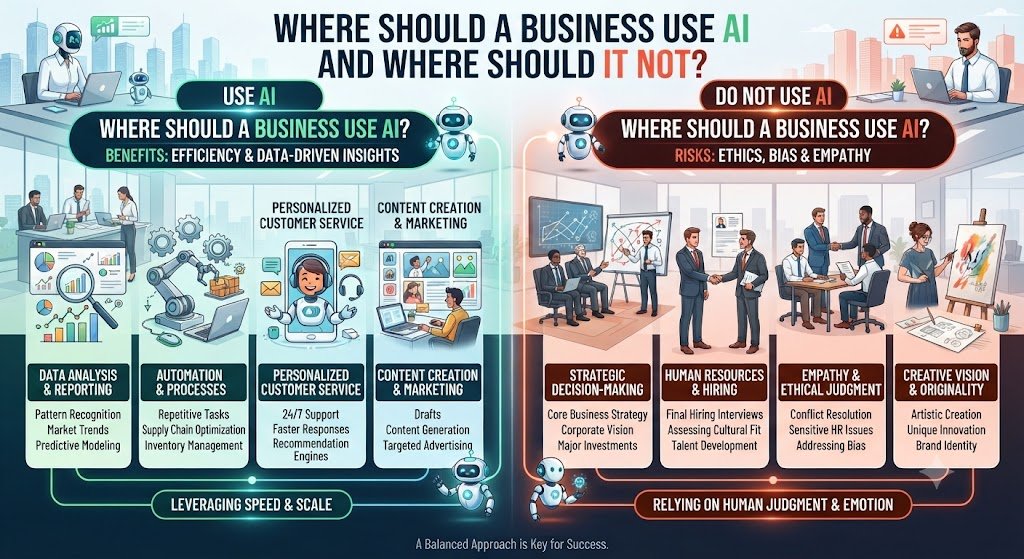
The AI Decision Trap: Why "Use AI Everywhere" Fails
Every business conference in 2026 has a session on AI. Every vendor claims their tool is AI-powered. Every consultant says you need an AI strategy.
The pressure to adopt AI is intense. But the pressure to adopt wisely is even greater.
Indian businesses that rushed AI into every process are discovering a hard truth: AI applied to the wrong problem creates new problems. It automates bad processes faster. It adds complexity without improving outcomes. It can expose the business to regulatory risk.
The question is not "Should we use AI?" The question is "Where should we use AI, and where should we not?"
This guide provides a practical, India-specific framework for making that decision. It covers where AI delivers measurable value, where it fails, and how to govern it responsibly under DPDPA and MeitY's IndiaAI Governance Guidelines.
The Core Principle: AI for Scale, Humans for Judgment
The most reliable way to decide where AI belongs is to apply one principle:
Use AI where work is high-volume, repetitive, rule-based, or data-intensive. Keep humans where work requires judgment, relationships, creativity, or ethical nuance.
This is not a perfect rule. But it correctly classifies the vast majority of business processes.
AI excels at:
Processing large volumes of data
Applying consistent rules
Operating 24/7
Detecting patterns
Extracting information from documents
Generating routine communication
Humans excel at:
Making judgment calls with incomplete information
Building trust and relationships
Creative problem-solving
Handling exceptions and ambiguity
Ethical reasoning
Strategic vision
The goal is not replacing humans. It is removing the repetitive burden that prevents humans from doing higher-value work.
Where Businesses SHOULD Use AI
1. High-Volume, Repetitive Tasks
What it looks like: Data entry, order processing, invoice matching, form filling, report generation, status updates.
Why AI fits: These tasks follow patterns. They are time-consuming. They are prone to human error. AI handles them consistently, 24/7, at a fraction of the cost.
Indian example: A Delhi e-commerce business processing 500 WhatsApp orders daily manually enters each into their ERP. AI extracts order details automatically, reducing entry time by 90% and eliminating errors.
Typical impact: 70–95% reduction in time spent on repetitive tasks.
2. Rule-Based Decision Making
What it looks like: Approving orders below a threshold, categorizing support tickets, flagging invoices for review, routing leads to the right salesperson.
Why AI fits: These decisions follow clear rules. AI applies them consistently without fatigue or bias.
Indian example: A BFSI company manually routes loan applications to underwriters. AI scores applications based on predefined criteria and routes only complex cases to humans.
Typical impact: 60–80% reduction in time per decision.
3. 24/7 Operations and After-Hours Coverage
What it looks like: Customer inquiries at night, weekend orders, emergency support, global customer communication.
Why AI fits: Humans need sleep. AI does not. Businesses lose leads and customers every night. AI captures them.
Indian example: A Delhi CA firm receives client queries throughout the day. An AI assistant answers routine questions 24/7. By morning, there is no backlog.
Typical impact: 100% after-hours coverage; morning backlog reduced to near zero.
4. Document Processing and Data Extraction
What it looks like: Reading invoices, purchase orders, application forms, contracts, ID proofs; extracting data; validating against rules.
Why AI fits: AI can read structured and unstructured documents, extract key fields, and validate them faster and more accurately than humans.
Indian example: A logistics company manually processes 200 invoices daily. AI extracts data from PDFs and images, matches against purchase orders, and flags exceptions.
Typical impact: 80–95% reduction in document processing time; error rate reduced from 3–5% to under 1%.
5. Pattern Detection and Anomaly Detection
What it looks like: Finding fraud, spotting quality issues, detecting operational bottlenecks, identifying unusual transactions.
Why AI fits: AI can analyze millions of data points and find patterns humans miss.
Indian example: An e-commerce business uses AI to detect fraudulent return requests. The system flags anomalies for human review, reducing fraud losses.
Typical impact: 40–70% reduction in fraud or error-related losses.
6. Personalization at Scale
What it looks like: Recommending products, personalizing email sequences, tailoring content, dynamic pricing.
Why AI fits: AI can analyze customer behavior and deliver personalized experiences to thousands of customers simultaneously.
Indian example: A D2C brand uses AI to recommend products based on browsing history, increasing conversion rates.
Typical impact: 15–30% improvement in conversion rates.
7. Predictive Forecasting
What it looks like: Demand forecasting, inventory planning, staffing predictions, sales forecasting.
Why AI fits: AI learns from historical data and predicts future trends with greater accuracy than manual methods.
Indian example: A Delhi retailer uses AI to predict Diwali-season demand, reducing stockouts and excess inventory.
Typical impact: 15–25% reduction in inventory waste; improved stock availability.
8. Language and Communication at Scale
What it looks like: Customer support in multiple languages, translation, sentiment analysis, chatbot conversations.
Why AI fits: AI can understand and respond in Hindi, English, and regional languages, handling thousands of conversations simultaneously.
Indian example: A logistics company deploys an AI assistant supporting 12+ Indian languages, handling Level 1 support queries automatically.
Typical impact: 60–80% of routine queries resolved without human intervention.
9. Back-Office Automation
What it looks like: HR onboarding, payroll input, expense categorization, compliance tracking, vendor management.
Why AI fits: These processes are repetitive, rule-based, and document-heavy.
Indian example: A growing company automates employee onboarding. AI extracts data from documents, creates records, and triggers payroll setup.
Typical impact: 70–85% reduction in administrative time.
10. Quality Assurance and Error Detection
What it looks like: Checking outputs for errors, validating data, ensuring compliance, reviewing content.
Why AI fits: AI can review 100% of outputs, not just samples, catching errors humans miss.
Indian example: A financial services firm uses AI to review loan documents for missing signatures or inconsistent data before submission.
Typical impact: 50–80% reduction in error-related rework.
Where Businesses Should NOT Use AI (Or Use With Extreme Caution)
1. High-Stakes Decisions Without Human Oversight
Examples: Medical diagnosis, legal judgments, final loan approvals, hiring decisions, disciplinary actions.
Why AI fails here: These decisions have serious consequences. AI can make mistakes, reflect biases, and cannot be held accountable. Human judgment, empathy, and accountability are essential.
The right approach: Use AI to assist — provide data, flag risks, suggest options — but keep humans in the final decision.
2. Relationship Building and High-Value Sales
Examples: Enterprise sales, strategic partnerships, client relationship management, negotiations.
Why AI fails here: Trust is built through human interaction. High-value clients expect personal relationships. AI can support with data and reminders, but cannot replace the human connection.
The right approach: Use AI for lead qualification and scheduling. Keep human salespeople for relationship building and closing.
3. Creative Strategy and Brand Vision
Examples: Brand positioning, creative campaigns, product innovation, company vision.
Why AI fails here: AI can generate content, but it cannot set strategic direction or understand cultural nuance at a deep level. Creativity requires human intuition and lived experience.
The right approach: Use AI for content generation and ideation support. Keep humans for strategy and final creative decisions.
4. Ethical Dilemmas and Nuanced Judgment
Examples: Handling sensitive employee issues, resolving ethical conflicts, managing PR crises, dealing with vulnerable customers.
Why AI fails here: These situations require empathy, context, and moral reasoning. AI lacks the ability to understand human emotion and ethical complexity.
The right approach: Keep humans fully in charge. AI can provide background information but should not make decisions.
5. Situations with Poor Data Quality
Examples: Businesses with no clean historical data, processes that are not documented, systems that do not capture data.
Why AI fails here: AI learns from data. Bad data produces bad outcomes. Garbage in, garbage out.
The right approach: Fix data quality first. Document processes. Implement systems that capture data. Then consider AI.
6. When the Process Is Already Broken
Examples: Inefficient workflows, unclear ownership, redundant approvals, manual workarounds.
Why AI fails here: Automating a broken process makes it faster, not better. It can amplify existing problems.
The right approach: Fix the process first. Streamline. Remove unnecessary steps. Then automate.
7. When Regulatory Compliance Is Unclear
Examples: Processing personal data without consent, operating in regulated industries without clear guidelines, using AI for decisions that require explainability.
Why AI fails here: DPDPA and IndiaAI Governance Guidelines impose obligations. Using AI without compliance exposes the business to penalties and reputational risk.
The right approach: Consult legal and compliance experts. Implement governance frameworks. Ensure transparency and accountability.
8. When AI Would Create a Surveillance Culture
Examples: Monitoring employee keystrokes, reading private messages, tracking individual performance in real time.
Why AI fails here: Surveillance destroys trust and morale. It can violate privacy laws. It creates a toxic work environment.
The right approach: Analyze processes, not people. Use aggregated data. Be transparent. Focus on improvement, not punishment.
9. When the Cost Exceeds the Benefit
Examples: Low-volume tasks, processes that change frequently, one-time activities.
Why AI fails here: AI implementation has costs. If the volume is low or the process is temporary, the ROI may never materialize.
The right approach: Calculate ROI honestly. If the payback period exceeds 12–18 months, consider alternatives.
10. When Human Touch Is the Product
Examples: Luxury hospitality, premium healthcare, personal coaching, artisanal products.
Why AI fails here: The human experience is the value proposition. Automating it diminishes what customers pay for.
The right approach: Use AI for back-office operations. Keep the customer-facing experience human.
The AI Suitability Scorecard
Use this scorecard to evaluate any potential AI use case.
| Criteria | Weight | Score 1–5 | Weighted Score |
|---|---|---|---|
| Volume (higher = better for AI) | 20% | ||
| Repetitiveness (higher = better) | 15% | ||
| Rule-based nature (higher = easier) | 15% | ||
| Data availability (higher = easier) | 15% | ||
| Error cost (higher = more benefit) | 10% | ||
| Human judgment required (lower = better) | 15% | ||
| Regulatory clarity (higher = safer) | 5% | ||
| Integration complexity (lower = easier) | 5% | ||
| Total | 100% | /5 |
Interpretation:
Above 4.0: Strong AI candidate. Proceed to pilot.
3.0–4.0: Possible AI candidate. Validate with pilot.
Below 3.0: Keep human-led. Consider process improvement first.
Industry-Specific Guidance for Indian Businesses
BFSI (Banking, Financial Services, Insurance)
Use AI for: Fraud detection, document processing, customer support, risk scoring, compliance monitoring.
Do not use AI for: Final loan approvals, investment advice, handling vulnerable customers, disciplinary actions.
Governance note: RBI and DPDPA impose strict requirements. Ensure explainability and audit trails.
Healthcare
Use AI for: Appointment scheduling, billing, medical coding, patient communication, diagnostic support.
Do not use AI for: Final diagnosis, treatment decisions, sensitive patient conversations.
Governance note: Patient data is highly sensitive. Consent and security are paramount.
Retail and E-commerce
Use AI for: Order processing, inventory management, product recommendations, customer support, fraud detection.
Do not use AI for: Handling high-value customer escalations, brand strategy, creative campaigns.
Governance note: DPDPA applies to customer data. Ensure consent and data minimisation.
Manufacturing
Use AI for: Quality control, predictive maintenance, supply chain forecasting, inventory management, safety monitoring.
Do not use AI for: Strategic sourcing decisions, union negotiations, safety-critical decisions without human oversight.
Governance note: Safety and compliance are critical. Human oversight is mandatory for safety-related decisions.
Professional Services (CA, Legal, Consulting)
Use AI for: Document review, research, scheduling, client communication, billing.
Do not use AI for: Final legal opinions, tax advice, audit conclusions, client relationship management.
Governance note: Professional liability requires human accountability. AI is an assistant, not a replacement.
Education
Use AI for: Administrative tasks, grading objective tests, personalized learning paths, student support.
Do not use AI for: Final grades, disciplinary decisions, sensitive student counseling.
Governance note: Student data is sensitive. Parental consent may be required.
Hospitality
Use AI for: Booking management, guest communication, review responses, back-office operations.
Do not use AI for: Guest experience design, handling complaints, personalized concierge for VIPs.
Governance note: The human touch is the product. Use AI to free staff for guest interaction.
Logistics
Use AI for: Route optimization, shipment tracking, customer updates, document processing, demand forecasting.
Do not use AI for: Handling delivery exceptions, driver management, safety-critical decisions.
Governance note: Safety and reliability are critical. Human oversight for exceptions.
The Human-in-the-Loop Spectrum: 5 Levels of AI Autonomy
Not all AI use is the same. Choose the right level of autonomy for each process.
| Level | Description | When to Use | Example |
|---|---|---|---|
| 1. AI suggests, human decides | AI provides recommendations; human makes final call | High-stakes decisions | Loan approval |
| 2. AI acts, human reviews | AI performs task; human reviews before finalizing | Medium-stakes tasks | Invoice processing |
| 3. AI acts, human monitors | AI performs task; human monitors for exceptions | Routine tasks with clear rules | Order entry |
| 4. AI acts, human handles exceptions | AI handles routine; human handles only complex cases | High-volume, low-risk tasks | Customer support |
| 5. AI fully autonomous | AI handles everything; human oversight is periodic | Very low-risk, high-volume tasks | Data backup |
Rule of thumb: The higher the stakes, the lower the autonomy. Start at Level 2 or 3 and increase autonomy as confidence grows.
Governance and Compliance: The Non-Negotiable Framework
DPDPA Requirements
The Digital Personal Data Protection Rules, 2025 apply to AI systems processing personal data.
Data minimisation: Collect only what is necessary
Purpose limitation: Use data only for disclosed purposes
Consent: Obtain consent before processing
Storage limitation: Delete data when purpose is fulfilled
Security safeguards: Implement reasonable security
Grievance redressal: Provide mechanisms for complaints
IndiaAI Governance Guidelines (November 2025)
MeitY's seven principles (Sutras) apply to all AI deployments:
Trust — Systems should be reliable and secure
People First — Human welfare is paramount
Innovation over Restraint — Enable progress while managing risk
Fairness & Equity — Avoid bias and discrimination
Accountability — Clear responsibility for outcomes
Understandable by Design — Explainable decisions
Safety, Resilience & Sustainability — Safe and sustainable operation
Questions to Ask Before Any AI Deployment
What problem are we solving?
Is AI the right tool, or is process improvement enough?
What data will AI use? Is it compliant with DPDPA?
Who is accountable for AI decisions?
How will we handle errors?
What is the human oversight mechanism?
How will we measure success?
Implementation Framework: From Assessment to Production
Phase 1: Use Case Assessment (Weeks 1–2)
Identify and score potential AI use cases using the suitability scorecard.
Phase 2: Data Readiness (Weeks 2–4)
Assess data quality, availability, and compliance. Fix gaps before proceeding.
Phase 3: Vendor Selection (Weeks 4–6)
Evaluate vendors on production experience, integration capability, governance, and pilot willingness.
Phase 4: Pilot (Weeks 6–12)
Run a 3–6 week paid pilot on one use case. Define success metrics upfront.
Pilot investment: ₹75,000–₹3,00,000 ($900–$3,600)
Phase 5: Production Deployment (Weeks 12–20)
Roll out gradually. Maintain human oversight. Monitor performance. Train the team.
Phase 6: Scale and Optimise (Ongoing)
Expand to adjacent use cases. Increase autonomy as confidence grows. Monitor governance.
Cost and ROI Benchmarks for AI in India 2026
| Use Case | Implementation Cost (INR) | Ongoing Monthly (INR) | Typical ROI Timeline |
|---|---|---|---|
| Lead qualification | ₹1.5–5 lakhs | ₹5–25k | 4–8 months |
| Customer support | ₹2–6 lakhs | ₹15–50k | 5–10 months |
| Invoice processing | ₹2–6 lakhs | ₹15–40k | 4–8 months |
| Order processing | ₹2.5–8 lakhs | ₹20–60k | 5–10 months |
| HR administration | ₹1.5–4 lakhs | ₹10–30k | 4–8 months |
| Reporting | ₹2–6 lakhs | ₹15–50k | 5–10 months |
| Document processing | ₹2–7 lakhs | ₹15–45k | 4–8 months |
Ongoing costs: Budget 15–30% of initial implementation annually for monitoring, maintenance, and updates.
Common Mistakes in AI Adoption
Mistake 1: Using AI everywhere without a framework. Not every process needs AI.
Mistake 2: Automating a broken process. Fix the process first.
Mistake 3: Ignoring governance. DPDPA and MeitY guidelines are not optional.
Mistake 4: Expecting 100% automation. Plan for human-in-the-loop.
Mistake 5: Choosing the cheapest vendor. Low quotes often mean low quality.
Mistake 6: Skipping the pilot. Pilots reveal real-world performance.
Mistake 7: Not measuring ROI. AI should deliver measurable value.
Mistake 8: Creating a surveillance culture. Analyze processes, not people.
Frequently Asked Questions
1. Where should a business use AI first?
Start with high-volume, repetitive, rule-based tasks: order processing, invoice processing, customer support, lead qualification, or appointment scheduling. These deliver fast ROI and low risk.
2. Where should a business never use AI?
Never use AI for final high-stakes decisions without human oversight: medical diagnosis, legal judgments, final loan approvals, hiring decisions, or disciplinary actions. Also avoid AI when data quality is poor or the process is broken.
3. How do I decide if a process is right for AI?
Use the AI Suitability Scorecard in this guide. Score volume, repetitiveness, rule-based nature, data availability, and human judgment required. A score above 4.0 indicates a strong candidate.
4. Can AI replace human judgment?
No. AI can support judgment by providing data, flagging risks, and suggesting options. But final decisions in complex, high-stakes, or ethical situations should remain human.
5. What is the biggest mistake businesses make with AI?
Automating a broken process. AI makes a bad process faster, not better. Fix the process first, then automate.
6. How does DPDPA affect where I can use AI?
DPDPA requires data minimisation, consent, purpose limitation, and security safeguards. You cannot use personal data for AI without complying. Consult legal experts before deploying AI on personal data.
7. What is the right level of AI autonomy?
Start at Level 2 (AI acts, human reviews) or Level 3 (AI acts, human monitors). Increase autonomy only as confidence grows and risks are managed.
8. Can AI be used for creative work?
AI can assist with content generation and ideation. But final creative strategy, brand vision, and campaign decisions should remain human-led.
9. How much does AI implementation cost in India?
A focused pilot starts at ₹75,000–₹1,50,000 ($900–$1,800). Production deployment for one use case typically costs ₹1.5–8 lakhs ($1,800–$9,600).
10. How long does it take to see ROI from AI?
Most businesses see measurable ROI within 3–8 months, depending on the use case and volume.
11. What if my business is too small for AI?
AI is accessible to small businesses. Cloud-based tools start at ₹3,000–₹5,000 monthly. Start with one high-impact use case.
12. How can Innovative AI Solutions help?
Innovative AI Solutions is a Delhi-based AI development company specialising in production AI systems for Indian businesses. We help you decide where to use AI, where to avoid it, and how to implement responsibly. Our approach begins with a structured assessment and pilot. Learn more at https://innovativeais.com.
Contact Innovative AI Solutions
Ready to build the right AI strategy for your business?
We help Indian businesses identify where AI creates value — and where it does not.
Contact Information
Innovative AI Solutions
📍 Netaji Subhash Place, Pitampura, Delhi – 110034
🌐 Website: https://innovativeais.com 📧 Email: info@innovativeais.com
📞 Phone: +91 7464 099 059 / +91 96899 67356
Business Services
• AI Automation
• AI Development
• AI Consulting
• Machine Learning Solutions
• Deep Learning Solutions
• Generative AI Services
• NLP Solutions
• AI Agents
• AI Chatbots
• Voice AI
• CRM Development
• Custom Software Development
• Website Development
• Mobile App Development
About the Author
Abhishek Kumar
Founder & CEO, Innovative AI Solutions
5+ years building production AI systems for Indian businesses. Based in Delhi, serving clients across India.
Ready to build AI solutions for your business?
Innovative AI Solutions — Delhi's leading AI development company. Free consultation available.
Get Free Consultation →
A practical 2026 decision framework for Indian businesses on where to use AI and where to keep human judgment.
#WhereToUseAI #WhereNotToUseAI #AIBusinessStrategy #AIDecisionFramework #AIforSMEs #AIgovernance #DPDPA #MeitYGuidelines #HumanInTheLoop #AIimplementation #DelhiNCRTech #AIadoption #BusinessAI #AIuseCases #AIlimitations #AIrisk #AIcost #AIROI #DigitalTransformation #IndianBusiness #TechStrategy #AIConsulting #ResponsibleAI #InnovativeAISolutions
Copyright ©️ 2015–2026 Innovative AI Solutions. All Rights Reserved. | Privacy Policy | Terms & Conditions


