



The Problem RAG Solves
Large language models are impressive. They can write, reason, summarise, and answer questions across an enormous range of topics. But they have a fundamental limitation: they only know what they were trained on.
Ask a model about your company's internal policies, and it cannot answer. Ask about a document you uploaded last week, and it does not know. Ask about your product catalogue, and it has no idea.
This is the knowledge gap. Models are trained on public data up to a certain date. They do not know your data. They do not know recent events. They cannot answer questions about information they were never trained on.
RAG — Retrieval-Augmented Generation — solves this. Instead of retraining the model on your data (expensive, slow), RAG retrieves relevant information from your knowledge base and provides it to the model when answering.
The result is an AI system that answers questions using your data, without retraining. It can cite sources. It can be updated by changing documents, not retraining models. And it works with any language model.
This guide explains RAG in plain English. It covers what RAG is, how it works, real use cases, costs in India, and how to implement it in 2026.
For organisations building RAG systems, Innovative AI Solutions provides AI development services and generative AI services.
What RAG Actually Is
The Simple Definition
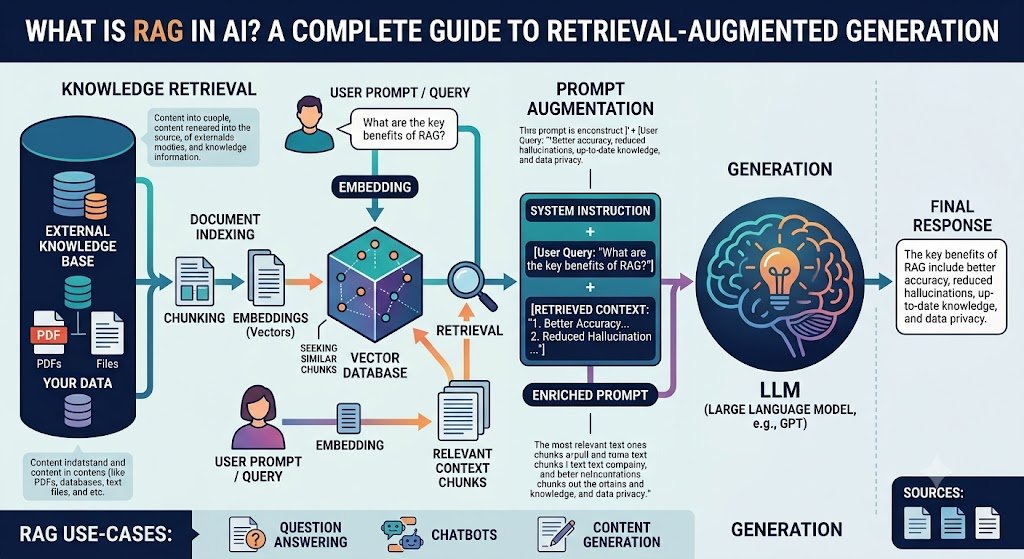
RAG is a technique that gives language models access to external knowledge. Instead of relying only on what the model was trained on, RAG retrieves relevant information from a knowledge base and provides it to the model when generating a response.
| Without RAG | With RAG |
|---|---|
| Model uses training knowledge only | Model uses retrieved knowledge |
| Cannot answer about your data | Answers using your data |
| Knowledge is fixed at training | Knowledge updates with documents |
| Cannot cite sources | Can cite sources |
The Core Idea
text User question ↓ Retrieve relevant information from knowledge base ↓
Provide retrieved information to LLM
↓ LLM generates answer grounded in retrieved information ↓ Return answer (with sources)
Why RAG Matters
| Benefit | Explanation |
|---|---|
| No retraining | Update knowledge by changing documents |
| Current information | Always up to date |
| Source attribution | Can cite where answers came from |
| Cost effective | Cheaper than fine-tuning |
| Works with any model | Model-agnostic approach |
How RAG Works
The RAG Pipeline
text
1. Document ingestion
↓ 2. Chunking (split into pieces) ↓
3. Embedding (convert to vectors)
↓ 4. Storage (vector database) ↓ 5. Query (user asks question) ↓
6. Query embedding
↓ 7. Retrieval (find similar chunks) ↓
8. Context assembly
↓ 9. Generation (LLM answers with context)
Step 1: Document Ingestion
Your knowledge base is loaded into the system.
| Source Type | Examples |
|---|---|
| Documents | PDFs, Word, text files |
| Web pages | Website content |
| Databases | Structured data |
| APIs | External data sources |
Step 2: Chunking
Documents are split into smaller pieces for retrieval.
| Chunking Strategy | When to Use |
|---|---|
| Fixed size | Simple documents |
| Sentence-based | Prose documents |
| Paragraph-based | Structured documents |
| Semantic | Complex documents |
Step 3: Embedding
Each chunk is converted into a vector — a numerical representation of its meaning.
text "Machine learning is a subset of AI" ↓ [0.23, -0.45, 0.67, 0.12, ...] (vector)
Step 4: Storage
Vectors are stored in a vector database for fast retrieval.
| Vector Database | Characteristics |
|---|---|
| Pinecone | Managed, scalable |
| Weaviate | Open source, flexible |
| Qdrant | Open source, fast |
| pgvector | PostgreSQL extension |
Step 5: Query
The user asks a question.
text " What is machine learning?"
Step 6: Query Embedding
The question is converted into a vector using the same embedding model.
Step 7: Retrieval
The system finds chunks whose vectors are most similar to the query vector.
text Query vector ↓ Similarity search in vector database ↓ Top-K most similar chunks
Step 8: Context Assembly
Retrieved chunks are assembled into context for the LLM.
text Retrieved context:
- "Machine learning is a subset of AI that..."
- "ML models learn patterns from data..."
- "Common ML types include supervised..." Step 9: Generation The LLM generates an answer using the retrieved context.
text Prompt: "Using the following context, answer the question: [context]
Question: What is machine learning?"
Answer: "Machine learning is a subset of AI that enables computers to learn patterns from data..."
RAG vs Fine-Tuning
The Comparison
| Aspect | RAG | Fine-Tuning |
|---|---|---|
| Knowledge updates | Change documents | Retrain model |
| Implementation time | Weeks | Weeks to months |
| Upfront cost | Lower | Higher |
| Source attribution | Yes | No |
| Hallucination | Reduced | Still possible |
| Best for | Facts, knowledge | Style, format |
When to Use RAG
| Use Case | Why RAG |
|---|---|
| Document Q&A | Knowledge from documents |
| Customer support | Answers from knowledge base |
| Internal knowledge | Company information |
| Current information | Updates frequently |
When to Use Fine-Tuning
| Use Case | Why Fine-Tuning |
|---|---|
| Format consistency | Learned output format |
| Brand voice | Learned style |
| Specific tasks | Specialised behaviour |
When to Use Both
| Use Case | Why Both |
|---|---|
| Complex support | Format + current facts |
| Regulated industries | Tone + source attribution |
Real RAG Use Cases
Use Case 1: Customer Support
| What RAG Does | Business Value |
|---|---|
| Answers using knowledge base | Faster resolution |
| Cites sources | Trust and verification |
| Handles common queries | Reduced support cost |
Use Case 2: Internal Knowledge Assistant
| What RAG Does | Business Value |
|---|---|
| Answers using company documents | Faster information access |
| Cites sources | Verification |
| Handles policy queries | Reduced HR/IT burden |
Use Case 3: Document Q&A
| What RAG Does | Business Value |
|---|---|
| Answers questions about documents | Faster analysis |
| Extracts relevant information | Reduced reading time |
Use Case 4: Product Information
| What RAG Does | Business Value |
|---|---|
| Answers using product catalogue | Better customer experience |
| Handles specification queries | Reduced support burden |
Use Case 5: Compliance and Policy
| What RAG Does | Business Value |
|---|---|
| Answers using policy documents | Compliance support |
| Cites sources | Audit trail |
Use Case 6: Research Assistant
| What RAG Does | Business Value |
|---|---|
| Answers using research documents | Faster research |
| Summarises findings | Time savings |
What RAG Costs in India
Implementation Cost Benchmarks
| RAG Complexity | Implementation Cost (INR) | Implementation Cost (USD) | Timeline |
|---|---|---|---|
| Basic RAG (single knowledge base) | ₹2,00,000–₹4,00,000 | $2,400–$4,800 | 4–6 weeks |
| Standard RAG (multiple sources) | ₹4,00,000–₹8,00,000 | $4,800–$9,600 | 8–12 weeks |
| Advanced RAG (hybrid, reranking) | ₹8,00,000–₹15,00,000 | $9,600–$18,000 | 12–18 weeks |
| Enterprise RAG platform | ₹15,00,000–₹35,00,000+ | $18,000–$42,000+ | 18–32 weeks |
Ongoing Costs
| Cost Category | Monthly Range (INR) | Monthly Range (USD) |
|---|---|---|
| LLM API usage | ₹5,000–₹60,000 | $60–$720 |
| Vector database | ₹3,000–₹20,000 | $36–$240 |
| Embedding generation | ₹2,000–₹15,000 | $24–$180 |
| Infrastructure | ₹5,000–₹30,000 | $60–$360 |
| Monitoring and improvement | ₹5,000–₹25,000 | $60–$300 |
Cost Per Query
| RAG Type | Cost Per Query (INR) | Cost Per Query (USD) |
|---|---|---|
| Basic RAG | ₹1–₹5 | $0.012–$0.060 |
| Standard RAG | ₹3–₹12 | $0.036–$0.144 |
| Advanced RAG | ₹8–₹25 | $0.096–$0.30 |
ROI Calculation
| Factor | Manual | RAG Automated |
|---|---|---|
| Cost per query | ₹50–₹200 | ₹5–₹25 |
| Volume | 10,000/month | 10,000/month |
| Monthly cost | ₹5,00,000–₹20,00,000 | ₹50,000–₹2,50,000 |
| Annual saving | — | ₹30,00,000–₹2,10,00,000 |
RAG Accuracy and Evaluation
Accuracy Factors
| Factor | Impact |
|---|---|
| Retrieval quality | Highest impact |
| Chunking strategy | High impact |
| Embedding model | High impact |
| Reranking | Improves precision |
| LLM quality | Affects generation |
| Prompt design | Affects answer quality |
Evaluation Metrics
| Metric | What It Measures |
|---|---|
| Retrieval precision | Are retrieved chunks relevant? |
| Retrieval recall | Are all relevant chunks retrieved? |
| Answer groundedness | Is the answer supported by context? |
| Answer relevance | Does the answer address the question? |
| Hallucination rate | How often does the model invent? |
Improving RAG Accuracy
| Technique | Impact |
|---|---|
| Better chunking | Higher retrieval quality |
| Hybrid retrieval | Vector + keyword search |
| Reranking | Better precision |
| Query expansion | Better recall |
| Validation | Catch errors |
India-Specific Considerations
Common Indian RAG Use Cases
| Industry | Use Case |
|---|---|
| Banking | Policy Q&A, compliance |
| Insurance | Claims support |
| Healthcare | Medical knowledge |
| E-commerce | Product support |
| SMEs | Internal knowledge |
| Government | Citizen services |
Indian Language Support
| Language | RAG Support |
|---|---|
| English | Excellent |
| Hindi | Good |
| Hinglish | Moderate |
| Regional languages | Variable |
Compliance
| Requirement | Implementation |
|---|---|
| DPDPA | Data protection |
| Access control | Filter by permission |
| Audit trails | Log retrievals |
| Data residency | Where processing happens |
Decision Framework: RAG Readiness
Is RAG Right for Your Use Case?
| Question | If Yes | If No |
|---|---|---|
| Do you have a knowledge base? | RAG viable | Build knowledge base |
| Do you need source attribution? | RAG ideal | Fine-tuning may work |
| Does knowledge change frequently? | RAG ideal | Fine-tuning may work |
| Is the use case Q&A? | RAG ideal | Other approaches |
| Do you need current information? | RAG ideal | Fine-tuning may work |
Readiness Scorecard
| Criteria | Weight | Score (1–5) | Weighted Score |
|---|---|---|---|
| Knowledge base available | 25% | ||
| Knowledge changes frequently | 20% | ||
| Source attribution needed | 20% | ||
| Q&A use case | 15% | ||
| Budget for implementation | 10% | ||
| Compliance requirements understood | 10% | ||
| Total | 100% | /5 |
Implementation Roadmap
| Phase | What to Build | Timeline |
|---|---|---|
| Phase 1 | Basic RAG pipeline | 4–6 weeks |
| Phase 2 | Hybrid retrieval, reranking | 4–6 weeks |
| Phase 3 | Evaluation framework | 3–5 weeks |
| Phase 4 | Access control, governance | 4–6 weeks |
Frequently Asked Questions
1. What is RAG in AI?
RAG (Retrieval-Augmented Generation) is a technique that gives language models access to external knowledge. It retrieves relevant information from a knowledge base and provides it to the model when answering questions.
2. How does RAG work?
RAG follows a pipeline: documents are chunked, embedded, and stored in a vector database. When a user asks a question, the query is embedded, similar chunks are retrieved, and the LLM generates an answer using the retrieved context.
3. What is the difference between RAG and fine-tuning?
RAG retrieves information at query time — knowledge updates by changing documents. Fine-tuning adjusts model weights — knowledge updates by retraining. RAG is better for facts and current information; fine-tuning is better for format and style.
4. Why is RAG important?
RAG lets AI systems answer questions using your data without retraining. It provides current information, source attribution, and works with any language model.
5. What is a vector database?
A vector database stores embeddings — numerical representations of text — and enables fast similarity search. It is the retrieval component of RAG.
6. How accurate is RAG?
RAG accuracy depends on retrieval quality, chunking strategy, embedding model, and LLM quality. Well-implemented RAG achieves 90–95% answer accuracy for suitable use cases.
7. How much does RAG cost in India?
Basic RAG costs ₹2,00,000–₹4,00,000 ($2,400–$4,800). Standard RAG costs ₹4,00,000–₹8,00,000 ($4,800–$9,600). Advanced RAG with hybrid retrieval costs ₹8,00,000–₹15,00,000 ($9,600–$18,000).
8. What are common RAG use cases?
Customer support, internal knowledge assistants, document Q&A, product information, compliance and policy Q&A, and research assistants.
9. Can RAG handle Indian languages?
English is excellent. Hindi is good. Hinglish is moderate. Regional language support varies. Verify embedding model capability for your specific languages.
10. How does DPDPA affect RAG?
DPDPA requires data protection, access control, audit trails, and potentially data residency. RAG systems must filter retrieval by user permission and log retrievals for compliance.
11. What is hybrid retrieval in RAG?
Hybrid retrieval combines vector search (semantic similarity) with keyword search (exact matching). It improves retrieval quality by compensating for the weaknesses of each approach.
12. How can Innovative AI Solutions help?
Innovative AI Solutions is a Delhi-based AI development company specialising in RAG systems. We build RAG pipelines with hybrid retrieval, reranking, validation, and access control — designed for Indian documents, languages, and DPDPA compliance. Explore our AI development services and generative AI services.
Contact Innovative AI Solutions
Ready to build a RAG system for your business?
We help Indian businesses build RAG systems that answer questions using their data, with source attribution and governance.
Contact Information
Innovative AI Solutions
📍 Netaji Subhash Place, Pitampura, Delhi – 110034
🌐 Website: https://innovativeais.com 📧 Email: info@innovativeais.com
📞 Phone: +91 7464 099 059 / +91 96899 67356
Business Services
• AI Automation • AI Development • AI Consulting • Machine Learning Solutions • Deep Learning Solutions • Generative AI Services • NLP Solutions • AI Agents • AI Chatbots • Voice AI • CRM Development • Custom Software Development • Website Development • Mobile App Development
About the Author
Abhishek Kumar
Founder & CEO, Innovative AI Solutions
5+ years building production AI systems for Indian businesses. Based in Delhi, serving clients across India.
Ready to build AI solutions for your business?
Innovative AI Solutions — Delhi's leading AI development company. Free consultation available.
Get Free Consultation →
A complete 2026 guide to RAG (Retrieval-Augmented Generation) — how it works, use cases, costs in India, and implementation for businesses.
#RAG #RetrievalAugmentedGeneration #AI #2026 #LLM #VectorDatabase #Embeddings #Retrieval #Generation #Architecture #Implementation #UseCases #Accuracy #Evaluation #EnterpriseAI #India #DelhiNCRTech #EnterpriseApps #StartupApps #Chatbots #DocumentQA #KnowledgeSystems #TechIndia #DigitalProducts #AIDevelopment #InnovativeAISolutions
Copyright © 2015–2026 Innovative AI Solutions. All Rights Reserved. | Privacy Policy | Terms & Conditions


