



The Jargon Problem
Machine learning is discussed constantly in business and technology conversations. It appears in vendor pitches, strategy documents, and news headlines. It is assumed to be understood.
But ask a business leader to explain what machine learning actually is, and the answers often reveal confusion. Some describe it as artificial intelligence. Others describe it as advanced analytics. Others describe it as a black box that produces predictions.
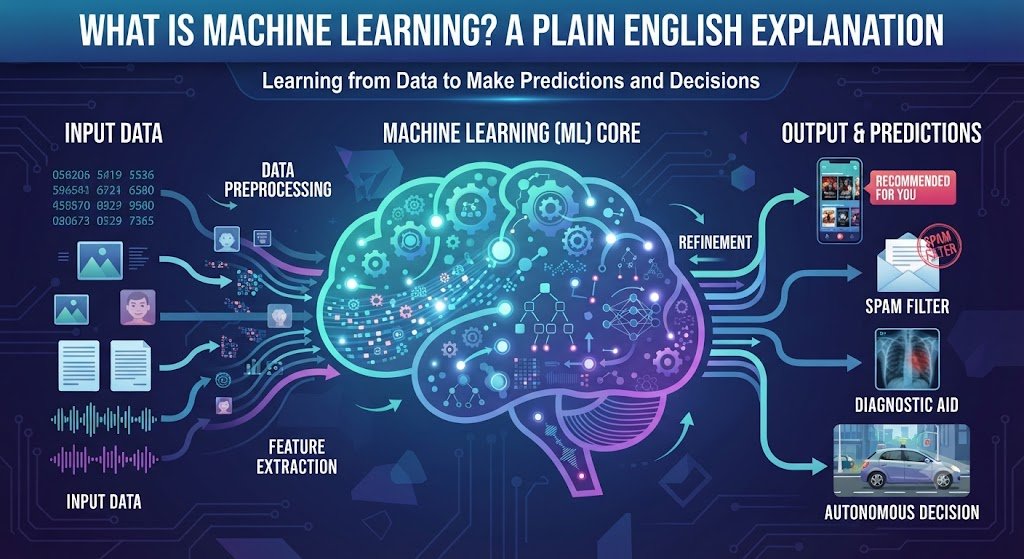
The jargon obscures a simple idea. Machine learning is pattern recognition at scale. Instead of programming rules by hand, you show a computer examples and let it learn the rules itself.
This guide explains machine learning in plain English. It covers what ML actually is, how it learns, the main types, real business examples, and what it costs for Indian businesses in 2026.
For organisations building ML-powered systems, Innovative AI Solutions provides specialised machine learning solutions and AI development services.
What Machine Learning Actually Is
The Simple Definition
Machine learning is a way of building software where the computer learns from examples instead of being explicitly programmed.
Traditional programming: You write rules. The computer follows them.
Machine learning: You provide examples. The computer learns the rules.
A Simple Analogy
Traditional programming is like giving someone a recipe. Follow these steps exactly, and you will get the result.
Machine learning is like showing someone hundreds of dishes and saying "these are good." They figure out the recipe themselves.
Traditional Programming vs Machine Learning
| Aspect | Traditional Programming | Machine Learning |
|---|---|---|
| Rules | Written by programmer | Learned from data |
| Input | Rules + data | Data + answers |
| Output | Answers | Rules (model) |
| Changes | Programmer updates code | Retrain on new data |
| Complex problems | Hard to program | Learnable |
The Core Idea
Machine learning finds patterns in data. Those patterns become a model. The model makes predictions on new data.
text Historical data (examples) ↓ Learning algorithm ↓ Model (learned patterns) ↓ Predictions on new data
How Machine Learning Works
Step 1: Collect Data
Machine learning needs examples. The more relevant examples, the better the model.
| Data Type | Example |
|---|---|
| Structured | Tables, spreadsheets, databases |
| Unstructured | Text, images, audio, video |
| Mixed | Documents, transactions |
Step 2: Prepare Data
Raw data is rarely ready for learning. It must be cleaned, formatted, and labelled.
| Preparation Step | Purpose |
|---|---|
| Cleaning | Fix errors, handle missing values |
| Formatting | Convert to usable format |
| Labelling | Add correct answers |
| Splitting | Training and testing sets |
Step 3: Choose a Model
Different problems need different model types.
| Problem Type | Model Type |
|---|---|
| Predict a number | Regression |
| Predict a category | Classification |
| Find groups | Clustering |
| Learn from rewards | Reinforcement learning |
Step 4: Train the Model
The model learns from data.
text Training data → Model → Predictions → Compare to answers ↑ ↓ └────────── Adjust model ←───────────────┘ (repeat many times)
Step 5: Evaluate the Model
Does the model work on data it has not seen?
| Metric | What It Measures |
|---|---|
| Accuracy | Percentage correct |
| Precision | Correct positives |
| Recall | Found positives |
| F1 score | Balance of precision and recall |
Step 6: Deploy and Use
The model makes predictions on new data.
text New data → Model → Prediction
The Three Main Types of Machine Learning
Supervised Learning
The model learns from labelled examples — data with correct answers.
| Aspect | Detail |
|---|---|
| Data | Labelled (inputs + correct outputs) |
| Goal | Predict outputs for new inputs |
| Examples | Spam detection, price prediction |
How it works: Show the model thousands of emails labelled "spam" or "not spam." The model learns to classify new emails.
Business examples:
Predict customer churn
Classify support tickets
Forecast sales
Detect fraud
Approve loans
Unsupervised Learning
The model finds patterns in unlabelled data — no correct answers provided.
| Aspect | Detail |
|---|---|
| Data | Unlabelled (inputs only) |
| Goal | Find structure and patterns |
| Examples | Customer segmentation, anomaly detection |
How it works: Show the model customer data with no labels. It finds groups of similar customers.
Business examples:
Customer segmentation
Anomaly detection
Product recommendations
Market basket analysis
Reinforcement Learning
The model learns by trial and error, receiving rewards for good actions.
| Aspect | Detail |
|---|---|
| Data | No fixed dataset; learns from interaction |
| Goal | Learn optimal actions |
| Examples | Game playing, robotics, dynamic pricing |
How it works: The model takes actions, receives rewards or penalties, and learns which actions lead to better outcomes.
Business examples:
Dynamic pricing
Inventory optimisation
Ad bidding
Route optimisation
Type Comparison
| Type | Data | Goal | Business Use |
|---|---|---|---|
| Supervised | Labelled | Predict | Classification, regression |
| Unsupervised | Unlabelled | Find patterns | Segmentation, anomaly |
| Reinforcement | Interaction | Learn actions | Optimisation, control |
Real Business Examples
Example 1: Customer Churn Prediction
| Aspect | Detail |
|---|---|
| Type | Supervised learning |
| Data | Customer history, usage, complaints |
| Output | Likelihood of churning |
| Business value | Retain at-risk customers |
Example 2: Fraud Detection
| Aspect | Detail |
|---|---|
| Type | Supervised + unsupervised |
| Data | Transaction history |
| Output | Fraud probability |
| Business value | Prevent losses |
Example 3: Product Recommendations
| Aspect | Detail |
|---|---|
| Type | Supervised + unsupervised |
| Data | User behaviour, purchase history |
| Output | Recommended products |
| Business value | Increase basket size |
Example 4: Demand Forecasting
| Aspect | Detail |
|---|---|
| Type | Supervised learning |
| Data | Historical sales, seasonality |
| Output | Predicted demand |
| Business value | Reduce waste, improve availability |
Example 5: Document Classification
| Aspect | Detail |
|---|---|
| Type | Supervised learning |
| Data | Labelled documents |
| Output | Document category |
| Business value | Route documents automatically |
Example 6: Predictive Maintenance
| Aspect | Detail |
|---|---|
| Type | Supervised learning |
| Data | Sensor data, maintenance history |
| Output | Failure prediction |
| Business value | Prevent downtime |
Machine Learning vs Related Terms
ML vs AI
| Term | Relationship |
|---|---|
| Artificial Intelligence | Broad field — machines that perform intelligent tasks |
| Machine Learning | Subset of AI — learning from data |
| Deep Learning | Subset of ML — neural networks with many layers |
ML vs Traditional Analytics
| Aspect | Traditional Analytics | Machine Learning |
|---|---|---|
| Purpose | Explain past | Predict future |
| Approach | Rules and queries | Learned patterns |
| Output | Reports, dashboards | Predictions, actions |
| Updates | Manual | Retraining |
ML vs Traditional Programming
| Aspect | Traditional Programming | Machine Learning |
|---|---|---|
| Rules | Written by humans | Learned from data |
| Complexity | Simple rules | Complex patterns |
| Adaptation | Manual updates | Retraining |
| Best for | Deterministic problems | Pattern-based problems |
What Machine Learning Costs in India
Implementation Costs
| Scope | Cost Range (INR) | Cost Range (USD) | Timeline |
|---|---|---|---|
| Simple ML model | ₹2,00,000–₹5,00,000 | $2,400–$6,000 | 6–10 weeks |
| Standard ML system | ₹5,00,000–₹15,00,000 | $6,000–$18,000 | 10–18 weeks |
| Complex ML platform | ₹15,00,000–₹40,00,000 | $18,000–$48,000 | 18–32 weeks |
| Enterprise ML | ₹40,00,000–₹1,00,00,000+ | $48,000–$120,000+ | 32–52 weeks |
Ongoing Costs
| Cost Category | Monthly Range (INR) | Monthly Range (USD) |
|---|---|---|
| Cloud infrastructure | ₹10,000–₹80,000 | $120–$960 |
| Model monitoring | ₹5,000–₹30,000 | $60–$360 |
| Retraining | ₹15,000–₹75,000 | $180–$900 |
| Data engineering | ₹10,000–₹50,000 | $120–$600 |
ML vs Traditional Analytics Cost
| Approach | Implementation | Ongoing |
|---|---|---|
| Traditional analytics | ₹1,00,000–₹5,00,000 | ₹10,000–₹30,000 |
| Machine learning | ₹2,00,000–₹40,00,000 | ₹30,000–₹2,00,000 |
ML costs more to implement and maintain but enables predictive capabilities that traditional analytics cannot.
India-Specific Considerations
Machine Learning Talent
| Factor | Availability |
|---|---|
| ML engineers | Strong in Delhi NCR, Bangalore, Hyderabad |
| Data scientists | Growing pool |
| MLOps engineers | Limited but growing |
Common Indian ML Use Cases
| Industry | Use Case |
|---|---|
| Banking | Fraud detection, credit scoring |
| E-commerce | Recommendations, demand forecasting |
| Healthcare | Diagnosis support, patient risk |
| Logistics | Route optimisation, demand prediction |
| Manufacturing | Predictive maintenance, quality control |
| Agriculture | Crop prediction, yield forecasting |
Data Considerations
| Consideration | Implication |
|---|---|
| Data quality | Often needs significant cleaning |
| Data volume | Large volumes available in some sectors |
| Language data | Indian language data less available |
| Privacy | DPDPA compliance required |
DPDPA Compliance
| Requirement | ML Implementation |
|---|---|
| Consent | For using personal data in training |
| Purpose limitation | Data used only for stated purposes |
| Data minimisation | Only necessary data used |
| Security safeguards | Encryption, access control |
| User rights | Access, correction, deletion |
Decision Framework: ML Readiness
Is ML Right for Your Problem?
| Question | If Yes | If No |
|---|---|---|
| Do you have historical data? | ML possible | ML not viable |
| Is the pattern complex? | ML useful | Rules may suffice |
| Do you need predictions? | ML useful | Analytics may suffice |
| Can you tolerate errors? | ML viable | Careful design needed |
| Is the problem stable? | ML viable | Frequent retraining needed |
ML Readiness Scorecard
| Criteria | Weight | Score (1–5) | Weighted Score |
|---|---|---|---|
| Data availability | 25% | ||
| Data quality | 20% | ||
| Problem suitability | 20% | ||
| Business value | 15% | ||
| Team capability | 10% | ||
| Budget | 10% | ||
| Total | 100% | /5 |
When to Use ML vs Simpler Approaches
| Situation | Recommendation |
|---|---|
| Simple rules work | Use rules |
| Need explainability | Use rules or simple models |
| Complex patterns | Use ML |
| Large data volumes | Use ML |
| Predictions needed | Use ML |
| Limited data | Use simpler approaches |
Common Misconceptions
Misconception 1: ML Is Magic
ML is pattern recognition, not magic. It finds patterns in data. If patterns do not exist or data is poor, ML will not work.
Misconception 2: ML Is Always Better
For simple, deterministic problems, rules are better. ML is for complex patterns that are hard to program explicitly.
Misconception 3: ML Needs Massive Data
Some ML needs large data. Other ML works with modest data. The requirement depends on the problem.
Misconception 4: ML Is Always Accurate
ML models make mistakes. Accuracy depends on data quality, problem difficulty, and model choice.
Misconception 5: ML Replaces Humans
ML augments human decisions. It handles scale and finds patterns, but humans provide judgment and context.
Frequently Asked Questions
1. What is machine learning in simple terms?
Machine learning is a way of building software where the computer learns from examples instead of being programmed with rules. You show it data, it finds patterns, and it uses those patterns to make predictions.
2. How is machine learning different from traditional programming?
Traditional programming: you write rules, computer follows them. Machine learning: you provide examples, computer learns the rules. ML is better for complex patterns that are hard to program explicitly.
3. What are the main types of machine learning?
Supervised learning (learns from labelled examples), unsupervised learning (finds patterns in unlabelled data), and reinforcement learning (learns from rewards and penalties).
4. What is supervised learning?
Supervised learning uses labelled data — examples with correct answers. The model learns to predict outputs for new inputs. Examples: spam detection, price prediction, churn prediction.
5. What is unsupervised learning?
Unsupervised learning finds patterns in unlabelled data — no correct answers provided. Examples: customer segmentation, anomaly detection, product recommendations.
6. What is reinforcement learning?
Reinforcement learning learns by trial and error, receiving rewards for good actions. Examples: dynamic pricing, inventory optimisation, ad bidding.
7. How much does machine learning cost in India?
Simple ML models cost ₹2,00,000–₹5,00,000 ($2,400–$6,000). Standard ML systems cost ₹5,00,000–₹15,00,000 ($6,000–$18,000). Complex platforms cost ₹15,00,000–₹40,00,000 ($18,000–$48,000).
8. Do I need large data for machine learning?
It depends on the problem. Some ML needs large data; other ML works with modest data. The requirement depends on problem complexity and model type.
9. How accurate is machine learning?
Accuracy depends on data quality, problem difficulty, and model choice. Simple problems can achieve 95%+ accuracy. Complex problems may achieve 70–90%.
10. What is the difference between AI and machine learning?
AI is the broad field of machines performing intelligent tasks. ML is a subset of AI — specifically, learning from data. All ML is AI, but not all AI is ML.
11. How does DPDPA affect machine learning?
DPDPA requires consent for using personal data in training, purpose limitation, data minimisation, security safeguards, and user rights. ML systems using personal data must comply.
12. How can Innovative AI Solutions help?
Innovative AI Solutions is a Delhi-based AI development company specialising in machine learning solutions. We build predictive models, recommendation systems, and classification systems — designed for Indian business requirements and DPDPA compliance. Explore our machine learning solutions and AI development services.
Contact Innovative AI Solutions
Ready to use machine learning in your business?
We help Indian businesses assess ML opportunities, build models, and deploy production ML systems.
Contact Information
Innovative AI Solutions
📍 Netaji Subhash Place, Pitampura, Delhi – 110034
🌐 Website: https://innovativeais.com 📧 Email: info@innovativeais.com
📞 Phone: +91 7464 099 059 / +91 96899 67356
Business Services
• AI Automation • AI Development • AI Consulting • Machine Learning Solutions • Deep Learning Solutions • Generative AI Services • NLP Solutions • AI Agents • AI Chatbots • Voice AI • CRM Development • Custom Software Development • Website Development • Mobile App Development
About the Author
Abhishek Kumar
Founder & CEO, Innovative AI Solutions
5+ years building production AI systems for Indian businesses. Based in Delhi, serving clients across India.
Ready to build AI solutions for your business?
Innovative AI Solutions — Delhi's leading AI development company. Free consultation available.
Get Free Consultation →
A plain-English 2026 guide to machine learning — what it is, how it works, the main types, real business examples, and costs for Indian businesses.
#MachineLearning #PlainEnglish #2026 #SupervisedLearning #UnsupervisedLearning #ReinforcementLearning #MLModels #AI #BusinessApplications #UseCases #MLCost #India #DelhiNCRTech #EnterpriseApps #StartupApps #DataScience #PredictiveModels #Classification #Clustering #TechIndia #DigitalProducts #AIBasics #MLGuide #BusinessTechnology #InnovativeAISolutions
Copyright © 2015–2026 Innovative AI Solutions. All Rights Reserved. | Privacy Policy | Terms & Conditions


