



Why Testing Needs Three Layers
Most teams understand that testing matters. Fewer understand that testing is not one activity — it is three distinct activities, each catching different classes of problems.
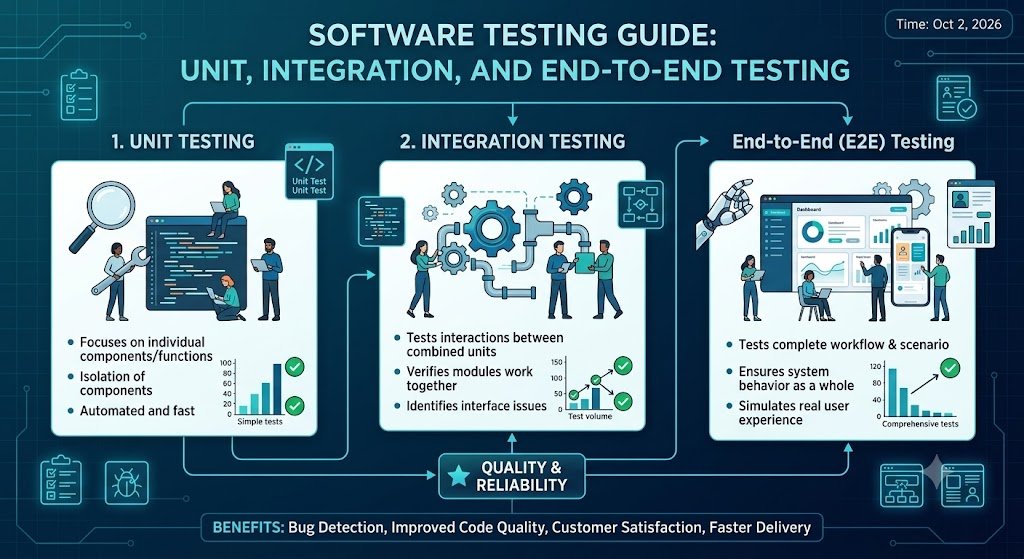
Unit tests verify individual functions and components. They catch bugs in logic.
Integration tests verify that components work together. They catch bugs in connections, APIs, and data flow.
End-to-end tests verify that complete user workflows work. They catch bugs in the experience users actually have.
Skipping any layer leaves a category of bugs undetected. Teams with only unit tests ship code that works in isolation but fails when integrated. Teams with only end-to-end tests have slow, brittle test suites that miss logic errors. Teams with only integration tests miss both low-level and user-facing issues.
This guide explains all three testing layers in 2026. It covers what each tests, real examples, the tools that work, costs in India, and how to build a testing strategy that catches bugs before users do.
For organisations building quality software, Innovative AI Solutions provides custom software development with proper testing practices.
The Testing Pyramid
What It Is
The testing pyramid describes the ideal distribution of tests across three layers.
text /\ /E2E\ Few, slow, expensive /------\ / INT \ Moderate number /----------\ / UNIT \ Many, fast, cheap /--------------\
| Layer | Quantity | Speed | Cost | Scope |
|---|---|---|---|---|
| Unit | Many | Fast | Low | Function |
| Integration | Moderate | Moderate | Moderate | Components |
| End-to-End | Few | Slow | High | Workflow |
Why the Distribution Matters
| Too Many E2E | Too Many Unit |
|---|---|
| Slow test suites | Miss integration bugs |
| Brittle tests | Miss user-facing bugs |
| High maintenance | False confidence |
The Distribution Guideline
| Layer | Typical % |
|---|---|
| Unit | 60–70% |
| Integration | 20–30% |
| End-to-End | 5–10% |
Unit Testing
What Unit Testing Is
Unit tests verify individual functions, methods, or components in isolation. They test the smallest testable unit of code.
| Characteristic | Detail |
|---|---|
| Scope | Single function or component |
| Dependencies | Mocked or stubbed |
| Speed | Milliseconds |
| Quantity | Many |
| Cost | Low to write and run |
What Unit Tests Catch
| Bug Type | Example |
|---|---|
| Logic errors | Wrong calculation |
| Edge cases | Empty input, null values |
| Boundary conditions | Off-by-one errors |
| Type errors | Wrong data types |
Real Example: Price Calculation
javascript // Function under test function calculateTotal(items, taxRate) { const subtotal = items.reduce((sum, item) => sum + (item.price
- item.quantity), 0); return subtotal
- (1 + taxRate); }
// Unit tests test('calculates total with tax', () => { const items = [{ price: 100, quantity: 2 }]; expect(calculateTotal(items, 0.18)).toBe(236); });
test('handles empty cart', () => { expect(calculateTotal([], 0.18)).toBe(0); });
test('handles multiple items', () => { const items = [ { price: 100, quantity: 2 }, { price: 50, quantity: 3 } ]; expect(calculateTotal(items, 0.18)).toBe(413); });
Unit Testing Tools
| Language | Tools |
|---|---|
| JavaScript/TypeScript | Jest, Vitest, Mocha |
| Python | pytest, unittest |
| Java | JUnit, TestNG |
| Go | testing package |
| C# | NUnit, xUnit |
Unit Testing Best Practices
| Practice | Why It Matters |
|---|---|
| Test one thing per test | Clear failure diagnosis |
| Use descriptive names | Understand what failed |
| Arrange-Act-Assert | Clear test structure |
| Mock external dependencies | Isolate the unit |
| Test edge cases | Catch boundary bugs |
| Keep tests fast | Run frequently |
Unit Testing Cost
| Factor | Cost (INR) | Timeline |
|---|---|---|
| Writing tests | 20–30% of development time | Ongoing |
| Tooling | Free (open source) | Minimal |
| Maintenance | 10–15% of test writing time | Ongoing |
Integration Testing
What Integration Testing Is
Integration tests verify that different components work correctly together — APIs, databases, services, and modules.
| Characteristic | Detail |
|---|---|
| Scope | Multiple components |
| Dependencies | Real or test doubles |
| Speed | Seconds |
| Quantity | Moderate |
| Cost | Moderate |
What Integration Tests Catch
| Bug Type | Example |
|---|---|
| API contract violations | Wrong response format |
| Data flow errors | Data lost between components |
| Database issues | Query errors, schema mismatch |
| Service communication | Timeouts, errors |
| Configuration issues | Wrong settings |
Real Example: User Registration API
javascript // Integration test describe('POST /api/users', () => { test('creates user and returns 201', async () => { const response = await request(app) .post('/api/users') .send({ name: 'Abhishek Kumar', email: 'abhishek@example.com', password: 'securepassword' });
expect(response.status).toBe(201); expect(response.body.data.email).toBe('abhishek@example.com');
// Verify user was actually created in database const user = await db.users.findByEmail('abhishek@example.com'); expect(user).toBeTruthy(); });
test('returns 422 for invalid email', async () => { const response = await request(app) .post('/api/users') .send({ name: 'Test', email: 'invalid-email', password: 'securepassword' });
expect(response.status).toBe(422); }); });
Integration Testing Tools
| Type | Tools |
|---|---|
| API testing | Supertest, Postman, REST Assured |
| Database testing | Test containers, in-memory DB |
| Service testing | Testcontainers, WireMock |
| Contract testing | Pact, Spring Cloud Contract |
Integration Testing Best Practices
| Practice | Why It Matters |
|---|---|
| Use real dependencies where possible | Catch real issues |
| Isolate test data | Prevent interference |
| Clean up after tests | Consistent state |
| Test error paths | Catch failure handling |
| Test contracts | Ensure compatibility |
Integration Testing Cost
| Factor | Cost (INR) | Timeline |
|---|---|---|
| Writing tests | 15–25% of development time | Ongoing |
| Test infrastructure | ₹5,000–₹30,000 monthly | Ongoing |
| Maintenance | 15–20% of test writing time | Ongoing |
End-to-End Testing
What End-to-End Testing Is
End-to-end tests verify complete user workflows from start to finish — through the UI, APIs, and database.
| Characteristic | Detail |
|---|---|
| Scope | Complete workflow |
| Dependencies | All real |
| Speed | Seconds to minutes |
| Quantity | Few |
| Cost | High |
What End-to-End Tests Catch
| Bug Type | Example |
|---|---|
| User flow issues | Cannot complete checkout |
| UI issues | Button missing |
| Integration issues | Data not saving |
| Timing issues | Race conditions |
| Configuration issues | Wrong environment |
Real Example: User Registration Flow
javascript
// End-to-end test with Playwright
test('user can register and login', async ({ page }) => { // Navigate to registration await page.goto('/register');
// Fill registration form await page.fill('[name="name"]', 'Abhishek Kumar'); await page.fill('[name="email"]', 'abhishek@example.com'); await page.fill('[name="password"]', 'securepassword');
// Submit await page.click('button[type="submit"]');
// Verify redirect to dashboard await expect(page).toHaveURL('/dashboard'); await expect(page.locator('h1')).toContainText('Welcome');
// Logout await page.click('[data-testid="logout"]');
// Login with new credentials await page.goto('/login'); await page.fill('[name="email"]', 'abhishek@example.com'); await page.fill('[name="password"]', 'securepassword'); await page.click('button[type="submit"]');
// Verify login successful await expect(page).toHaveURL('/dashboard'); });
End-to-End Testing Tools
| Tool | Best For |
|---|---|
| Playwright | Modern, cross-browser |
| Cypress | Developer-friendly |
| Selenium | Legacy, broad support |
| Puppeteer | Chrome/Chromium |
| TestCafe | Simple setup |
End-to-End Testing Best Practices
| Practice | Why It Matters |
|---|---|
| Test critical paths only | E2E is expensive |
| Use stable selectors | Reduce brittleness |
| Handle async properly | Avoid flakiness |
| Run on real browsers | Catch browser issues |
| Test on real devices | Catch device issues |
End-to-End Testing Cost
| Factor | Cost (INR) | Timeline |
|---|---|---|
| Writing tests | 10–20% of development time | Ongoing |
| Test infrastructure | ₹10,000–₹50,000 monthly | Ongoing |
| Maintenance | 20–30% of test writing time | Ongoing |
Testing Strategy for Indian Teams
The Recommended Approach
| Layer | Coverage | Priority |
|---|---|---|
| Unit tests | 70%+ of code | High |
| Integration tests | Critical paths | High |
| End-to-end tests | Core workflows | Medium |
Testing by Development Stage
| Stage | Focus |
|---|---|
| Development | Unit tests |
| Pre-commit | Unit tests, linting |
| CI pipeline | Unit + integration tests |
| Pre-release | End-to-end tests |
Testing Costs in India
| Testing Type | Cost (INR) | Timeline |
|---|---|---|
| Unit test writing | 20–30% of dev time | Ongoing |
| Integration test writing | 15–25% of dev time | Ongoing |
| E2E test writing | 10–20% of dev time | Ongoing |
| Test infrastructure | ₹15,000–₹1,00,000 monthly | Ongoing |
| QA engineer | ₹50,000–₹1,50,000 monthly | Ongoing |
India-Specific Considerations
| Factor | Implication |
|---|---|
| Device diversity | Test on multiple devices |
| Network conditions | Test on variable networks |
| Language support | Test in Indian languages |
| DPDPA | Test data protection |
Decision Framework: Testing Readiness
Testing Maturity Assessment
| Level | Characteristics |
|---|---|
| Level 1 | Manual testing only |
| Level 2 | Some unit tests |
| Level 3 | Unit + integration tests |
| Level 4 | Full testing pyramid, automated |
Testing Readiness Scorecard
| Criteria | Weight | Score (1–5) | Weighted Score |
|---|---|---|---|
| Unit test coverage | 25% | ||
| Integration test coverage | 25% | ||
| E2E test coverage | 15% | ||
| Test automation | 15% | ||
| CI/CD integration | 10% | ||
| Test maintenance | 10% | ||
| Total | 100% | /5 |
Testing Priority Matrix
| Action | Effort | Impact | Priority |
|---|---|---|---|
| Unit tests for critical logic | Low | High | Immediate |
| Integration tests for APIs | Moderate | High | High |
| E2E tests for core flows | Moderate | High | High |
| CI integration | Moderate | High | High |
| Test coverage metrics | Low | Moderate | Medium |
| Performance testing | Moderate | Moderate | Medium |
Implementation Roadmap
| Phase | What to Build | Timeline |
|---|---|---|
| Phase 1 | Unit tests for critical logic | 2–4 weeks |
| Phase 2 | Integration tests for APIs | 4–6 weeks |
| Phase 3 | E2E tests for core flows | 4–6 weeks |
| Phase 4 | CI integration, coverage tracking | 2–4 weeks |
Frequently Asked Questions
1. What is the difference between unit, integration, and end-to-end testing?
Unit tests verify individual functions in isolation. Integration tests verify components work together. End-to-end tests verify complete user workflows through the full system.
2. What is the testing pyramid?
The testing pyramid describes the ideal distribution — many unit tests, fewer integration tests, few end-to-end tests. This balances speed, cost, and coverage.
3. How many tests should I have at each level?
Typically 60–70% unit tests, 20–30% integration tests, and 5–10% end-to-end tests. The exact distribution depends on your application.
4. What is test coverage and what should I target?
Test coverage measures the percentage of code exercised by tests. Target 70–80% for unit tests. Coverage is a guideline, not a goal — meaningful tests matter more than coverage numbers.
5. What tools should I use for testing?
Jest or Vitest for JavaScript unit tests. pytest for Python. Supertest for API integration tests. Playwright or Cypress for end-to-end tests.
6. How much does testing cost in India?
Testing adds 20–30% to development time. Test infrastructure costs ₹15,000–₹1,00,000 monthly. QA engineers cost ₹50,000–₹1,50,000 monthly.
7. How do I test Indian language support?
Test UI rendering in Hindi, Hinglish, and regional languages. Test text input, search, and display. Verify Unicode handling.
8. How do I handle device diversity in testing?
Test on real devices across Android and iOS versions. Use device farms for broad coverage. Test on budget, mid-range, and premium devices.
9. What is flaky testing and how do I fix it?
Flaky tests pass and fail inconsistently. Causes include timing issues, shared state, and environment differences. Fix by isolating tests, handling async properly, and using stable selectors.
10. How does DPDPA affect testing?
DPDPA requires data protection. Use synthetic test data, not real personal data. Test consent flows, data deletion, and access controls.
11. How do I integrate testing with CI/CD?
Run unit tests on every commit. Run integration tests on every build. Run E2E tests before release. Block deployment on test failures.
12. How can Innovative AI Solutions help?
Innovative AI Solutions is a Delhi-based software development company that builds quality software with proper testing. We implement unit, integration, and end-to-end testing with CI/CD integration — designed for Indian requirements. Explore our custom software development.
Contact Innovative AI Solutions
Ready to improve your software testing?
We help Indian teams implement unit, integration, and end-to-end testing with proper tooling and CI/CD integration.
Contact Information
Innovative AI Solutions
📍 Netaji Subhash Place, Pitampura, Delhi – 110034
🌐 Website: https://innovativeais.com 📧 Email: info@innovativeais.com
📞 Phone: +91 7464 099 059 / +91 96899 67356
Business Services
• AI Automation • AI Development • AI Consulting • Machine Learning Solutions • Deep Learning Solutions • Generative AI Services • NLP Solutions • AI Agents • AI Chatbots • Voice AI • CRM Development • Custom Software Development • Website Development • Mobile App Development
About the Author
Abhishek Kumar
Founder & CEO, Innovative AI Solutions
5+ years building production AI systems for Indian businesses. Based in Delhi, serving clients across India.
Ready to build AI solutions for your business?
Innovative AI Solutions — Delhi's leading AI development company. Free consultation available.
Get Free Consultation →
A practical 2026 guide to software testing — unit, integration, and end-to-end testing explained with real examples, tools, costs, and India context.
#SoftwareTesting #UnitTesting #IntegrationTesting #EndToEndTesting #2026 #TestingPyramid #TestAutomation #QA #TestCoverage #TestingTools #Jest #Pytest #Cypress #Playwright #Selenium #TestStrategy #QualityAssurance #India #DelhiNCRTech #EnterpriseApps #StartupApps #SoftwareQuality #TechIndia #DigitalProducts #TestingGuide #EngineeringPractices #InnovativeAISolutions
Copyright © 2015–2026 Innovative AI Solutions. All Rights Reserved. | Privacy Policy | Terms & Conditions


