



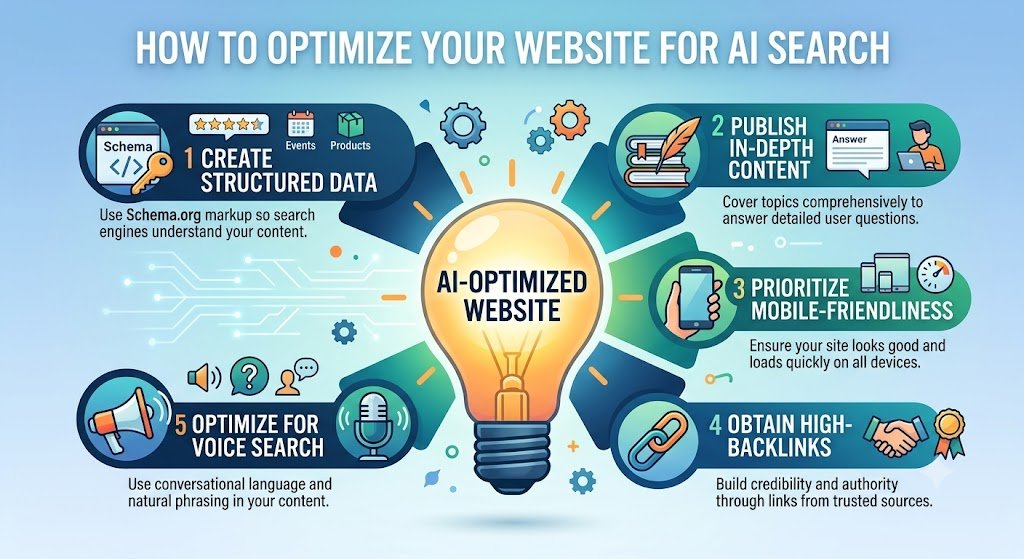
Why AI Search Optimisation Is Different
Traditional SEO optimised for ranking. You wanted your page to appear at the top of Google results. The signals were keywords, backlinks, page speed, and technical health.
AI search optimisation is different. You want your content to be cited by AI models. The signals are content structure, direct answers, authority, and extractability.
A page that ranks number one on Google may not be cited by ChatGPT if the content is a wall of text with no clear answers. A page that ranks lower may be cited frequently if it provides clear, extractable information.
This guide provides a complete optimisation checklist for AI search in 2026. It covers content structure, technical accessibility, structured data, authority signals, and monitoring — with India-specific tactics.
For organisations building AI-ready digital presence, Innovative AI Solutions provides website development and AI development services.
The AI Search Optimisation Checklist
Content Structure
| Check | Why It Matters |
|---|---|
| Clear H1, H2, H3 hierarchy | AI understands structure |
| Short paragraphs | Easier to process |
| Bullet lists for key points | Easy to extract |
| Tables for comparisons | Structured information |
| Direct answers to questions | AI can cite |
| Definitions in first sentence | Clear extraction |
| Numbered steps for processes | Extractable how-to |
Content Quality
| Check | Why It Matters |
|---|---|
| Original data and research | Unique, citable |
| Statistics with sources | Citable facts |
| Author credentials | Authority signal |
| Publication date | Currency signal |
| Last updated date | Freshness signal |
| Citations to credible sources | Trust signal |
Technical Accessibility
| Check | Why It Matters |
|---|---|
| Server-side rendering | AI can access content |
| Fast page load | Accessibility |
| Mobile-friendly | Broader access |
| Clean HTML | Easy to parse |
| Robots.txt allows AI crawlers | Permission to access |
| No JavaScript-only content | Content is visible |
| HTTPS | Trust signal |
Structured Data
| Check | Why It Matters |
|---|---|
| Article schema | Content type clarity |
| FAQ schema | Question-answer clarity |
| HowTo schema | Process clarity |
| Organization schema | Entity clarity |
| Person schema | Author clarity |
| Breadcrumb schema | Site structure |
Authority Signals
| Check | Why It Matters |
|---|---|
| About page | Organisation credibility |
| Author pages | Expertise signals |
| Contact information | Legitimacy |
| External citations | Trust signals |
| Backlinks | Authority |
| Media mentions | Third-party validation |
Monitoring
| Check | Why It Matters |
|---|---|
| AI citation tracking | Measure visibility |
| Brand mention monitoring | Track presence |
| Referral traffic from AI | Measure impact |
| Competitor comparison | Understand position |
Content Structure for AI Extraction
The Extraction Principle
AI models extract information from content. Content that is easy to extract is more likely to be cited.
| Content Format | Extractability |
|---|---|
| Wall of text | Low |
| Short paragraphs | Moderate |
| Bullet lists | High |
| Tables | High |
| Q&A format | High |
| Step-by-step | High |
The Question-Answer Format
AI search responds to questions. Structure content as questions with direct answers.
Example:
text
What is generative AI?
Generative AI is AI that creates new content — text, images, code, audio, video — based on patterns learned from training data. The question is a heading. The answer is a direct, extractable definition.
The Definition Format
For "what is" questions, provide a clear definition in the first sentence.
Example:
text
What is RAG?
RAG (Retrieval-Augmented Generation) is a technique that gives language models access to external knowledge without retraining.
The How-To Format
For process questions, provide numbered steps.
Example:
text
How to optimise for AI search
1. Structure content with clear headings 2. Answer questions directly 3. Add structured data 4. Build authority signals 5. Keep content current
The Comparison Format
For comparison questions, use tables.
Example:
| Aspect | SEO | GEO |
|---|---|---|
| Goal | Rank | Be cited |
| Signal | Keywords | Authority |
| Format | Pages | Extractable answers |
Technical Optimisation
Server-Side Rendering
AI crawlers may not execute JavaScript. Content must be in HTML.
| Rendering | AI Accessibility |
|---|---|
| Static HTML | Full access |
| Server-side rendering | Full access |
| Client-side rendering | Limited access |
| JavaScript-only | No access |
Robots.txt Configuration
Ensure AI crawlers are not blocked.
text
User-agent: GPTBot
Allow: /
User-agent: Google-Extended
Allow: /
User-agent: PerplexityBot
Allow: /
User-agent: ClaudeBot
Allow: /
Page Speed
Fast pages are more accessible.
| Metric | Target |
|---|---|
| Largest Contentful Paint | Under 2.5 seconds |
| First Input Delay | Under 100ms |
| Cumulative Layout Shift | Under 0.1 |
Clean HTML
| Practice | Benefit |
|---|---|
| Semantic HTML | AI understands structure |
| Descriptive headings | Clear organisation |
| Alt text for images | Accessibility |
| ARIA labels | Accessibility |
Structured Data Implementation
Article Schema
json { "@context": "https://schema.org", "@type": "Article", "headline": "How to Optimise Your Website for AI Search", "author": { "@type": "Person", "name": "Abhishek Kumar" }, "datePublished": "2026-01-15", "dateModified": "2026-01-15" }
FAQ Schema
json { "@context": "https://schema.org", "@type": "FAQPage", "mainEntity": [ { "@type": "Question", "name": "What is AI search optimisation?", "acceptedAnswer": { "@type": "Answer", "text": "AI search optimisation is the practice of..." } } ] }
Organization Schema
json { "@context": "https://schema.org", "@type": "Organization", "name": "Innovative AI Solutions", "url": "https://innovativeais.com", "logo": "https://innovativeais.com/logo.png" }
Schema Priority
| Schema Type | Priority |
|---|---|
| Article | High |
| FAQ | High |
| HowTo | High |
| Organization | High |
| Person | Medium |
| Breadcrumb | Medium |
Authority Building
On-Site Authority
| Signal | Implementation |
|---|---|
| About page | Company story, expertise |
| Author pages | Credentials, experience |
| Contact information | Address, phone, email |
| Privacy policy | Compliance |
| Terms of service | Legitimacy |
Off-Site Authority
| Signal | Tactic |
|---|---|
| Backlinks | Earn links from credible sites |
| Media mentions | Get featured in publications |
| Guest posts | Contribute to industry sites |
| Podcast appearances | Share expertise |
| Conference talks | Build reputation |
Content Authority
| Signal | Implementation |
|---|---|
| Original research | Conduct and publish studies |
| Statistics | Gather and cite data |
| Expert quotes | Interview experts |
| Case studies | Document results |
Monitoring AI Visibility
Manual Monitoring
| Step | Action |
|---|---|
| 1 | List questions your audience asks |
| 2 | Query AI platforms with these questions |
| 3 | Note if your site is cited |
| 4 | Note if competitors are cited |
| 5 | Track changes weekly |
Tools
| Tool Type | Purpose |
|---|---|
| AI visibility trackers | Automated citation monitoring |
| Brand monitoring | Track mentions |
| Analytics | Referral traffic from AI |
| Search Console | Traditional search data |
Metrics to Track
| Metric | Target |
|---|---|
| AI citations | Increasing |
| Brand mentions | Increasing |
| Referral traffic | Increasing |
| Share of voice | Competitive position |
India-Specific Optimisation
Indian Search Behaviour
| Factor | Optimisation |
|---|---|
| Mobile-first | Mobile-optimised content |
| Hindi/Hinglish | Content in Indian languages |
| Voice search | Natural language content |
| Local intent | Location-specific content |
Indian Language Content
| Language | Opportunity |
|---|---|
| English | Large audience |
| Hindi | Massive audience |
| Hinglish | Urban audience |
| Regional languages | Underserved |
Local SEO
| Tactic | Purpose |
|---|---|
| Google Business Profile | Local visibility |
| Local citations | Directory listings |
| Location pages | Local content |
| Reviews | Local authority |
Decision Framework: AI Search Readiness
Readiness Scorecard
| Criteria | Weight | Score (1–5) | Weighted Score |
|---|---|---|---|
| Content structured for extraction | 20% | ||
| Questions answered directly | 20% | ||
| Technical accessibility | 15% | ||
| Structured data implemented | 15% | ||
| Authority signals present | 15% | ||
| Content current | 10% | ||
| Monitoring in place | 5% | ||
| Total | 100% | /5 |
Priority Matrix
| Action | Effort | Impact | Priority |
|---|---|---|---|
| Add H2/H3 headings | Low | High | Immediate |
| Add direct answers | Low | High | Immediate |
| Add FAQ sections | Low | High | Immediate |
| Implement schema | Moderate | High | High |
| Add author credentials | Low | Moderate | High |
| Update old content | Moderate | Moderate | Medium |
| Build backlinks | High | High | Medium |
Implementation Roadmap
| Phase | What to Do | Timeline |
|---|---|---|
| Phase 1 | Content structure, direct answers | 2–4 weeks |
| Phase 2 | Structured data, FAQ sections | 2–4 weeks |
| Phase 3 | Authority signals, author pages | 2–4 weeks |
| Phase 4 | Monitoring, iteration | Ongoing |
Frequently Asked Questions
1. How do I optimise my website for AI search?
Structure content for extraction, answer questions directly, ensure technical accessibility, implement structured data, build authority signals, keep content current, and monitor visibility.
2. What is the difference between SEO and AI search optimisation?
SEO optimises for ranking on search engines. AI search optimisation (GEO) optimises for being cited by AI models. Different goals, different signals, but complementary.
3. Why is my website not cited by ChatGPT?
Common reasons: content is a wall of text, no clear answers to cite, no authority signals, outdated content, no structured data, or JavaScript-only content that AI cannot access.
4. What structured data helps with AI search?
Article schema, FAQ schema, HowTo schema, Organization schema, and Person schema. These help AI understand content type and context.
5. How do I make content extractable by AI?
Use clear headings, short paragraphs, bullet lists, tables, direct answers, definitions in first sentences, and numbered steps.
6. Do I need to block or allow AI crawlers?
Allow AI crawlers in robots.txt unless you have specific reasons to block. Blocking prevents AI visibility.
7. How do I monitor AI search visibility?
Manually query AI platforms with relevant questions. Use AI visibility tracking tools. Monitor referral traffic from AI platforms.
8. How long does AI search optimisation take?
Structural changes take 2–4 weeks to implement. Visibility improvements may take 1–3 months as AI models update.
9. Can I optimise for Indian languages in AI search?
Yes. Create content in Hindi, Hinglish, and regional languages. Indian language content is underserved, creating opportunity.
10. What content types get cited most by AI?
Original research, statistics, definitions, how-to guides, comparisons, and FAQ pages. Content that directly answers questions.
11. Is AI search optimisation different for B2B and B2C?
The principles are the same. B2B may benefit from more technical content, case studies, and expert credentials. B2C may benefit from simpler language and broader topics.
12. How can Innovative AI Solutions help?
Innovative AI Solutions is a Delhi-based technology company that helps businesses optimise for AI search. We implement GEO strategies, structured content, schema markup, and technical optimisation — designed for Indian audiences and AI platforms. Explore our website development and AI development services.
Contact Innovative AI Solutions
Ready to optimise your website for AI search?
We help Indian businesses implement GEO strategies, structure content, and monitor AI visibility.
Contact Information
Innovative AI Solutions
📍 Netaji Subhash Place, Pitampura, Delhi – 110034
🌐 Website: https://innovativeais.com 📧 Email: info@innovativeais.com
📞 Phone: +91 7464 099 059 / +91 96899 67356
Business Services
• AI Automation • AI Development • AI Consulting • Machine Learning Solutions • Deep Learning Solutions • Generative AI Services • NLP Solutions • AI Agents • AI Chatbots • Voice AI • CRM Development • Custom Software Development • Website Development • Mobile App Development
About the Author
Abhishek Kumar
Founder & CEO, Innovative AI Solutions
5+ years building production AI systems for Indian businesses. Based in Delhi, serving clients across India.
Ready to build AI solutions for your business?
Innovative AI Solutions — Delhi's leading AI development company. Free consultation available.
Get Free Consultation →
A practical 2026 guide to optimising your website for AI search — GEO checklist, structured content, schema markup, technical fixes, and India-specific tactics.
#AISearch #WebsiteOptimisation #2026 #GEO #GenerativeEngineOptimisation #ChatGPT #Gemini #AEO #AnswerEngineOptimisation #StructuredData #SchemaMarkup #ContentStructure #TechnicalSEO #AIVisibility #India #DelhiNCRTech #DigitalMarketing #ContentStrategy #EnterpriseApps #StartupApps #TechIndia #DigitalProducts #SearchOptimisation #LLMVisibility #AIDiscoverability #InnovativeAISolutions
Copyright © 2015–2026 Innovative AI Solutions. All Rights Reserved. | Privacy Policy | Terms & Conditions


