



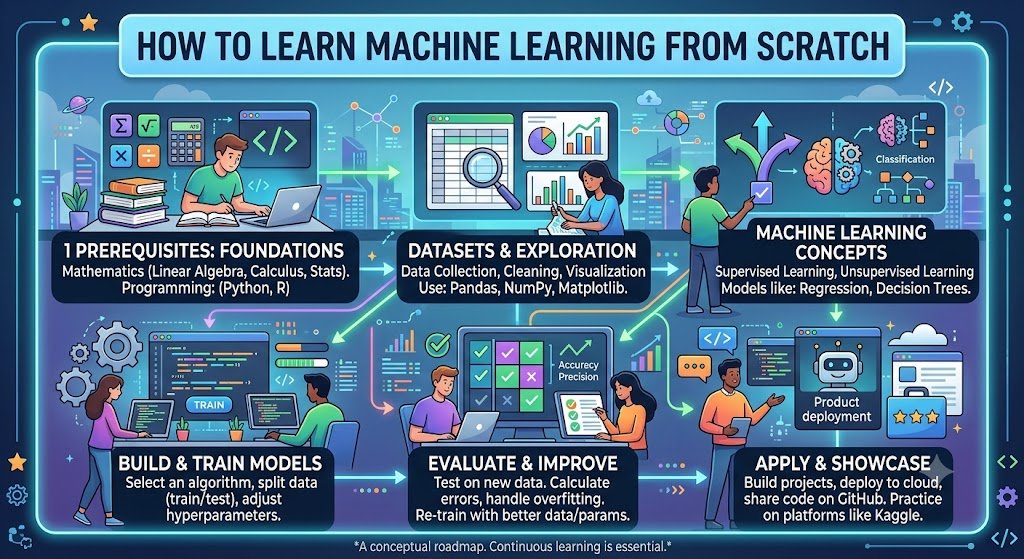
Is Machine Learning Learnable From Scratch?
Yes. Thousands of people learn machine learning from scratch every year without a formal degree. Many of them build successful careers.
But "from scratch" does not mean "without foundations." Machine learning sits on top of three foundations: programming, mathematics, and statistics. Skipping these foundations produces learners who can run code but cannot understand what they are doing.
The path is structured. It takes time. And it rewards consistency over intensity. A learner who studies two hours daily for a year will be far ahead of one who studies ten hours daily for a month and quits.
This guide provides a complete roadmap for learning machine learning from scratch in 2026. It covers prerequisites, the maths you actually need, the tools, the projects, realistic timelines, and career expectations in India.
For those who want to build ML systems professionally, Innovative AI Solutions provides machine learning solutions and works with ML engineers across India.
What Machine Learning Actually Is
The Definition
Machine learning is a field of AI where systems learn patterns from data rather than being explicitly programmed with rules.
| Traditional Programming | Machine Learning |
|---|---|
| Rules written by humans | Rules learned from data |
| Deterministic outputs | Probabilistic outputs |
| Explicit logic | Pattern recognition |
What ML Practitioners Actually Do
| Activity | Time Spent |
|---|---|
| Data preparation | 40–60% |
| Model training | 10–20% |
| Evaluation | 10–20% |
| Deployment | 10–20% |
| Framing problems | 10–20% |
Most of ML work is data work, not model work. This surprises beginners.
The Three Foundations
| Foundation | Why It Matters |
|---|---|
| Programming | Implement and run models |
| Mathematics | Understand how models work |
| Statistics | Interpret results, evaluate models |
Prerequisites Before You Start
Prerequisite 1: Python Programming
Python is the dominant language for machine learning. Learn it before learning ML.
| Topic | What to Learn |
|---|---|
| Basics | Variables, loops, functions |
| Data structures | Lists, dictionaries, sets |
| OOP | Classes, objects |
| Libraries | NumPy, Pandas |
| File handling | Reading, writing data |
Time to proficiency: 6–10 weeks.
Prerequisite 2: Mathematics
You do not need a maths degree, but you need specific topics.
| Topic | What You Need |
|---|---|
| Linear algebra | Vectors, matrices, operations |
| Calculus | Derivatives, gradients |
| Probability | Distributions, Bayes' theorem |
| Statistics | Mean, variance, hypothesis testing |
Time to proficiency: 8–12 weeks (focused study).
Prerequisite 3: Data Handling
| Skill | What You Need |
|---|---|
| NumPy | Array operations |
| Pandas | DataFrames, cleaning, transformation |
| Matplotlib/Seaborn | Visualisation |
| SQL | Basic queries |
Time to proficiency: 4–6 weeks.
The Prerequisites Timeline
| Prerequisite | Duration |
|---|---|
| Python basics | 6–8 weeks |
| Maths for ML | 8–12 weeks |
| Data handling | 4–6 weeks |
| Total | 4–6 months |
The Mathematics You Actually Need
Linear Algebra
| Concept | Why It Matters |
|---|---|
| Vectors | Feature representation |
| Matrices | Data and weights |
| Matrix multiplication | Neural network computation |
| Eigenvalues | PCA, dimensionality reduction |
Calculus
| Concept | Why It Matters |
|---|---|
| Derivatives | Optimisation |
| Partial derivatives | Multi-variable optimisation |
| Chain rule | Backpropagation |
| Gradients | Gradient descent |
Probability
| Concept | Why It Matters |
|---|---|
| Probability distributions | Model assumptions |
| Conditional probability | Bayesian reasoning |
| Bayes' theorem | Classification |
| Random variables | Uncertainty modelling |
Statistics
| Concept | Why It Matters |
|---|---|
| Descriptive statistics | Understanding data |
| Hypothesis testing | Model comparison |
| Confidence intervals | Uncertainty quantification |
| Correlation | Feature relationships |
How Deep to Go
| Depth | When to Stop |
|---|---|
| Basic | Can implement linear regression by hand |
| Intermediate | Understand backpropagation maths |
| Advanced | Only needed for research |
For most practitioners, intermediate depth is sufficient.
The Machine Learning Learning Path
Phase 1: Classic Machine Learning (Months 1–3)
| Topic | What to Learn |
|---|---|
| Linear regression | Simple and multiple |
| Logistic regression | Binary classification |
| Decision trees | Tree-based models |
| Random forests | Ensemble methods |
| K-means | Clustering |
| PCA | Dimensionality reduction |
| Model evaluation | Metrics, cross-validation |
| Feature engineering | Creating features |
Tools: scikit-learn, Pandas, NumPy.
Books: "Hands-On Machine Learning" by Aurélien Géron.
Phase 2: Deep Learning (Months 4–6)
| Topic | What to Learn |
|---|---|
| Neural networks | Perceptrons, layers |
| Backpropagation | Training |
| CNNs | Image processing |
| RNNs/LSTMs | Sequential data |
| Transformers | Modern architecture |
| Transfer learning | Pre-trained models |
| Regularisation | Dropout, batch norm |
Tools: PyTorch or TensorFlow.
Books: "Deep Learning" by Goodfellow, Bengio, Courville (for theory).
Phase 3: Modern ML and LLMs (Months 7–9)
| Topic | What to Learn |
|---|---|
| Large language models | GPT, Llama |
| Prompt engineering | Working with LLMs |
| RAG | Retrieval-augmented generation |
| Fine-tuning | Adapting models |
| Vector databases | Embeddings, search |
| AI agents | Tool-calling agents |
Tools: Hugging Face, LangChain, OpenAI APIs.
Phase 4: MLOps and Production (Months 10–12)
| Topic | What to Learn |
|---|---|
| Model deployment | Serving models |
| Monitoring | Detecting degradation |
| CI/CD for ML | Automated pipelines |
| Feature stores | Feature management |
| Model versioning | Tracking models |
| Evaluation | Continuous measurement |
Tools: Docker, MLflow, cloud platforms.
Projects That Build Real Skill
Beginner Projects
| Project | Skills |
|---|---|
| House price prediction | Regression |
| Titanic survival | Classification |
| Iris classification | Multi-class |
| Movie recommendation | Collaborative filtering |
Intermediate Projects
| Project | Skills |
|---|---|
| Image classifier | CNN, transfer learning |
| Sentiment analysis | NLP, text classification |
| Customer churn | Feature engineering |
| Fraud detection | Imbalanced data |
Advanced Projects
| Project | Skills |
|---|---|
| RAG chatbot | LLMs, vector DB |
| Custom object detection | Computer vision |
| Time series forecasting | Sequential models |
| AI agent | Tool calling, orchestration |
Portfolio Guidance
| Element | Why It Matters |
|---|---|
| 3–5 solid projects | Better than 20 shallow ones |
| Deployed projects | Shows you can ship |
| GitHub repositories | Shows code quality |
| README documentation | Shows communication |
| Real datasets | Shows real-world skill |
Learning Resources
Free Resources
| Resource | Best For |
|---|---|
| Fast.ai | Practical deep learning |
| Andrew Ng's Coursera | ML fundamentals |
| Kaggle Learn | Hands-on practice |
| Scikit-learn docs | Classic ML |
| PyTorch tutorials | Deep learning |
| Hugging Face courses | LLMs, transformers |
Paid Resources
| Resource | Best For |
|---|---|
| Coursera specialisations | Structured learning |
| Udacity Nanodegrees | Project-based |
| Coding Ninjas | India-focused |
| Scaler | India-focused, mentorship |
| Books (Géron, etc.) | Deep understanding |
Indian Learning Communities
| Community | Purpose |
|---|---|
| Kaggle India | Competitions, learning |
| Local ML meetups | Networking (Delhi NCR, Bangalore) |
| Discord/Slack groups | Help, discussion |
| GitHub | Open source contribution |
Realistic Timelines
Full-Time Study
| Phase | Duration | Hours |
|---|---|---|
| Prerequisites | 4–6 months | 40 hrs/week |
| Classic ML | 2–3 months | 40 hrs/week |
| Deep Learning | 2–3 months | 40 hrs/week |
| Modern ML/LLMs | 2–3 months | 40 hrs/week |
| MLOps | 1–2 months | 40 hrs/week |
| Total | 11–17 months | — |
Part-Time Study
| Phase | Duration | Hours |
|---|---|---|
| Prerequisites | 8–12 months | 15–20 hrs/week |
| Classic ML | 4–6 months | 15–20 hrs/week |
| Deep Learning | 4–6 months | 15–20 hrs/week |
| Modern ML/LLMs | 4–6 months | 15–20 hrs/week |
| Total | 20–30 months | — |
The 12-Month Intensive Path
A focused learner studying 20–25 hours per week can reach job-ready in approximately 12 months with dedication.
Career Expectations in India
ML Engineer Salaries
| Level | Experience | Salary Range (INR) | Salary Range (USD) |
|---|---|---|---|
| Entry | 0–2 years | ₹6,00,000–₹15,00,000 | $7,200–$18,000 |
| Mid-level | 3–5 years | ₹15,00,000–₹35,00,000 | $18,000–$42,000 |
| Senior | 5–8 years | ₹30,00,000–₹70,00,000 | $36,000–$84,000 |
| Lead / Principal | 8+ years | ₹50,00,000–₹1,20,00,000+ | $60,000–$1,44,000+ |
Salary by City
| City | Mid-Level (INR/year) |
|---|---|
| Bangalore | ₹18,00,000–₹40,00,000 |
| Delhi NCR | ₹15,00,000–₹35,00,000 |
| Mumbai | ₹16,00,000–₹38,00,000 |
| Hyderabad | ₹15,00,000–₹35,00,000 |
| Pune | ₹14,00,000–₹32,00,000 |
Roles to Target
| Role | Focus |
|---|---|
| ML Engineer | Building and deploying models |
| Data Scientist | Analysis, modelling |
| AI Engineer | LLMs, AI systems |
| MLOps Engineer | ML infrastructure |
| Research Engineer | Applied research |
Job Market Reality
| Factor | Consideration |
|---|---|
| Competition | Moderate to high |
| Portfolio matters | More than certificates |
| Production skills valued | Deployment, MLOps |
| LLM skills in demand | Rapidly growing |
| Domain knowledge | Differentiator |
India-Specific Considerations
Indian ML Ecosystem
| Factor | Status |
|---|---|
| Talent | Growing rapidly |
| Companies hiring | Startups, product, services |
| AI investment | Increasing |
| Government support | IndiaAI Mission |
Learning Challenges in India
| Challenge | Solution |
|---|---|
| Cost of courses | Use free resources |
| Hardware limitations | Use Colab, Kaggle |
| Mentorship | Join communities |
| English resources | Hindi resources growing |
Common Indian ML Use Cases
| Industry | Application |
|---|---|
| E-commerce | Recommendations, demand forecasting |
| Fintech | Fraud detection, credit scoring |
| Healthcare | Diagnosis support |
| Logistics | Route optimisation |
| Manufacturing | Predictive maintenance |
Decision Framework: ML Learning Readiness
Readiness Scorecard
| Criteria | Weight | Score (1–5) | Weighted Score |
|---|---|---|---|
| Time available | 25% | ||
| Programming foundation | 20% | ||
| Maths comfort | 20% | ||
| Learning resources | 15% | ||
| Practice opportunities | 10% | ||
| Career goal clarity | 10% | ||
| Total | 100% | /5 |
Learning Path Selection
| Your Situation | Recommended Path |
|---|---|
| Complete beginner | Prerequisites first |
| Programmer, no ML | Maths + classic ML |
| Maths background | Python + ML |
| Working professional | Part-time path |
| Career switcher | Full-time intensive |
Implementation Roadmap
| Phase | What to Learn | Timeline |
|---|---|---|
| Phase 1 | Python, maths, data handling | 4–6 months |
| Phase 2 | Classic ML | 2–3 months |
| Phase 3 | Deep learning | 2–3 months |
| Phase 4 | LLMs, MLOps | 3–5 months |
Frequently Asked Questions
1. Can I learn machine learning from scratch without a degree?
Yes. Many ML practitioners are self-taught. What matters is foundations (programming, maths, statistics), projects, and practical skills — not the degree.
2. How long does it take to learn machine learning from scratch?
Full-time study: 11–17 months to job-ready. Part-time study: 20–30 months. A focused learner at 20–25 hours weekly can reach job-ready in about 12 months.
3. What are the prerequisites for machine learning?
Python programming, mathematics (linear algebra, calculus, probability, statistics), and data handling (NumPy, Pandas, visualisation).
4. Do I need advanced mathematics for machine learning?
No. You need specific topics: linear algebra, calculus, probability, statistics. Intermediate depth is sufficient for most practitioners.
5. Which programming language should I learn for ML?
Python. It is the dominant language with the best ecosystem (scikit-learn, PyTorch, TensorFlow).
6. What projects should I build to get hired?
3–5 solid deployed projects with real datasets, documented on GitHub. Beginner: regression, classification. Intermediate: image classifier, sentiment analysis. Advanced: RAG chatbot, AI agent.
7. What is the salary for ML engineers in India?
Entry: ₹6,00,000–₹15,00,000. Mid-level: ₹15,00,000–₹35,00,000. Senior: ₹30,00,000–₹70,00,000. Lead: ₹50,00,000–₹1,20,00,000+.
8. Should I learn deep learning or classic ML first?
Classic ML first. It builds the foundations (evaluation, feature engineering, overfitting) that apply to deep learning.
9. Are certifications worth it for ML jobs?
Certifications help but portfolio matters more. Employers want to see deployed projects, code quality, and real-world skills.
10. What resources are best for learning ML?
Fast.ai (practical), Andrew Ng's Coursera (fundamentals), Kaggle Learn (hands-on), Hugging Face courses (LLMs), Géron's book (depth).
11. Can I learn ML with a full-time job?
Yes. Part-time study at 15–20 hours weekly reaches job-ready in 20–30 months. Many professionals transition this way.
12. How can Innovative AI Solutions help?
Innovative AI Solutions is a Delhi-based AI development company that builds ML systems. We work with ML engineers and help businesses implement machine learning solutions. Explore our machine learning solutions and AI development services.
Contact Innovative AI Solutions
Learning machine learning or building ML systems?
We help Indian businesses implement machine learning solutions and work with ML engineers across India.
Contact Information
Innovative AI Solutions
📍 Netaji Subhash Place, Pitampura, Delhi – 110034
🌐 Website: https://innovativeais.com 📧 Email: info@innovativeais.com
📞 Phone: +91 7464 099 059 / +91 96899 67356
Business Services
• AI Automation • AI Development • AI Consulting • Machine Learning Solutions • Deep Learning Solutions • Generative AI Services • NLP Solutions • AI Agents • AI Chatbots • Voice AI • CRM Development • Custom Software Development • Website Development • Mobile App Development
About the Author
Abhishek Kumar
Founder & CEO, Innovative AI Solutions
5+ years building production AI systems for Indian businesses. Based in Delhi, serving clients across India.
Ready to build AI solutions for your business?
Innovative AI Solutions — Delhi's leading AI development company. Free consultation available.
Get Free Consultation →
A practical 2026 roadmap for learning machine learning from scratch — prerequisites, maths, tools, projects, timelines, and career expectations for Indian learners.
#MachineLearning #LearnFromScratch #2026 #Roadmap #Prerequisites #Python #Maths #Statistics #Projects #Career #Salary #MLEngineer #India #DelhiNCRTech #Beginners #AI #DataScience #DeepLearning #TechIndia #DigitalProducts #CareerGuide #MachineLearningTutorial #Coding #Upskilling #InnovativeAISolutions
Copyright © 2015–2026 Innovative AI Solutions. All Rights Reserved. | Privacy Policy | Terms & Conditions


