



The Gap PWAs Fill
Businesses have faced a persistent choice. Build a website — reachable by anyone, but limited in capability. Or build a native app — capable and engaging, but requiring installation, app store approval, and separate development for iOS and Android.
Websites reach everyone but feel limited. Native apps feel powerful but are expensive and have high abandonment after download.
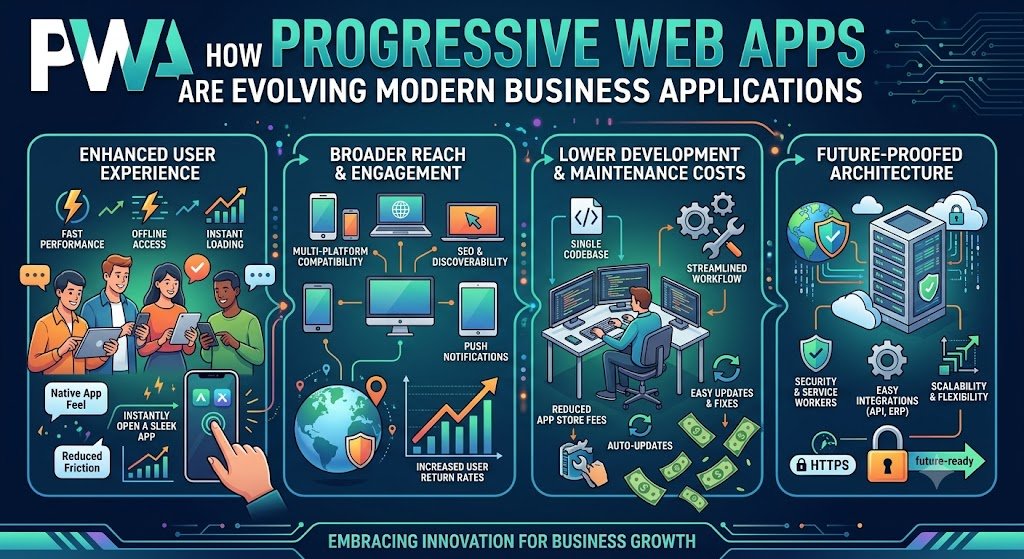
Progressive Web Apps fill this gap. They are websites that behave like native apps. They are installable, work offline, send push notifications, and load instantly — but they live on the web, require no app store, and work across platforms.
For businesses, this changes the calculus. You get app-like capability without app-like cost and friction. You reach users across devices without building multiple apps. And you can update instantly without app store reviews.
This guide covers how Progressive Web Apps are evolving modern business applications in 2026. It explains what PWAs are, their capabilities, real use cases, costs in India, and implementation approaches.
For organisations building Progressive Web Apps, Innovative AI Solutions provides website development and custom software development.
What a Progressive Web App Actually Is
The Definition
A Progressive Web App is a website built with modern web technologies that provides an app-like experience — installable, offline-capable, fast, and engaging.
| Characteristic | What It Means |
|---|---|
| Progressive | Works on any browser |
| Responsive | Fits any screen |
| Installable | Add to home screen |
| Offline-capable | Works without network |
| App-like | Native-like experience |
| Fresh | Always up to date |
| Safe | Served over HTTPS |
What Makes a PWA
| Technology | Purpose |
|---|---|
| Service workers | Offline capability, caching |
| Web app manifest | Installability, appearance |
| HTTPS | Security |
| Responsive design | Cross-device |
| App shell | Fast loading |
PWA vs Website vs Native App
| Aspect | Website | PWA | Native App |
|---|---|---|---|
| Installation | None | Optional | Required |
| Offline | No | Yes | Yes |
| Push notifications | Limited | Yes | Yes |
| Home screen | No | Yes | Yes |
| App store | No | No | Required |
| Development cost | Lowest | Moderate | Highest |
| Cross-platform | Yes | Yes | Separate builds |
PWA Capabilities in 2026
Capability 1: Installability
Users can install PWAs to their home screen without app stores.
| Benefit | Impact |
|---|---|
| No app store | Direct installation |
| No review | Instant availability |
| No download friction | One-tap install |
| Cross-platform | One codebase |
Capability 2: Offline Functionality
PWAs work without network connectivity.
| Use Case | Benefit |
|---|---|
| Field workers | Work in low-connectivity areas |
| Travel apps | Access content offline |
| Data entry | Enter data offline, sync later |
| Reference apps | Access information anytime |
Capability 3: Push Notifications
PWAs can send push notifications like native apps.
| Notification Type | Use Case |
|---|---|
| Transactional | Order updates |
| Promotional | Offers, new products |
| Reminders | Appointments, tasks |
| Re-engagement | Bring users back |
Capability 4: Fast Performance
PWAs load instantly through caching and optimisation.
| Technique | Impact |
|---|---|
| App shell | Instant loading |
| Service worker caching | Fast repeat visits |
| Code splitting | Smaller initial load |
| Image optimisation | Faster rendering |
Capability 5: Device Access
PWAs can access device capabilities.
| Capability | Support Level |
|---|---|
| Camera | Good |
| Geolocation | Good |
| Microphone | Good |
| File system | Growing |
| Bluetooth | Limited |
| Biometrics | Growing |
Capability 6: Background Sync
PWAs can sync data in the background.
| Use Case | Benefit |
|---|---|
| Form submissions | Submit when connected |
| Data uploads | Upload when network available |
| Content updates | Fresh content on reconnect |
Real Business PWA Use Cases
Use Case 1: E-commerce
| What PWA Provides | Business Value |
|---|---|
| Fast browsing | Better conversion |
| Offline product viewing | Engagement |
| Push notifications | Re-engagement |
| Home screen access | Repeat visits |
Typical impact: 20–40% conversion improvement.
Use Case 2: Field Service Applications
| What PWA Provides | Business Value |
|---|---|
| Offline data access | Work anywhere |
| Offline data entry | No connectivity dependency |
| Camera for documentation | Photo capture |
| GPS for location | Location tracking |
Typical impact: 30–50% productivity improvement.
Use Case 3: Customer Portals
| What PWA Provides | Business Value |
|---|---|
| App-like experience | Better engagement |
| Push notifications | Proactive updates |
| Offline access | Convenience |
| No app install | Higher adoption |
Typical impact: Higher portal adoption.
Use Case 4: Internal Business Apps
| What PWA Provides | Business Value |
|---|---|
| Cross-device access | Any device |
| No IT installation | Easy deployment |
| Instant updates | Always current |
| Offline capability | Works anywhere |
Typical impact: Lower IT overhead.
Use Case 5: Content and Media
| What PWA Provides | Business Value |
|---|---|
| Fast loading | Better experience |
| Offline reading | Convenience |
| Push notifications | Re-engagement |
| Installable | Home screen access |
Typical impact: Higher engagement.
Use Case 6: Booking and Reservations
| What PWA Provides | Business Value |
|---|---|
| Fast booking | Higher conversion |
| Offline viewing | Browse anywhere |
| Push reminders | Fewer no-shows |
| Home screen access | Repeat bookings |
Typical impact: 15–30% booking improvement.
PWA vs Native App: When to Choose
Choose PWA When
| Situation | Why PWA |
|---|---|
| Broad reach needed | Works on any device |
| Cost sensitivity | Lower development cost |
| Frequent updates | No app store delays |
| Cross-platform priority | One codebase |
| Content-focused | Web-first experience |
| Quick launch needed | Faster to market |
Choose Native App When
| Situation | Why Native |
|---|---|
| Maximum performance | Best possible speed |
| Deep device integration | Full hardware access |
| App store presence | Discoverability |
| Complex features | Advanced capabilities |
| Offline-first design | Full offline capability |
| Push priority | Best notification support |
The Decision Matrix
| Factor | PWA | Native |
|---|---|---|
| Reach | High | Lower |
| Cost | Lower | Higher |
| Performance | Good | Best |
| Device access | Growing | Full |
| Updates | Instant | App store |
| Discovery | Web | App store |
The Hybrid Approach
Many businesses use both.
| Component | Approach |
|---|---|
| Core experience | PWA |
| Power features | Native app |
| Marketing | Web |
| Retention | Push notifications |
What PWAs Cost in India
Implementation Cost Benchmarks
| PWA Complexity | Cost Range (INR) | Cost Range (USD) | Timeline |
|---|---|---|---|
| Basic PWA (existing site) | ₹1,00,000–₹3,00,000 | $1,200–$3,600 | 4–8 weeks |
| Standard PWA | ₹3,00,000–₹8,00,000 | $3,600–$9,600 | 8–14 weeks |
| Complex PWA | ₹8,00,000–₹20,00,000 | $9,600–$24,000 | 14–24 weeks |
| Enterprise PWA | ₹20,00,000–₹50,00,000+ | $24,000–$60,000+ | 24–40 weeks |
Cost Comparison: PWA vs Native
| Factor | PWA | Native (Both Platforms) |
|---|---|---|
| Initial development | ₹3,00,000–₹20,00,000 | ₹8,00,000–₹40,00,000 |
| Updates | Instant | App store review |
| Maintenance | Single codebase | Two codebases |
| App store fees | None | Apple + Google |
Ongoing Costs
| Cost Category | Monthly Range (INR) | Monthly Range (USD) |
|---|---|---|
| Cloud hosting | ₹5,000–₹50,000 | $60–$600 |
| CDN | ₹3,000–₹20,000 | $36–$240 |
| Push notification service | ₹2,000–₹15,000 | $24–$180 |
| Maintenance | ₹10,000–₹50,000 | $120–$600 |
ROI Considerations
| Factor | Impact |
|---|---|
| Lower development cost | 40–60% less than native |
| No app store fees | ₹8,500/year saved (Apple) |
| Higher reach | Web accessibility |
| Faster updates | No review delays |
India-Specific Considerations
Indian Mobile Context
| Factor | Implication |
|---|---|
| Mobile-first users | PWA ideal |
| Data cost sensitivity | Lower data usage |
| Storage constraints | No app install |
| Device diversity | Works across devices |
| Network variability | Offline capability valuable |
Indian Language Support
| Language | PWA Support |
|---|---|
| English | Excellent |
| Hindi | Good |
| Hinglish | Moderate |
| Regional languages | Variable |
Common Indian PWA Use Cases
| Industry | Use Case |
|---|---|
| E-commerce | Shopping experience |
| Logistics | Field operations |
| Banking | Customer portal |
| Healthcare | Patient apps |
| Education | Learning platforms |
| SMEs | Customer engagement |
Compliance
| Requirement | Implementation |
|---|---|
| DPDPA | Data protection, consent |
| Push notification consent | User permission |
| Data residency | Where data stored |
Implementation Framework
Phase 1: Assessment (Weeks 1–2)
| Activity | Purpose |
|---|---|
| Assess existing web app | Understand current state |
| Identify PWA opportunities | Find high-value features |
| Define requirements | What PWA needs to do |
| Plan approach | Strategy and timeline |
Phase 2: Foundation (Weeks 2–6)
| Activity | Purpose |
|---|---|
| Implement service worker | Offline capability |
| Create web app manifest | Installability |
| Optimise performance | Fast loading |
| Ensure HTTPS | Security |
Phase 3: Features (Weeks 6–14)
| Activity | Purpose |
|---|---|
| Add offline functionality | Work without network |
| Implement push notifications | Re-engagement |
| Add device access | Camera, GPS |
| Optimise experience | App-like feel |
Phase 4: Launch and Optimise (Weeks 14+)
| Activity | Purpose |
|---|---|
| Test across devices | Ensure compatibility |
| Launch | Make available |
| Monitor performance | Track metrics |
| Iterate | Continuous improvement |
Decision Framework: PWA Readiness
Readiness Scorecard
| Criteria | Weight | Score (1–5) | Weighted Score |
|---|---|---|---|
| Mobile user base significant | 20% | ||
| Offline capability valuable | 15% | ||
| Push notifications useful | 15% | ||
| Cost sensitivity | 15% | ||
| Cross-platform needed | 15% | ||
| Native features not essential | 10% | ||
| Budget for implementation | 10% | ||
| Total | 100% | /5 |
Use Case Priority Matrix
| Use Case | Impact | Feasibility | Priority |
|---|---|---|---|
| E-commerce | High | High | High |
| Field service | High | High | High |
| Customer portal | High | High | High |
| Internal apps | Moderate-High | High | Medium-High |
| Content/media | Moderate | High | Medium |
| Booking | High | High | High |
Implementation Roadmap
| Phase | What to Build | Timeline |
|---|---|---|
| Phase 1 | Basic PWA (offline, installable) | 4–8 weeks |
| Phase 2 | Push notifications | 2–4 weeks |
| Phase 3 | Device access features | 4–6 weeks |
| Phase 4 | Full PWA experience | 8–14 weeks |
Frequently Asked Questions
1. What is a Progressive Web App?
A PWA is a website built with modern web technologies that provides an app-like experience — installable, offline-capable, fast, and engaging. It combines web reach with app capability.
2. How is a PWA different from a website?
A PWA is installable, works offline, sends push notifications, and loads instantly. A regular website requires network connectivity and does not have these capabilities.
3. How is a PWA different from a native app?
A PWA lives on the web, requires no app store, and works across platforms from one codebase. Native apps are installed from app stores, built separately for iOS and Android, and have full device access.
4. When should I choose a PWA over a native app?
Choose PWA for broad reach, cost sensitivity, frequent updates, cross-platform priority, content-focused experiences, and quick launches. Choose native for maximum performance, deep device integration, and app store presence.
5. How much does PWA development cost in India?
Basic PWAs cost ₹1,00,000–₹3,00,000 ($1,200–$3,600). Standard PWAs cost ₹3,00,000–₹8,00,000 ($3,600–$9,600). Complex PWAs cost ₹8,00,000–₹20,00,000 ($9,600–$24,000).
6. Can PWAs work offline?
Yes. PWAs use service workers to cache content and functionality, enabling offline operation. Data entered offline can sync when connectivity returns.
7. Do PWAs support push notifications?
Yes. PWAs support push notifications on Android and desktop. iOS support has improved but remains more limited than native apps.
8. Can PWAs access device features?
PWAs can access camera, geolocation, and microphone. Support for Bluetooth and some advanced features is limited. Device access is improving.
9. How do PWAs improve performance?
PWAs use app shell architecture, service worker caching, and code splitting to load instantly. Repeat visits are served from cache, making them extremely fast.
10. How does DPDPA affect PWAs?
DPDPA requires data protection, consent, and security safeguards. PWAs collecting personal data must comply. Push notifications require user consent.
11. Should I replace my native app with a PWA?
Not necessarily. Many businesses use both — PWA for broad reach and native app for power features. Assess your specific requirements.
12. How can Innovative AI Solutions help?
Innovative AI Solutions is a Delhi-based technology company that builds Progressive Web Apps. We implement service workers, offline capability, push notifications, and performance optimisation — designed for Indian mobile users and DPDPA compliance. Explore our website development and custom software development.
Contact Innovative AI Solutions
Ready to build a Progressive Web App?
We help Indian businesses build PWAs that combine web reach with app-like experience.
Contact Information
Innovative AI Solutions
📍 Netaji Subhash Place, Pitampura, Delhi – 110034
🌐 Website: https://innovativeais.com 📧 Email: info@innovativeais.com
📞 Phone: +91 7464 099 059 / +91 96899 67356
Business Services
• AI Automation • AI Development • AI Consulting • Machine Learning Solutions • Deep Learning Solutions • Generative AI Services • NLP Solutions • AI Agents • AI Chatbots • Voice AI • CRM Development • Custom Software Development • Website Development • Mobile App Development
About the Author
Abhishek Kumar
Founder & CEO, Innovative AI Solutions
5+ years building production AI systems for Indian businesses. Based in Delhi, serving clients across India.
Ready to build AI solutions for your business?
Innovative AI Solutions — Delhi's leading AI development company. Free consultation available.
Get Free Consultation →
How Progressive Web Apps are evolving modern business applications in 2026 — capabilities, use cases, costs in India, and implementation.
#ProgressiveWebApps #PWA #BusinessApplications #2026 #ServiceWorkers #OfflineCapability #PushNotifications #InstallableApps #WebDevelopment #MobileWeb #PWAvsNative #Performance #Cost #India #DelhiNCRTech #EnterpriseApps #StartupApps #Ecommerce #TechIndia #DigitalProducts #WebApps #MobileApps #AppDevelopment #BusinessEfficiency #InnovativeAISolutions
Copyright © 2015–2026 Innovative AI Solutions. All Rights Reserved. | Privacy Policy | Terms & Conditions


