



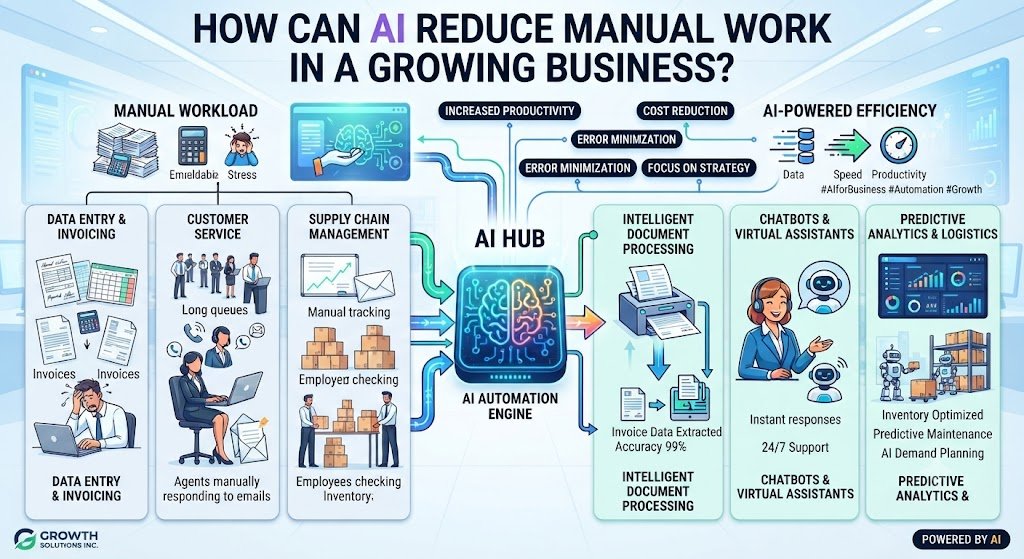
The Growing Business Paradox: More Demand, Same Hands
Every growing Indian business hits the same wall. Revenue increases. Customer count multiplies. Order volume doubles. But the team handling the work? It grows much slower — or not at all.
This creates the growing business paradox: success creates operational strain that threatens the very growth that caused it.
A Delhi-based e-commerce brand processing 200 orders daily with five people suddenly needs to handle 800 orders. The math is brutal. Hiring four more people costs ₹15-20 lakhs annually in salaries alone. Training takes months. And the new hires will spend 60% of their time on repetitive tasks that don't require human judgment.
This is where AI changes the equation.
According to Deloitte's 2026 India AI adoption report, Indian organisations report that only 0-4% possess high levels of AI expertise internally, compared to a global average of 2-8%[14]. Yet 91% of Indian organisations have increased AI spending over the past year — well above the APAC average of 85%[2][8].
The gap between AI investment and AI expertise is where growing businesses either capture massive efficiency gains or waste resources on tools that don't solve real problems.
This guide provides a practical framework for Indian businesses to identify where AI can genuinely reduce manual work, what it costs, and how to implement it without disrupting operations.
Understanding What "Manual Work" Actually Means
The Five Categories of Manual Work in Growing Businesses
Before automating anything, classify the manual work happening in your business. Not all manual tasks are equal. Some are prime automation candidates. Others should remain human.
Category 1: Repetitive Data Entry and Transfer
Moving information from one system to another. Entering order details from WhatsApp into a CRM. Copying invoice data from PDFs into accounting software. Updating inventory spreadsheets after each sale.
This work is high-volume, low-complexity, and error-prone. It is the first automation target.
Category 2: Rule-Based Decision Making
Applying consistent logic to routine decisions. Approving orders below a certain value. Categorising customer inquiries by type. Flagging invoices for payment based on due dates.
This work follows patterns. AI can learn the rules and apply them consistently.
Category 3: Communication and Follow-Up
Responding to routine inquiries. Sending order confirmations. Following up on pending payments. Scheduling appointments.
This work consumes enormous time but follows predictable structures.
Category 4: Document Processing
Reading, extracting, and validating information from documents. Purchase orders, invoices, application forms, contracts, ID proofs.
Indian businesses process millions of documents annually. Most require manual reading and keying.
Category 5: Analysis and Reporting
Compiling data from multiple sources. Generating weekly performance reports. Calculating commissions. Tracking KPIs across departments.
This work requires judgment but often involves significant manual data assembly before analysis begins.
Which Manual Work Should NOT Be Automated
Not everything should be automated. Tasks requiring nuanced human judgment, relationship building, creative problem-solving, or emotional intelligence should remain human-led.
Tasks to keep human:
Complex customer escalations requiring empathy
Strategic planning and vision setting
Relationship-based sales for high-value clients
Creative work (design, content strategy, branding)
Exception handling for unusual situations
Team management and mentorship
The goal is not eliminating humans. It is removing the repetitive burden that prevents humans from doing higher-value work.
How AI Actually Reduces Manual Work: The Five Mechanisms
Mechanism 1: Task Elimination
AI can eliminate entire categories of manual work by performing them automatically.
Example: A Delhi logistics company manually enters shipment details from email confirmations into their tracking system. An AI system reads incoming emails, extracts shipment details, and creates tracking records automatically. The manual task disappears entirely.
Typical impact: 80-95% reduction in time spent on data transfer tasks.
Mechanism 2: Task Acceleration
AI can dramatically speed up tasks that still require human involvement.
Example: A financial services firm manually reviews loan applications. An AI system pre-screens applications, highlights risk factors, and provides a recommendation. The human reviewer makes the final decision in 2 minutes instead of 20.
Typical impact: 60-80% reduction in time per task.
Mechanism 3: Error Reduction
AI can catch mistakes that humans miss, preventing costly rework.
Example: An e-commerce business manually processes returns. An AI system validates return requests against policy, flags anomalies, and prevents fraudulent claims. Human processors handle only legitimate exceptions.
Typical impact: 40-70% reduction in error-related rework.
Mechanism 4: 24/7 Operation
AI can handle work outside business hours, eliminating the backlog that accumulates overnight.
Example: A Delhi CA firm receives client queries throughout the day. An AI assistant answers routine questions immediately, 24/7. When the team arrives in the morning, they face zero backlog of unanswered emails.
Typical impact: 100% after-hours coverage; morning backlog reduced to near zero.
Mechanism 5: Capacity Multiplication
AI enables the same team to handle significantly more volume without proportional headcount increases.
Example: A growing SaaS company's support team handles 500 tickets daily. With AI handling routine queries and providing suggested responses, the same team handles 1,200 tickets.
Typical impact: 2-3x capacity increase without hiring.
Manual Work Automation Opportunities by Business Function
Operations and Fulfillment
Manual tasks that AI can reduce:
| Task | Manual Time | AI-Assisted Time | Reduction |
|---|---|---|---|
| Order entry from multiple channels | 5 min/order | 30 sec/order | 90% |
| Inventory reconciliation | 4 hours/day | 30 min/day | 87% |
| Shipping label generation | 2 min/shipment | 15 sec/shipment | 87% |
| Delivery status updates | 3 min/update | Automated | 100% |
| Return processing | 10 min/return | 2 min/return | 80% |
Delhi example: A Karol Bagh-based wholesaler processing 300+ orders daily reduced order entry time from 25 hours daily to 3 hours by deploying an AI system that reads WhatsApp orders and creates entries in their ERP.
Customer Support and Communication
Manual tasks that AI can reduce:
| Task | Manual Time | AI-Assisted Time | Reduction |
|---|---|---|---|
| First response to inquiry | 2-4 hours | Instant | 100% |
| FAQ handling | 5 min/query | Automated | 100% |
| Order status queries | 3 min/query | Automated | 100% |
| Appointment scheduling | 8 min/booking | 1 min/booking | 87% |
| Follow-up sequences | 15 min/lead | Automated | 100% |
India context: 91% of online adults in India message businesses every week[10]. WhatsApp-native AI assistants can handle the majority of these conversations without human intervention.
Finance and Accounting
Manual tasks that AI can reduce:
| Task | Manual Time | AI-Assisted Time | Reduction |
|---|---|---|---|
| Invoice data entry | 4 min/invoice | 20 sec/invoice | 92% |
| Payment reconciliation | 3 hours/day | 20 min/day | 89% |
| Expense categorisation | 2 min/expense | Automated | 100% |
| GST filing preparation | 8 hours/month | 2 hours/month | 75% |
| Financial report generation | 6 hours/week | 1 hour/week | 83% |
Compliance note: DPDPA requires data minimisation and purpose limitation for personal data. Financial data often contains personal information, so AI systems must be configured for compliance from day one.
Sales and Lead Management
Manual tasks that AI can reduce:
| Task | Manual Time | AI-Assisted Time | Reduction |
|---|---|---|---|
| Lead qualification | 10 min/lead | 1 min/lead | 90% |
| Initial outreach | 5 min/lead | Automated | 100% |
| Follow-up scheduling | 3 min/lead | Automated | 100% |
| CRM data entry | 4 min/lead | Automated | 100% |
| Proposal generation | 45 min/proposal | 10 min/proposal | 78% |
Production example: IndiaMART's agentic AI system conducts over 1 lakh buyer-seller conversations daily, achieving 20% higher conversion than manual calls with 95% accuracy[5].
Human Resources and Administration
Manual tasks that AI can reduce:
| Task | Manual Time | AI-Assisted Time | Reduction |
|---|---|---|---|
| Resume screening | 8 min/resume | 30 sec/resume | 94% |
| Interview scheduling | 15 min/candidate | 2 min/candidate | 87% |
| Employee query handling | 10 min/query | 1 min/query | 90% |
| Attendance and leave tracking | 2 hours/day | 15 min/day | 87% |
| Onboarding document processing | 3 hours/employee | 30 min/employee | 83% |
The ROI of AI Automation: Real Numbers for Indian Businesses
Cost-Benefit Analysis Framework
To evaluate AI automation ROI, calculate:
Current Annual Cost of Manual Work =
(Hours spent × Hourly cost) + (Error rate × Cost per error) + (Delay cost)
AI Automation Investment =
Implementation cost + (Annual subscription × Years) + Training cost
Annual Savings =
(Time saved × Hourly cost) + (Error reduction × Cost per error) + (Speed improvement value)
ROI Timeline =
Investment ÷ Annual Savings
Benchmark ROI by Business Size
| Business Size | Annual Manual Work Cost | AI Investment | Annual Savings | ROI Timeline |
|---|---|---|---|---|
| Small (10-25 employees) | ₹15-30 lakhs | ₹3-6 lakhs | ₹8-18 lakhs | 3-6 months |
| Medium (25-100 employees) | ₹40-80 lakhs | ₹8-15 lakhs | ₹25-50 lakhs | 4-8 months |
| Large (100+ employees) | ₹1-3 crores | ₹20-50 lakhs | ₹60 lakhs-2 crores | 5-12 months |
Case Study: Delhi Manufacturing SME
Business: Auto components manufacturer, 45 employees, ₹8 crore annual revenue
Manual work challenges:
Order entry from emails and phone calls: 6 hours daily
Inventory reconciliation: 4 hours daily
Invoice processing: 3 hours daily
Production status updates: 2 hours daily
Total manual work: 15 hours daily (approximately ₹18 lakhs annually in labour cost)
AI implementation:
Order extraction from email and WhatsApp: ₹2,50,000
Automated inventory sync with ERP: ₹1,50,000
Invoice OCR and validation: ₹1,00,000
Production dashboard automation: ₹1,00,000
Total investment: ₹6,00,000
Results after 6 months:
Manual work reduced from 15 hours to 4 hours daily
Annual labour cost savings: ₹12 lakhs
Error-related rework reduced by 70%
Order processing time reduced from 4 hours to 30 minutes
ROI achieved in 6 months
Implementation Framework: From Assessment to Production
Phase 1: Manual Work Audit (Weeks 1-2)
Before automating, document what manual work actually happens.
Audit framework:
| Department | Task | Frequency | Time per Task | Who Does It | Error Frequency |
|---|---|---|---|---|---|
| Operations | Order entry | 50/day | 5 min | Rahul | 3% |
| Finance | Invoice processing | 30/day | 4 min | Priya | 5% |
| Support | Query response | 40/day | 8 min | Team | N/A |
Scoring each task:
| Criterion | Score 1-5 | Weight |
|---|---|---|
| Volume (higher = better candidate) | 25% | |
| Time per task (higher = more savings) | 20% | |
| Error rate (higher = more benefit) | 15% | |
| Rule-based nature (higher = easier to automate) | 20% | |
| Integration complexity (lower = easier) | 10% | |
| Strategic importance (lower = better candidate) | 10% |
Tasks scoring above 3.5 are strong automation candidates.
Phase 2: Prioritisation and Vendor Selection (Weeks 2-4)
Prioritisation matrix:
| Task | Volume | Time | Error | Ease | Total Score | Priority |
|---|---|---|---|---|---|---|
| Order entry | 5 | 4 | 3 | 4 | 4.2 | 1 |
| Invoice processing | 4 | 3 | 4 | 3 | 3.6 | 2 |
| Query response | 5 | 4 | 2 | 3 | 3.8 | 2 |
| Report generation | 2 | 5 | 2 | 4 | 3.2 | 3 |
Vendor evaluation criteria:
| Criteria | What to Verify | Red Flag |
|---|---|---|
| Production experience | Live systems handling real volume | Only POC case studies |
| Integration capability | Experience with your existing systems | No API integration experience |
| Pilot willingness | 3-6 week paid pilot on your data | Demands full contract upfront |
| Support model | Ongoing monitoring and optimization | Build-and-handover only |
| Governance framework | Clear approach to data handling | Dismissive of compliance |
Phase 3: Pilot Execution (Weeks 4-8)
Pilot design principles:
Scope: One high-priority task, real data, defined success metrics
Duration: 3-6 weeks
Success criteria: Defined before start (e.g., 70% time reduction, <2% error rate)
Investment: ₹75,000-₹3,00,000 ($900-$3,600) depending on complexity
What the pilot reveals:
How the vendor handles real data conditions
Actual time savings vs. promised savings
Integration challenges
Team adoption and feedback
Vendor communication and iteration speed
Phase 4: Production Deployment (Weeks 8-16)
Deployment checklist:
□ Gradual rollout (start with 20% of volume) □ Human oversight for first 2 weeks □ Error tracking and correction workflow □ Team training on new processes □ Documentation of automated workflows □ Monitoring dashboard for performance
Phase 5: Expansion and Optimisation (Ongoing)
After successful first deployment:
Add adjacent tasks to automation scope
Optimise based on real usage patterns
Expand to other departments
Build internal capability for monitoring
What AI Automation Actually Costs in India: 2026 Pricing
Implementation Cost Ranges
| Automation Type | Duration | Cost (INR) | Cost (USD) | Ongoing Monthly (INR) |
|---|---|---|---|---|
| Email/WhatsApp order extraction | 3-5 weeks | ₹1,00,000-₹2,50,000 | $1,200-$3,000 | ₹10,000-₹25,000 |
| Invoice processing system | 4-8 weeks | ₹2,00,000-₹5,00,000 | $2,400-$6,000 | ₹15,000-₹40,000 |
| Customer query AI assistant | 4-8 weeks | ₹2,50,000-₹6,00,000 | $3,000-$7,200 | ₹20,000-₹50,000 |
| Report generation automation | 3-6 weeks | ₹1,50,000-₹4,00,000 | $1,800-$4,800 | ₹10,000-₹30,000 |
| Multi-step workflow agent | 8-16 weeks | ₹5,00,000-₹15,00,000 | $6,000-$18,000 | ₹40,000-₹1,20,000 |
| Custom ML decision system | 12-20 weeks | ₹8,00,000-₹25,00,000+ | $9,600-$30,000+ | ₹60,000-₹2,00,000 |
Ongoing Cost Components
| Component | Monthly Range (INR) | Monthly Range (USD) |
|---|---|---|
| Cloud infrastructure | ₹5,000-₹50,000 | $60-$600 |
| API costs (LLM, OCR, etc.) | ₹3,000-₹30,000 | $36-$360 |
| Monitoring and maintenance | ₹10,000-₹50,000 | $120-$600 |
| Model updates and retraining | ₹15,000-₹75,000 | $180-$900 |
Total Cost of Ownership Example
Scenario: Growing e-commerce business automating order processing
| Cost Component | Year 1 | Year 2 | Year 3 |
|---|---|---|---|
| Implementation | ₹3,00,000 | - | - |
| Monthly subscription | ₹30,000 × 12 = ₹3,60,000 | ₹3,60,000 | ₹3,60,000 |
| Internal management | ₹50,000 | ₹50,000 | ₹50,000 |
| Total | ₹7,10,000 | ₹4,10,000 | ₹4,10,000 |
Savings: ₹12,00,000 annually in reduced manual work
3-year net benefit: ₹36,00,000 - ₹15,30,000 = ₹20,70,000
Governance and Compliance for AI Automation
DPDPA Requirements for Automated Systems
The Digital Personal Data Protection (DPDP) Rules, 2025 create specific obligations for AI systems processing personal data.
| Requirement | What It Means for Automation |
|---|---|
| Data Minimisation | Collect only data necessary for the automated task |
| Purpose Limitation | Use data only for disclosed purposes |
| Consent | Obtain consent before processing personal data |
| Storage Limitation | Delete data when purpose is fulfilled |
| Security Safeguards | Implement reasonable security measures |
IndiaAI Governance Guidelines (November 2025)
MeitY's seven principles (Sutras) apply to AI automation:
Trust — Systems should be reliable and secure
People First — Human welfare is paramount
Innovation over Restraint — Enable progress while managing risk
Fairness & Equity — Avoid bias and discrimination
Accountability — Clear responsibility for outcomes
Understandable by Design — Explainable decisions
Safety, Resilience & Sustainability — Safe and sustainable operation
Questions to Ask Before Deploying AI Automation
How does the system handle personal data under DPDPA?
What audit trails exist for automated decisions?
How does the system escalate to human operators?
What happens when the AI produces incorrect outputs?
How are model updates and retraining governed?
What is the data retention and deletion policy?
Common Mistakes in AI Automation Projects
Mistake 1: Automating the Wrong Task First
Starting with a complex, high-variability task because it's painful. Starting with a simple, high-volume task proves the concept and builds confidence.
Mistake 2: Expecting 100% Automation Immediately
AI systems handle 70-90% of cases initially. The remaining 10-30% require human handling or system refinement. Plan for human-in-the-loop from day one.
Mistake 3: Ignoring Integration Complexity
AI automation that doesn't integrate with existing systems creates new manual work. Verify API availability and integration experience before selecting a vendor.
Mistake 4: Underestimating Change Management
Team members may resist automation that threatens their role. Frame automation as removing drudgery, not replacing people. Involve the team in design and rollout.
Mistake 5: Skipping the Pilot
Pilots reveal real-world performance that demos hide. A 3-6 week pilot costs far less than a failed full deployment.
Frequently Asked Questions
1. How quickly can AI reduce manual work in my business?
Initial results appear within 4-8 weeks of starting a pilot. Full production deployment takes 8-16 weeks depending on complexity. Most businesses see measurable time savings within the first month of production use.
2. What is the minimum investment for meaningful AI automation?
A focused pilot starts at ₹75,000-₹1,50,000 ($900-$1,800). Production deployments typically begin at ₹2,00,000-₹3,00,000 ($2,400-$3,600) for simple applications. Budgets below ₹50,000 ($600) rarely produce systems that survive real business conditions.
3. Will AI automation replace my employees?
AI reduces manual work, not headcount. Growing businesses typically redeploy team members to higher-value activities rather than reducing staff. The goal is enabling growth without proportional hiring.
4. What manual tasks should I automate first?
Start with high-volume, rule-based, time-consuming tasks that don't require complex judgment. Order entry, invoice processing, and routine customer queries are common starting points. Use the scoring framework in this guide to prioritise.
5. How do I measure ROI on AI automation?
Calculate current annual cost of manual work (hours × hourly cost + error costs + delay costs). Compare against implementation cost plus ongoing subscription. Most businesses achieve positive ROI within 3-8 months.
6. What happens when the AI makes a mistake?
Well-designed systems include confidence thresholds and escalation protocols. When AI confidence drops below a defined level, the task routes to a human with full context. All decisions should be logged for audit and improvement.
7. Can AI automation work with my existing software?
Yes, but integration complexity varies. Modern AI systems connect to common platforms (Zoho, Tally, SAP, custom ERPs) through APIs. Verify integration capability specifically during vendor evaluation.
8. Do I need technical staff to manage AI automation?
For initial deployment, no—a competent vendor handles implementation. For ongoing operation, you need someone who can monitor system performance, review escalations, and coordinate with the vendor on updates. This is typically a business operations role.
9. How does DPDPA affect AI automation?
DPDPA governs how personal data is collected, processed, and stored. Your automation system must implement data minimisation, consent management, and deletion mechanisms. Ask your vendor specifically how the system handles personal data.
10. What is the difference between AI automation and traditional RPA?
Traditional RPA follows rigid rules and breaks when inputs vary. AI automation uses machine learning and language models to handle unstructured data, adapt to variations, and make judgment calls. For growing businesses dealing with diverse inputs, AI automation is significantly more robust.
11. Can AI automation scale as my business grows?
Yes, cloud-based AI systems scale elastically with volume. Unlike hiring, which requires recruitment, training, and management overhead, AI capacity expands automatically. This is why AI is particularly valuable for growing businesses.
12. How can Innovative AI Solutions help?
Innovative AI Solutions is a Delhi-based AI development company specialising in production automation systems for Indian businesses. We help growing companies identify manual work that can be automated, implement AI systems with proven ROI, and provide ongoing support for continuous improvement. Our approach begins with a structured audit and pilot, ensuring measurable results before full deployment. Learn more at https://innovativeais.com.
Contact Innovative AI Solutions
Ready to reduce manual work and scale without proportional hiring?
We help Indian businesses automate repetitive tasks, free up team capacity, and grow efficiently with AI.
Contact Information
Innovative AI Solutions
📍 Netaji Subhash Place, Pitampura, Delhi – 110034
🌐 Website: https://innovativeais.com 📧 Email: info@innovativeais.com
📞 Phone: +91 7464 099 059 / +91 96899 67356
Business Services
• AI Automation
• AI Development
• AI Consulting
• Machine Learning Solutions
• Deep Learning Solutions
• Generative AI Services
• NLP Solutions
• AI Agents
• AI Chatbots
• Voice AI
• CRM Development
• Custom Software Development
• Website Development
• Mobile App Development
About the Author
Abhishek Kumar
Founder & CEO, Innovative AI Solutions
5+ years building production AI systems for Indian businesses. Based in Delhi, serving clients across India.
Ready to build AI solutions for your business?
Innovative AI Solutions — Delhi's leading AI development company. Free consultation available.
Get Free Consultation →
A practical 2026 framework for growing Indian businesses to reduce manual work with AI — covering automation categories, ROI benchmarks, and implementation strategies.
#AIReduceManualWork #BusinessAutomation #GrowingBusiness #AIforSMEs #WorkflowAutomation #DelhiNCRTech #OperationalEfficiency #ScaleWithAI #ManualTaskAutomation #BusinessProcessAI #AIProductivity #AutomationROI #AIimplementation #DigitalTransformation #IndianBusiness #TechAutomation #AIforBusiness #SmartBusiness #EfficiencyAI #DelhiBusiness #AIAdoption #FutureOfWork #BusinessGrowth #InnovativeAISolutions
Copyright ©️ 2015–2026 Innovative AI Solutions. All Rights Reserved. | Privacy Policy | Terms & Conditions


