


The Shift That Is Already Happening
Software engineering has changed more in the last two years than in the previous decade. Not because engineers stopped writing code, but because the work around writing code has been transformed.
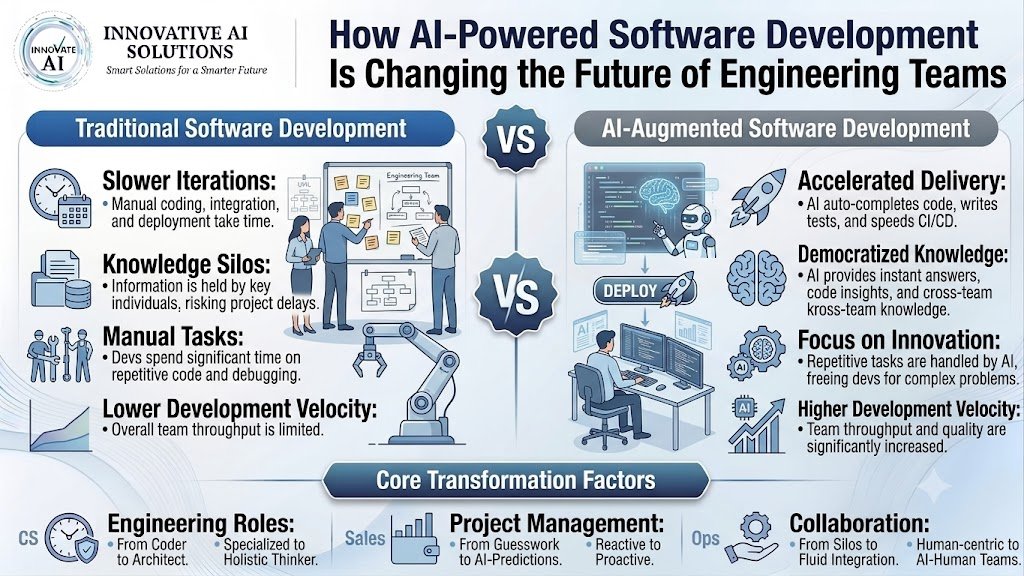
AI coding assistants generate boilerplate, suggest implementations, and catch errors before they reach review. AI testing tools generate test cases from specifications. AI code review tools identify issues that human reviewers miss. AI agents handle routine maintenance tasks — dependency updates, bug fixes, refactoring.
The result is not fewer engineers. It is engineers spending their time differently. Less time on mechanical work. More time on architecture, problem definition, system design, and the judgment calls that AI cannot make.
Indian engineering teams are at the centre of this shift. India has one of the largest software engineering workforces in the world, and Indian teams at product companies, service firms, and startups are adopting AI-powered development faster than many Western counterparts. Delhi NCR, Bangalore, and Hyderabad have become testing grounds for how AI changes engineering practice.
This guide covers how AI-powered software development is changing engineering teams in 2026. It addresses the tools, the team structures, the skills that matter, the costs, and the India-specific impact.
What AI-Powered Development Actually Includes
The Tool Categories
| Category | Function | Examples |
|---|---|---|
| Code completion | Suggest code as you type | GitHub Copilot, Codeium |
| Chat-based coding | Answer questions, generate code | ChatGPT, Claude, Gemini |
| Code review | Identify issues in pull requests | CodeRabbit, custom tools |
| Test generation | Generate test cases | Diffblue, custom tools |
| Documentation | Generate and maintain docs | Custom tools |
| Refactoring | Restructure code | AI-assisted IDEs |
| Debugging | Identify and fix bugs | AI-assisted debugging |
| Agentic development | Multi-step autonomous coding | Claude Code, custom agents |
What Each Category Actually Delivers
| Category | Productivity Impact | Quality Impact |
|---|---|---|
| Code completion | 20–40% faster coding | Fewer typos, more consistent |
| Chat-based coding | Faster problem solving | Better approaches |
| Code review | Faster reviews | More issues caught |
| Test generation | Less manual test writing | Broader coverage |
| Documentation | Less manual writing | More current docs |
| Refactoring | Faster cleanup | Safer changes |
| Debugging | Faster diagnosis | Faster resolution |
| Agentic development | Significant for routine tasks | Variable, needs review |
How AI Changes Engineering Team Structure
The Traditional Structure
text
Engineering Manager
├── Senior Engineers (design, review, mentor) ├── Mid-level Engineers (feature development) ├── Junior Engineers (bug fixes, simple features) └── QA Engineers (testing)
The AI-Augmented Structure
text
Engineering Manager
├── Senior Engineers (architecture, problem definition) ├── AI-augmented Engineers (feature development with AI) ├── AI Operations (prompt engineering, model management) └── QA Engineers (strategy, edge cases, AI test validation)
What Changes
| Role | Before | After |
|---|---|---|
| Junior engineer | Writes simple code | Reviews AI output, handles integration |
| Mid-level engineer | Builds features | Builds complex features, orchestrates AI |
| Senior engineer | Designs, reviews, mentors | Architecture, problem definition, AI governance |
| QA engineer | Writes and runs tests | Designs test strategy, validates AI tests |
| New role: AI Ops | — | Manages AI tools, prompts, evaluation |
The Junior Engineer Question
A significant change is the role of junior engineers. AI tools can now generate much of the code that junior engineers traditionally wrote. This has two implications:
Risk: If junior engineers only review AI output, they may not develop fundamental skills.
Opportunity: Junior engineers can work on more interesting problems earlier, with AI handling mechanical work.
The teams that handle this well use AI to accelerate learning — juniors work alongside AI, review output critically, and develop judgment faster.
The Tools Changing Indian Engineering Teams
What Indian Teams Are Actually Using
| Tool Category | Common Choices | Adoption |
|---|---|---|
| Code completion | GitHub Copilot, Codeium, Cursor | Very high |
| Chat-based coding | ChatGPT, Claude, Gemini | Very high |
| AI IDEs | Cursor, Windsurf | Growing rapidly |
| Code review | CodeRabbit, custom | Growing |
| Testing | AI-assisted test generation | Growing |
| Agentic coding | Claude Code, custom agents | Emerging |
Productivity Impact: What Teams Report
| Metric | Typical Improvement |
|---|---|
| Code writing speed | 20–40% faster |
| Boilerplate generation | 50–70% faster |
| Test writing | 30–50% faster |
| Documentation | 40–60% faster |
| Bug diagnosis | 20–40% faster |
| Code review time | 20–30% faster |
These are self-reported improvements from Indian engineering teams. Actual impact varies by task type, team experience, and tool quality.
Where AI Does Not Help (Yet)
| Area | Why AI Struggles |
|---|---|
| Complex architecture | Requires business context and judgment |
| Novel problem solving | No patterns to learn from |
| Cross-team coordination | Human communication essential |
| Ambiguous requirements | Requires clarification and judgment |
| Legacy system understanding | Context rarely documented |
| Production incident response | High-stakes, context-dependent |
The Skills That Matter More (And Less)
Skills Increasing in Value
| Skill | Why It Matters More |
|---|---|
| Problem definition | AI needs clear problems to solve |
| System design | Architecture decisions are more consequential |
| Code review | Reviewing AI output requires judgment |
| Prompt engineering | Getting good AI output is a skill |
| AI evaluation | Knowing when AI output is correct |
| Domain expertise | Business context AI lacks |
| Communication | Coordinating human and AI work |
| Security awareness | AI can introduce vulnerabilities |
Skills Decreasing in Value
| Skill | Why It Matters Less |
|---|---|
| Boilerplate coding | AI generates it |
| Syntax memorisation | AI handles syntax |
| Simple CRUD development | AI generates it |
| Basic test writing | AI generates tests |
| Documentation writing | AI generates docs |
| Routine refactoring | AI handles it |
The New Skill Stack
| Layer | Skills |
|---|---|
| Foundation | Problem definition, system design, domain expertise |
| AI collaboration | Prompt engineering, output evaluation, AI tool mastery |
| Quality | Code review, security awareness, testing strategy |
| Human | Communication, mentoring, cross-team coordination |
How AI Changes Development Workflows
The AI-Augmented Workflow
text 1. Problem definition (human-led) ↓
2. Solution design (human-led, AI-assisted)
↓ 3. Implementation (AI-assisted, human-reviewed) ↓ 4. Testing (AI-generated, human-validated) ↓ 5. Code review (AI-assisted, human-decided) ↓ 6. Deployment (AI-assisted, human-approved) ↓ 7. Maintenance (AI-assisted for routine, human for complex)
What Changes at Each Stage
| Stage | Before | After |
|---|---|---|
| Definition | Same | Same — human judgment essential |
| Design | Human-led | Human-led with AI suggestions |
| Implementation | Human writes code | AI generates, human reviews |
| Testing | Human writes tests | AI generates, human validates |
| Review | Human reviews | AI pre-reviews, human decides |
| Deployment | Manual pipelines | AI-assisted automation |
| Maintenance | Human fixes | AI fixes routine, human handles complex |
The Cost Impact
Tool Costs for Indian Engineering Teams
| Tool Type | Cost Per Developer/Month (INR) | Cost Per Developer/Month (USD) |
|---|---|---|
| Code completion (basic) | ₹800–₹1,500 | $10–$18 |
| Code completion (premium) | ₹1,500–₹3,000 | $18–$36 |
| AI IDE | ₹1,500–₹4,000 | $18–$48 |
| Code review AI | ₹1,000–₹2,500 | $12–$30 |
| Agentic coding | ₹2,000–₹6,000 | $24–$72 |
ROI Calculation
| Factor | Calculation |
|---|---|
| Productivity gain | 20–40% faster coding |
| Developer cost | ₹1,00,000–₹2,50,000 monthly |
| Value of 25% gain | ₹25,000–₹62,500 monthly per developer |
| Tool cost | ₹3,000–₹8,000 monthly per developer |
| Net benefit | ₹22,000–₹54,500 monthly per developer |
The economics are compelling. Even at modest productivity gains, AI tools deliver significant ROI for Indian engineering teams.
Infrastructure Costs
| Cost Category | Monthly Range (INR) | Monthly Range (USD) |
|---|---|---|
| AI tool subscriptions | ₹3,000–₹8,000 per developer | $36–$96 per developer |
| Self-hosted model infrastructure | ₹50,000–₹3,00,000 | $600–$3,600 |
| API costs (if usage-based) | ₹5,000–₹50,000 | $60–$600 |
| Training and enablement | ₹10,000–₹40,000 per developer (one-time) | $120–$480 per developer |
What This Means for Indian Engineering Teams
The Competitive Advantage
Indian engineering teams that adopt AI-powered development effectively gain a significant advantage:
| Advantage | Explanation |
|---|---|
| Faster delivery | 20–40% faster feature development |
| Better quality | AI catches issues humans miss |
| Lower cost | More output per engineer |
| Better retention | Engineers prefer modern tooling |
| Faster onboarding | AI helps new engineers become productive |
The Risk of Not Adopting
| Risk | Impact |
|---|---|
| Competitive disadvantage | Slower delivery than AI-augmented competitors |
| Talent attraction | Engineers expect modern tooling |
| Cost disadvantage | Higher cost per feature |
| Quality gap | Missed issues, slower reviews |
The India-Specific Opportunity
India's engineering talent pool is large but has historically competed on cost. AI-powered development shifts the competition to productivity and quality.
| Factor | Implication |
|---|---|
| Large talent pool | AI tools amplify existing capability |
| Cost advantage | Combined with AI productivity, India becomes even more competitive |
| English proficiency | Effective use of English-language AI tools |
| Growing AI ecosystem | Access to AI expertise |
Implementation Framework
Phase 1: Assessment (Weeks 1–2)
| Activity | Purpose |
|---|---|
| Assess current workflow | Identify where AI can help |
| Evaluate tools | Test options with your codebase |
| Identify pilot team | Start with willing adopters |
| Define success metrics | How you will measure impact |
Phase 2: Pilot (Weeks 2–8)
| Activity | Purpose |
|---|---|
| Deploy tools to pilot team | Real usage |
| Train on effective use | Prompting, evaluation |
| Measure productivity | Before/after comparison |
| Gather feedback | What works, what does not |
Phase 3: Expand (Weeks 8–20)
| Activity | Purpose |
|---|---|
| Roll out to more teams | Based on pilot learnings |
| Establish guidelines | AI usage policy, review standards |
| Train all engineers | Ensure consistent adoption |
| Monitor impact | Track productivity and quality |
Phase 4: Optimise (Ongoing)
| Activity | Purpose |
|---|---|
| Evaluate new tools | AI development is rapid |
| Refine workflows | Based on experience |
| Measure ROI | Justify continued investment |
| Develop AI Ops capability | Specialised AI management |
Decision Framework: AI Adoption Readiness
Readiness Scorecard
| Criteria | Weight | Score (1–5) | Weighted Score |
|---|---|---|---|
| Engineering team size and structure | 20% | ||
| Current tooling and infrastructure | 20% | ||
| Team openness to AI tools | 20% | ||
| Codebase suitability | 15% | ||
| Budget for tools and training | 15% | ||
| Leadership support | 10% | ||
| Total | 100% | /5 |
Adoption Priority Matrix
| Priority | Action | Timeline |
|---|---|---|
| Immediate | Code completion tools for all engineers | 1–2 weeks |
| High | AI-assisted code review | 2–4 weeks |
| High | Training on prompt engineering | 2–4 weeks |
| Medium | AI test generation | 4–8 weeks |
| Medium | Agentic development for routine tasks | 8–16 weeks |
| Long-term | AI Ops capability | 3–6 months |
Frequently Asked Questions
1. Will AI replace software engineers?
No. AI changes what engineers do, not whether they are needed. AI handles mechanical work — boilerplate, simple tests, routine refactoring — while engineers focus on problem definition, architecture, judgment, and coordination that AI cannot do.
2. How much does AI improve developer productivity?
Indian teams report 20–40% faster code writing, 50–70% faster boilerplate generation, 30–50% faster test writing, and 20–40% faster bug diagnosis. Actual impact varies by task type and team experience.
3. Which AI coding tools are best for Indian engineering teams?
GitHub Copilot and Codeium for code completion, Cursor and Windsurf for AI-native IDEs, ChatGPT and Claude for chat-based coding, and CodeRabbit for AI code review. Most teams use a combination.
4. How much do AI coding tools cost per developer in India?
Code completion tools cost ₹800–₹3,000 per developer monthly ($10–$36). AI IDEs cost ₹1,500–₹4,000 ($18–$48). Code review tools cost ₹1,000–₹2,500 ($12–$30). Agentic coding tools cost ₹2,000–₹6,000 ($24–$72).
5. What skills matter more in AI-powered development?
Problem definition, system design, code review, prompt engineering, AI output evaluation, domain expertise, communication, and security awareness. These are the skills AI cannot replace.
6. What skills matter less?
Boilerplate coding, syntax memorisation, simple CRUD development, basic test writing, documentation writing, and routine refactoring. AI handles these effectively.
7. How does AI change engineering team structure?
New roles emerge (AI Ops for prompt and model management), and existing roles shift. Junior engineers review AI output and handle integration. Senior engineers focus on architecture and problem definition. QA engineers design test strategy rather than writing all tests.
8. Is AI-generated code safe to use in production?
With proper review, yes. AI-generated code must be reviewed for security, correctness, and fit with existing patterns. Never deploy AI-generated code without human review, especially for security-sensitive code.
9. How do I measure ROI from AI coding tools?
Measure code writing speed, test writing time, review time, bug resolution time, and feature delivery velocity. Compare before and after adoption. At 25% productivity gain for a ₹2,00,000/month developer, the value is ₹50,000/month against ₹5,000 tool cost.
10. What is agentic development?
Agentic development uses AI agents to handle multi-step coding tasks — implementing features, fixing bugs, refactoring — with minimal human intervention. It is emerging in 2026 and works best for routine, well-defined tasks.
11. How should Indian engineering teams start with AI?
Start with code completion tools for all engineers — immediate value, low cost. Add AI code review and prompt engineering training. Expand to test generation and agentic development as teams gain experience.
12. How can Innovative AI Solutions help?
Innovative AI Solutions is a Delhi-based AI development company that helps engineering teams adopt AI-powered development. We assess workflows, recommend tools, train teams on effective AI use, and build custom AI tooling where off-the-shelf options do not fit. Our approach prioritises measurable productivity gains over tool adoption for its own sake. Learn more at https://innovativeais.com.
Contact Innovative AI Solutions
Ready to transform your engineering team with AI-powered development?
We help Indian engineering teams adopt AI tools effectively, measure productivity gains, and build custom AI development capabilities.
Contact Information
Innovative AI Solutions
📍 Netaji Subhash Place, Pitampura, Delhi – 110034
🌐 Website: https://innovativeais.com 📧 Email: info@innovativeais.com
📞 Phone: +91 7464 099 059 / +91 96899 67356
Business Services
• AI Automation • AI Development • AI Consulting • Machine Learning Solutions • Deep Learning Solutions • Generative AI Services • NLP Solutions • AI Agents • AI Chatbots • Voice AI • CRM Development • Custom Software Development • Website Development • Mobile App Development
About the Author
Abhishek Kumar
Founder & CEO, Innovative AI Solutions
5+ years building production AI systems for Indian businesses. Based in Delhi, serving clients across India.
Ready to build AI solutions for your business?
Innovative AI Solutions — Delhi's leading AI development company. Free consultation available.
Get Free Consultation →
A complete 2026 guide to how AI-powered software development is reshaping engineering teams, skills, and workflows in India.
#AISoftwareDevelopment #EngineeringTeams #2026 #AICodingAssistants #CodeGeneration #DeveloperProductivity #AIPairProgramming #AgenticDevelopment #CodeReview #DevOpsAI #EngineeringStructure #AITesting #DeveloperExperience #India #DelhiNCRTech #StartupEngineering #EnterpriseEngineering #SoftwareDevelopment #AITools #TechIndia #DigitalProducts #EngineeringProductivity #AIAdoption #FutureOfWork #InnovativeAISolutions
Copyright ©️ 2015–2026 Innovative AI Solutions. All Rights Reserved. | Privacy Policy | Terms & Conditions


