


From Autocomplete to Autonomous Agents
The first wave of AI in software development was assistive. Code completion tools suggested the next line. Chat assistants answered questions. The developer remained in control, typing every character and making every decision.
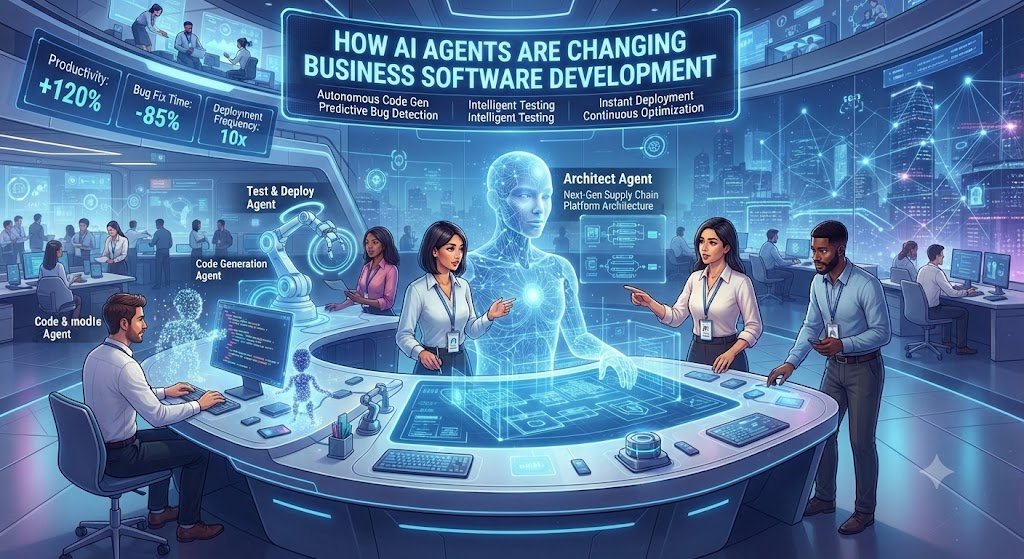
The second wave is agentic. AI agents now handle multi-step tasks — implementing features, fixing bugs, writing tests, refactoring code — with minimal human intervention. The developer defines the goal and reviews the output.
This shift is significant. It changes what developers do, how teams are structured, and what skills matter. It also introduces new risks: agents that take actions need guardrails, and agents that write code need review.
Indian engineering teams are adopting agentic development rapidly. The country's large developer workforce and growing AI ecosystem make it a natural testing ground for how agents change software development practice.
This guide covers how AI agents are changing business software development in 2026. It addresses the workflows, the team structures, the costs in India, and the risks that need management.
What AI Agents Actually Do in Development
The Agentic Development Spectrum
| Level | Description | Human Role |
|---|---|---|
| Assistive | AI suggests, human writes | Every keystroke |
| Collaborative | AI drafts, human refines | Review and edit |
| Delegative | AI implements, human reviews | Define and approve |
| Autonomous | AI handles end-to-end, human oversees | Goal and guardrails |
Most teams operate at collaborative and delegative levels. Fully autonomous development remains rare for complex tasks.
Agent Capabilities in 2026
| Capability | What Agents Do |
|---|---|
| Code generation | Implement features from specifications |
| Bug fixing | Diagnose and fix issues |
| Test creation | Generate unit and integration tests |
| Refactoring | Restructure code |
| Code review | Identify issues in changes |
| Documentation | Generate and update docs |
| Dependency updates | Update and validate dependencies |
| Migration | Convert code between patterns |
What Agents Do Well
| Task | Why Agents Excel |
|---|---|
| Boilerplate generation | Pattern-based, well-defined |
| Test writing | Structured, repeatable |
| Simple bug fixes | Well-scoped problems |
| Refactoring | Pattern-based transformations |
| Documentation | Generated from code |
| Dependency updates | Mechanical tasks |
What Agents Struggle With
| Task | Why Humans Still Lead |
|---|---|
| Architecture decisions | Strategic judgment |
| Ambiguous requirements | Needs clarification |
| Novel problem solving | No patterns to follow |
| Cross-team coordination | Human communication |
| Production incidents | High-stakes, context-dependent |
| Business logic validation | Domain knowledge required |
How Agentic Development Changes Workflows
The Traditional Workflow
text Requirement → Developer writes code → Developer writes tests → Human review →
Deploy
The Agentic Workflow
text Requirement → Agent generates implementation → Agent generates tests → Human reviews → Human approves → Deploy
What Changes at Each Step
| Step | Traditional | Agentic |
|---|---|---|
| Requirement | Developer interprets | Developer defines precisely |
| Implementation | Developer writes | Agent generates |
| Testing | Developer writes | Agent generates |
| Review | Human reviews | Human reviews agent output |
| Approval | Implicit | Explicit for agent actions |
The New Developer Role
| Before | After |
|---|---|
| Writing code | Defining problems precisely |
| Implementing features | Reviewing agent output |
| Writing tests | Validating agent-generated tests |
| Debugging | Guiding agents to debug |
| Manual refactoring | Approving refactoring |
How Agents Change Team Structure
The Emerging Structure
text
Engineering Manager
├── Senior Engineers (architecture, agent oversight) ├── Mid-level Engineers (feature definition, review) ├── Agent Operators (prompt design, agent config) └── QA Engineers (test strategy, agent validation)
Role Changes
| Role | Change |
|---|---|
| Junior engineer | Reviews agent output, handles integration |
| Mid-level engineer | Defines features, reviews agent work |
| Senior engineer | Architecture, agent governance, complex problems |
| QA engineer | Test strategy, validating agent-generated tests |
| New: Agent Operator | Configures and manages agents |
The Junior Engineer Question
A significant concern: if agents generate the code juniors traditionally wrote, how do juniors develop skills?
| Risk | Mitigation |
|---|---|
| Skill atrophy | Juniors review agent output critically |
| Shallow understanding | Juniors explain agent-generated code |
| No fundamentals | Structured learning alongside agent work |
| Over-reliance | Tasks without agent assistance |
Teams that handle this well use agents to accelerate learning, not replace it.
What Agentic Development Costs in India
Tool and Platform Costs
| Tool Category | Cost Per Developer/Month (INR) | Cost Per Developer/Month (USD) |
|---|---|---|
| Agentic coding tools | ₹2,000–₹6,000 | $24–$72 |
| AI-native IDEs | ₹1,500–₹4,000 | $18–$48 |
| Code review agents | ₹1,000–₹2,500 | $12–$30 |
| Test generation | ₹1,000–₹3,000 | $12–$36 |
| Custom agent development | Variable | Variable |
Productivity Impact
| Metric | Typical Improvement |
|---|---|
| Boilerplate generation | 50–70% faster |
| Test writing | 30–50% faster |
| Simple bug fixes | 30–50% faster |
| Refactoring | 30–50% faster |
| Documentation | 40–60% faster |
ROI Calculation
| Factor | Calculation |
|---|---|
| Developer cost | ₹1,00,000–₹2,50,000 monthly |
| Productivity gain | 20–35% on agent-eligible tasks |
| Value of gain | ₹20,000–₹87,500 monthly |
| Tool cost | ₹3,000–₹8,000 monthly |
| Net benefit | ₹17,000–₹79,500 monthly per developer |
Custom Agent Development
For teams building custom agents for specific workflows:
| Agent Type | Development Cost (INR) | Development Cost (USD) |
|---|---|---|
| Simple task agent | ₹1,50,000–₹4,00,000 | $1,800–$4,800 |
| Multi-step agent | ₹4,00,000–₹10,00,000 | $4,800–$12,000 |
| Complex orchestration | ₹10,00,000–₹25,00,000+ | $12,000–$30,000+ |
Risks and Governance
Agent-Specific Risks
| Risk | Mitigation |
|---|---|
| Incorrect code | Human review before merge |
| Security vulnerabilities | Security scanning, review |
| Unintended actions | Permission limits, approval workflows |
| Runaway loops | Iteration limits, cost caps |
| Data exposure | Access control, output filtering |
| Dependency on agents | Skill development alongside agent use |
Governance Requirements
| Requirement | Implementation |
|---|---|
| Human review | All agent output reviewed before merge |
| Approval workflows | High-risk changes require approval |
| Audit trails | Log all agent actions |
| Security scanning | Automated scans on agent output |
| Cost controls | Limits on agent usage |
| Skill development | Structured learning for juniors |
The Non-Negotiables
Human review before merge — No agent output merged without review
Security scanning — All code scanned, regardless of origin
Audit trails — Every agent action logged
Cost controls — Limits on agent usage per developer
Skill development — Structured learning alongside agent work
India-Specific Considerations
The Talent Advantage
| Factor | Implication |
|---|---|
| Large developer pool | Agents amplify existing capability |
| Strong fundamentals | Indian developers adapt quickly |
| Cost efficiency | Combined with agents, India is highly competitive |
| English proficiency | Effective use of English-language agent tools |
The Adoption Opportunity
Indian engineering teams are adopting agentic development rapidly. Early adoption creates competitive advantage in delivery speed and cost efficiency.
The Risk of Over-Reliance
| Risk | Mitigation |
|---|---|
| Skill atrophy | Structured learning, non-agent tasks |
| Quality issues | Rigorous review processes |
| Security gaps | Automated scanning, security training |
| Talent development | Mentorship, fundamentals focus |
Decision Framework: Agentic Development Readiness
Readiness Scorecard
| Criteria | Weight | Score (1–5) | Weighted Score |
|---|---|---|---|
| Current tooling and infrastructure | 20% | ||
| Team openness to agents | 20% | ||
| Codebase suitability | 15% | ||
| Review and governance processes | 20% | ||
| Budget for tools and training | 15% | ||
| Measurement capability | 10% | ||
| Total | 100% | /5 |
Adoption Priority Matrix
| Priority | Action | Timeline |
|---|---|---|
| Immediate | Code completion and agentic coding tools | 1–2 weeks |
| High | Review processes for agent output | 2–4 weeks |
| High | Security scanning on all code | 2–4 weeks |
| Medium | Test generation agents | 4–8 weeks |
| Medium | Custom agents for specific workflows | 8–16 weeks |
| Long-term | Agent operations capability | 3–6 months |
Phased Implementation
| Phase | What to Build | Timeline |
|---|---|---|
| Phase 1 | Agentic coding tools for all developers | 1–2 weeks |
| Phase 2 | Review and governance processes | 2–4 weeks |
| Phase 3 | Test generation, code review agents | 4–8 weeks |
| Phase 4 | Custom agents, agent operations | 8–16 weeks |
Frequently Asked Questions
1. What are AI agents in software development?
AI agents are systems that handle multi-step development tasks — implementing features, fixing bugs, writing tests, refactoring code — with minimal human intervention. The developer defines the goal and reviews the output.
2. How do AI agents differ from AI coding assistants?
Assistants suggest code as you type. Agents execute multi-step tasks autonomously. Assistants are collaborative; agents are delegative. The developer's role shifts from writing code to defining problems and reviewing output.
3. Will AI agents replace software developers?
No. Agents handle mechanical work — boilerplate, tests, simple fixes — while developers focus on problem definition, architecture, review, and judgment. The role changes; it does not disappear.
4. How much do agentic development tools cost in India?
Agentic coding tools cost ₹2,000–₹6,000 per developer monthly ($24–$72). Code review agents cost ₹1,000–₹2,500 ($12–$30). Custom agent development costs ₹1,50,000–₹25,00,000+ ($1,800–$30,000+) depending on complexity.
5. What productivity gains do AI agents deliver?
Boilerplate generation improves 50–70%, test writing 30–50%, simple bug fixes 30–50%, refactoring 30–50%, and documentation 40–60%. Overall productivity gains of 20–35% on agent-eligible tasks are typical.
6. What tasks are agents good at?
Boilerplate generation, test writing, simple bug fixes, refactoring, documentation, and dependency updates. These are pattern-based, well-defined tasks.
7. What tasks still require human developers?
Architecture decisions, ambiguous requirements, novel problem solving, cross-team coordination, production incidents, and business logic validation. These require judgment and context agents lack.
8. What governance is required for agentic development?
Human review before merge, security scanning on all code, audit trails for agent actions, cost controls on agent usage, and structured skill development for junior engineers.
9. How do junior engineers develop skills with AI agents?
Juniors review agent output critically, explain agent-generated code, work on tasks without agent assistance, and receive structured mentorship. Agents accelerate learning when used well.
10. What are the risks of agentic development?
Incorrect code, security vulnerabilities, unintended actions, runaway loops, data exposure, and dependency on agents that atrophies skills. All are manageable with proper governance.
11. Should I build custom agents or use off-the-shelf tools?
Use off-the-shelf tools for standard tasks (coding, testing, review). Build custom agents when you have specific workflows that off-the-shelf tools do not address. Start with off-the-shelf.
12. How can Innovative AI Solutions help?
Innovative AI Solutions is a Delhi-based AI development company that helps engineering teams adopt agentic development. We implement agentic coding tools, review processes, governance frameworks, and custom agents for specific workflows. Our approach prioritises measurable productivity gains with proper risk management. Learn more at https://innovativeais.com.
Contact Innovative AI Solutions
Ready to adopt AI agents in your development workflow?
We help Indian engineering teams implement agentic development with proper governance, review processes, and measurable productivity gains.
Contact Information
Innovative AI Solutions
📍 Netaji Subhash Place, Pitampura, Delhi – 110034
🌐 Website: https://innovativeais.com 📧 Email: info@innovativeais.com
📞 Phone: +91 7464 099 059 / +91 96899 67356
Business Services
• AI Automation • AI Development • AI Consulting • Machine Learning Solutions • Deep Learning Solutions • Generative AI Services • NLP Solutions • AI Agents • AI Chatbots • Voice AI • CRM Development • Custom Software Development • Website Development • Mobile App Development
About the Author
Abhishek Kumar
Founder & CEO, Innovative AI Solutions
5+ years building production AI systems for Indian businesses. Based in Delhi, serving clients across India.
Ready to build AI solutions for your business?
Innovative AI Solutions — Delhi's leading AI development company. Free consultation available.
Get Free Consultation →
A 2026 guide to how AI agents are reshaping business software development — workflows, team structures, costs, and governance for Indian engineering teams.
#AIAgents #SoftwareDevelopment #2026 #AgenticDevelopment #CodingAgents #AutonomousAgents #DeveloperProductivity #SoftwareEngineering #AgenticWorkflows #AIDevelopmentIndia #DelhiNCRTech #StartupEngineering #EnterpriseEngineering #CodeGeneration #AIAdoption #EngineeringTeams #AgenticAI #TechIndia #DigitalProducts #SoftwareAutomation #AITools #EngineeringProductivity #AgentOrchestration #DevelopmentWorkflow #InnovativeAISolutions
Copyright ©️ 2015–2026 Innovative AI Solutions. All Rights Reserved. | Privacy Policy | Terms & Conditions


