



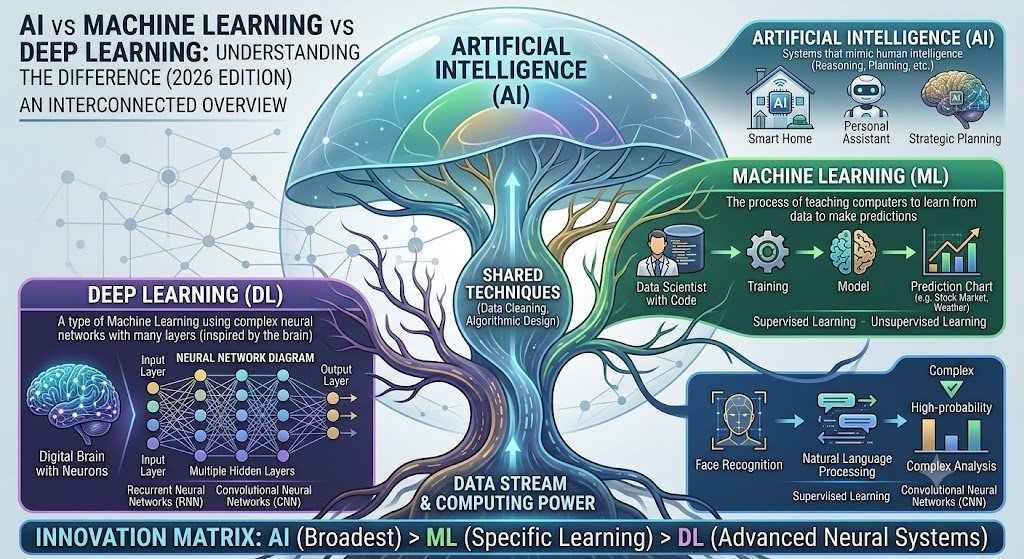
The Confusion, Explained
AI, machine learning, and deep learning are used interchangeably in most conversations. They are not the same thing.
AI is the broad goal: making machines intelligent. Machine learning is one way to achieve it: teaching machines from data. Deep learning is a powerful subset of machine learning: using large neural networks to learn complex patterns.
Think of it as nested circles:
| Layer | What It Is |
|---|---|
| Artificial Intelligence | The broad field of making machines intelligent |
| Machine Learning | A subset of AI that learns from data |
| Deep Learning | A subset of ML using large neural networks |
Everything in deep learning is machine learning. Everything in machine learning is AI. But not all AI is machine learning, and not all machine learning is deep learning.
This guide explains the difference in plain words, with examples and business use cases.
For organisations building AI, machine learning, or deep learning solutions, Innovative AI Solutions provides AI development, machine learning solutions, and deep learning solutions.
The Nested Relationship
| Concept | Definition | Example |
|---|---|---|
| Artificial Intelligence | Any technique that enables machines to mimic human intelligence | Chess engine, rule-based chatbot |
| Machine Learning | Systems that learn from data without explicit programming | Spam filter, recommendation engine |
| Deep Learning | ML using multi-layered neural networks | Image recognition, LLMs |
The Visual
| Layer | Contains |
|---|---|
| AI | ML, DL, rule-based systems, expert systems, robotics |
| ML | DL, decision trees, SVMs, clustering, regression |
| DL | CNNs, RNNs, transformers, LLMs |
What Is Artificial Intelligence?
AI is the broad goal of making machines perform tasks that normally require human intelligence.
Types of AI
| Type | Description | Exists? |
|---|---|---|
| Narrow AI | Performs one specific task | Yes |
| General AI | Human-level intelligence across tasks | No |
| Super AI | Beyond human intelligence | No |
All AI today is narrow AI. It is very good at one thing — playing chess, recommending videos, answering questions — but it cannot generalize like a human.
Examples of AI
| Example | Type |
|---|---|
| Chess engine | Rule-based AI |
| Spam filter | Machine learning |
| Recommendation engine | Machine learning |
| Voice assistant | Deep learning |
| ChatGPT | Deep learning |
| Self-driving car | Deep learning + rule-based |
AI Without Machine Learning
Early AI was rule-based. Programmers wrote explicit rules: "If temperature > 30, turn on fan." This is AI, but not machine learning. It does not learn from data.
| Approach | How It Works | Example |
|---|---|---|
| Rule-based AI | Explicit if-then rules | Thermostat |
| Expert systems | Rules from human experts | Medical diagnosis (1980s) |
| Machine learning | Learns from data | Spam filter |
What Is Machine Learning?
Machine learning is a subset of AI where systems learn from data instead of following explicit rules.
Instead of writing "if email contains 'free money', mark as spam," you show the system thousands of spam and non-spam emails. It learns the patterns itself.
How Machine Learning Works
| Step | What Happens |
|---|---|
| 1. Collect data | Gather examples |
| 2. Prepare data | Clean, label, split |
| 3. Choose model | Pick algorithm |
| 4. Train | Model learns patterns |
| 5. Evaluate | Test on unseen data |
| 6. Deploy | Use in production |
| 7. Monitor | Track performance |
Types of Machine Learning
| Type | How It Learns | Example |
|---|---|---|
| Supervised | From labeled data | Spam filter, price prediction |
| Unsupervised | From unlabeled data | Customer segmentation |
| Reinforcement | From rewards and penalties | Game playing, robotics |
Supervised Learning
You give the model input-output pairs. It learns to map inputs to outputs.
| Input | Output |
|---|---|
| Email text | Spam / Not spam |
| House features | Price |
| Customer data | Churn / No churn |
| Image | Cat / Dog |
Algorithms: Linear regression, logistic regression, decision trees, random forests, SVM, gradient boosting.
Unsupervised Learning
You give the model input only. It finds patterns on its own.
| Task | Example |
|---|---|
| Clustering | Group customers by behavior |
| Dimensionality reduction | Compress features |
| Anomaly detection | Find fraud |
Algorithms: K-means, hierarchical clustering, PCA, autoencoders.
Reinforcement Learning
An agent learns by interacting with an environment and receiving rewards or penalties.
| Concept | Meaning |
|---|---|
| Agent | The learner |
| Environment | What it interacts with |
| Action | What it can do |
| Reward | Feedback |
| Policy | Strategy |
Examples: Game playing (AlphaGo), robotics, recommendation, autonomous driving.
Machine Learning Examples
| Use Case | Type | Industry |
|---|---|---|
| Spam detection | Supervised | |
| Credit scoring | Supervised | Finance |
| Customer segmentation | Unsupervised | Marketing |
| Fraud detection | Supervised + anomaly | Finance |
| Recommendation | Supervised + RL | E-commerce |
| Predictive maintenance | Supervised | Manufacturing |
| Demand forecasting | Supervised | Retail |
What Is Deep Learning?
Deep learning is a subset of machine learning that uses large neural networks with many layers.
"Deep" refers to the number of layers. A shallow model might have one or two layers. A deep model has dozens or hundreds.
How Deep Learning Works
| Step | What Happens |
|---|---|
| 1. Input | Raw data (pixels, text, audio) |
| 2. Layers | Data passes through many layers |
| 3. Features | Each layer learns increasingly abstract features |
| 4. Output | Final prediction |
Why Deep Learning Works
Traditional ML requires humans to engineer features. Deep learning learns features automatically.
| Approach | Feature Engineering |
|---|---|
| Traditional ML | Human-designed features |
| Deep Learning | Learned features |
For image recognition, traditional ML needs humans to define "edges," "corners," "shapes." Deep learning learns these automatically from raw pixels.
Neural Network Basics
| Component | What It Does |
|---|---|
| Neuron | Takes inputs, applies weights, produces output |
| Layer | Collection of neurons |
| Weights | Learned parameters |
| Activation | Non-linear function |
| Loss | Measures error |
| Backpropagation | Adjusts weights to reduce error |
Types of Deep Learning Networks
| Type | Best For | Example |
|---|---|---|
| CNN | Images | Image recognition |
| RNN | Sequences | Time series |
| LSTM | Long sequences | Speech |
| Transformer | Text, everything | LLMs |
| GAN | Generation | Image generation |
| Diffusion | Generation | Image generation |
Deep Learning Examples
| Use Case | Type | Industry |
|---|---|---|
| Image recognition | CNN | Healthcare, retail |
| Speech recognition | RNN, Transformer | Voice assistants |
| Machine translation | Transformer | Language |
| Chatbots | Transformer | Customer support |
| Self-driving | CNN + RNN | Automotive |
| Medical imaging | CNN | Healthcare |
| Fraud detection | Autoencoder | Finance |
Side-by-Side Comparison
| Aspect | AI | Machine Learning | Deep Learning |
|---|---|---|---|
| Scope | Broadest | Subset of AI | Subset of ML |
| Definition | Machines mimicking intelligence | Systems that learn from data | ML with deep neural networks |
| Data Needs | Varies | Moderate | Large |
| Compute Needs | Varies | Moderate | High (GPUs) |
| Feature Engineering | Manual | Manual | Automatic |
| Interpretability | Varies | Often clear | Often opaque |
| Training Time | Varies | Minutes to hours | Hours to weeks |
| Examples | Chess engine, chatbot | Spam filter, recommendation | LLMs, image recognition |
| Best For | Any intelligent task | Structured data, predictions | Unstructured data, complex patterns |
When to Use Which
| Your Problem | Best Approach |
|---|---|
| Simple rules | Rule-based AI |
| Structured data, clear features | Traditional ML |
| Small dataset | Traditional ML |
| Need interpretability | Traditional ML |
| Images, audio, text | Deep Learning |
| Large dataset | Deep Learning |
| Complex patterns | Deep Learning |
| Generative tasks | Deep Learning |
| Need latest accuracy | Deep Learning |
Cost Comparison
Build Costs
| Approach | Cost Range (INR) | Cost Range (USD) |
|---|---|---|
| Rule-based AI | ₹25,000–₹1,00,000 | $300–$1,200 |
| Traditional ML | ₹1,00,000–₹5,00,000 | $1,200–$6,000 |
| Deep Learning | ₹3,00,000–₹20,00,000 | $3,600–$24,000 |
| LLM-based (API) | ₹50,000–₹5,00,000 | $600–$6,000 |
| Custom LLM | ₹10,00,000–₹1,00,00,000+ | $12,000–$1,20,000+ |
Ongoing Costs
| Approach | Monthly (INR) | Monthly (USD) |
|---|---|---|
| Rule-based AI | ₹1,000–₹10,000 | $12–$120 |
| Traditional ML | ₹5,000–₹50,000 | $60–$600 |
| Deep Learning (self-hosted) | ₹50,000–₹5,00,000 | $600–$6,000 |
| LLM API | ₹5,000–₹1,50,000 | $60–$1,800 |
Data Requirements
| Approach | Data Needed |
|---|---|
| Rule-based AI | None |
| Traditional ML | Hundreds to thousands of examples |
| Deep Learning | Thousands to millions of examples |
| LLMs | Billions of tokens (pre-trained) |
Real-World Examples in India
Traditional ML in India
| Use Case | Industry | Example |
|---|---|---|
| Credit scoring | Finance | NBFC loan decisions |
| Fraud detection | Finance | UPI transaction screening |
| Demand forecasting | Retail | Inventory planning |
| Churn prediction | Telecom | Customer retention |
| Predictive maintenance | Manufacturing | Equipment failure |
Deep Learning in India
| Use Case | Industry | Example |
|---|---|---|
| Document processing | BFSI | KYC automation |
| Medical imaging | Healthcare | Radiology screening |
| Voice AI | Customer service | Hindi voice bots |
| Recommendation | E-commerce | Product suggestions |
| Chatbots | Multiple | Customer support |
Indian AI Ecosystem
| Player | Focus |
|---|---|
| Sarvam AI | Indian language LLMs |
| Krutrim (Ola) | Indian context AI |
| BharatGen | Government-backed multilingual |
| IndiaAI Mission | Compute, datasets, funding |
India-Specific Considerations
Cost Advantage
| Factor | Advantage |
|---|---|
| Developer rates | 40–60% below Western markets |
| AI talent | Growing rapidly |
| Infrastructure | Competitive |
| Domestic models | Sarvam, BharatGen |
Compliance
| Requirement | Impact |
|---|---|
| DPDPA | 5–15% cost addition |
| RBI compliance | 10–25% for finance |
| Healthcare compliance | 15–30% |
| AI governance | 10–20% |
Cost Optimisation
| Strategy | Saving |
|---|---|
| Cloud APIs over self-hosted | Lower upfront |
| Open-source models | Lower ongoing |
| Caching | Reduced inference |
| Model routing | Cheaper models for simple tasks |
| IndiaAI Mission compute | Subsidised GPU access |
Decision Framework
Which Approach Scorecard
| Criteria | Weight | Score (1–5) | Weighted Score |
|---|---|---|---|
| Data volume sufficient | 25% | ||
| Problem complexity | 20% | ||
| Interpretability needed | 15% | ||
| Budget available | 15% | ||
| Compute available | 15% | ||
| Timeline | 10% | ||
| Total | 100% | /5 |
Recommended Approach
| If You Have... | Use |
|---|---|
| Clear rules, no data | Rule-based AI |
| Structured data, small dataset | Traditional ML |
| Unstructured data, large dataset | Deep Learning |
| Need speed, no ML expertise | LLM API |
| Need custom behavior, high volume | Fine-tuned LLM |
| Proprietary advantage, huge data | Custom deep learning |
Frequently Asked Questions
1. What is the difference between AI, machine learning, and deep learning?
AI is the broad field of making machines intelligent. Machine learning is a subset of AI that learns from data. Deep learning is a subset of machine learning that uses large neural networks.
2. Is deep learning better than machine learning?
Not always. Deep learning is better for unstructured data (images, audio, text) and complex patterns. Traditional ML is better for structured data, small datasets, and when interpretability matters.
3. Do I need deep learning for my business?
Only if you are working with images, audio, text, or very complex patterns. For structured data and predictions, traditional ML is often sufficient and cheaper.
4. What is a neural network?
A neural network is a computing system inspired by the brain. It has layers of connected nodes (neurons) that process data and learn patterns through training.
5. What is the difference between supervised and unsupervised learning?
Supervised learning uses labeled data (input-output pairs). Unsupervised learning uses unlabeled data and finds patterns on its own. Reinforcement learning learns from rewards.
6. What is a transformer?
A transformer is a deep learning architecture that uses attention to process sequences. It is the basis for LLMs like GPT, Gemini, and Claude.
7. How much data do I need for machine learning?
Traditional ML: hundreds to thousands of examples. Deep learning: thousands to millions. LLMs: billions of tokens (pre-trained, so you need less).
8. How much does machine learning cost in India?
Traditional ML projects cost ₹1,00,000–₹5,00,000. Deep learning projects cost ₹3,00,000–₹20,00,000. LLM-based applications cost ₹50,000–₹5,00,000.
9. Can I use AI without machine learning?
Yes. Rule-based AI (expert systems, if-then rules) is AI without machine learning. It does not learn from data.
10. Which is best for image recognition?
Deep learning, specifically CNNs (convolutional neural networks). Traditional ML cannot match deep learning for image tasks.
11. Which is best for tabular data?
Traditional ML (gradient boosting, random forests) often outperforms deep learning on tabular data and is easier to interpret.
12. How can Innovative AI Solutions help?
Innovative AI Solutions is a Delhi-based AI development company. We build rule-based AI, traditional ML, deep learning, and LLM applications with transparent pricing and full code ownership. Explore our machine learning solutions and deep learning solutions.
Contact Innovative AI Solutions
Ready to build AI, machine learning, or deep learning solutions?
We help Indian businesses choose the right approach and build production systems with transparent pricing and full code ownership.
Contact Information
Innovative AI Solutions
📍 Netaji Subhash Place, Pitampura, Delhi – 110034
🌐 Website: https://innovativeais.com 📧 Email: info@innovativeais.com
рџ“ћ Phone: +91 7464 099 059 / +91 96899 67356
Business Services
•⁠⁠AI Automation •⁠⁠AI Development •⁠⁠AI Consulting
•⁠⁠Machine Learning Solutions
•⁠⁠Deep Learning Solutions
•⁠⁠Generative AI Services
•⁠⁠NLP Solutions •⁠⁠AI Agents •⁠⁠AI Chatbots •⁠⁠Voice AI •⁠⁠CRM Development
•⁠⁠Custom Software Development
•⁠⁠Website Development
•⁠⁠Mobile App Development
About the Author
Abhishek Kumar
Founder & CEO, Innovative AI Solutions
5+ years building production AI systems for Indian businesses. Based in Delhi, serving clients across India.
Ready to build AI, ML, or deep learning solutions?
Innovative AI Solutions — Delhi's leading AI development company. Free consultation available.
Get Free Consultation в†’
A simple 2026 guide to AI vs machine learning vs deep learning — clear definitions, how they relate, real examples, and business use cases with costs in INR and USD.
#AI #MachineLearning #DeepLearning #Difference #Explained #2026 #Basics #NeuralNetworks #Supervised #Unsupervised #Reinforcement #AIforBeginners #Terminology #UseCases #Examples #India #DelhiNCRTech #GenerativeAI #LLM #DataScience #BusinessAI #InnovativeAISolutions
Copyright © 2015–2026 Innovative AI Solutions. All Rights Reserved. | Privacy Policy | Terms & Conditions


