



The Training Data Problem
Every AI project eventually confronts the same constraint: you do not have enough training data. Or you have data but it is not labelled. Or the labels are inconsistent. Or the data contains personal information you cannot use. Or the edge cases you need are rare in your dataset.
This is the training data problem, and it limits what AI can do for Indian businesses. A model trained on insufficient data performs poorly. A model trained on biased data produces biased outputs. A model trained on personal data without consent creates DPDPA compliance risk.
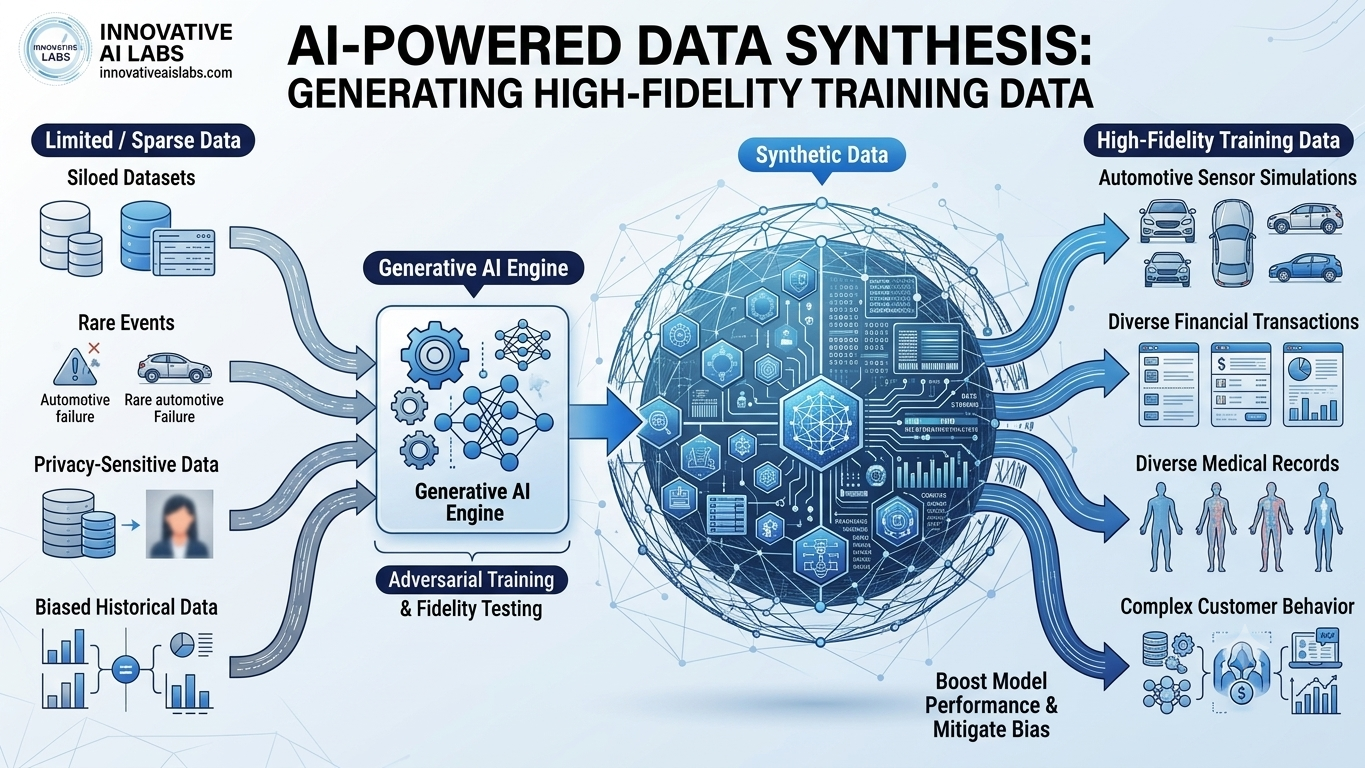
Data synthesis addresses this problem. By generating synthetic training data that preserves the statistical properties of real data while protecting privacy, businesses can train better models without the constraints of real-world data collection.
But synthetic data is not a free lunch. Poorly generated synthetic data produces poorly performing models. Synthetic data that does not match real-world distributions creates systems that fail in production. And synthetic data generation itself requires discipline, evaluation, and governance.
This guide covers AI-powered data synthesis in 2026. It explains how synthetic data is generated, how quality is validated, what it costs in India, and how to approach it in a DPDPA-compliant way.
What Data Synthesis Actually Is
The Core Concept
Data synthesis generates new data points that statistically resemble real data without being copies of it. The generated data can be used to train models, augment limited datasets, or replace sensitive data with privacy-preserving alternatives.
Why Businesses Use Synthetic Data
| Reason | Explanation |
|---|---|
| Data scarcity | Not enough real data to train effective models |
| Privacy | Cannot use personal data without consent |
| Rare events | Edge cases are rare in real data |
| Label cost | Labelling real data is expensive |
| Bias | Real data may underrepresent groups |
| Testing | Need data for testing without using production data |
| Speed | Synthetic data can be generated faster than collected |
Synthetic vs Real Data
| Dimension | Real Data | Synthetic Data |
|---|---|---|
| Source | Collected from the world | Generated by models |
| Privacy | May contain personal data | Can be privacy-preserving |
| Cost | Expensive to collect and label | Expensive to generate well |
| Rare events | Limited by occurrence | Can generate as needed |
| Distribution | Reflects real world | Reflects training data |
| Bias | Inherits real-world bias | Can be controlled |
| Quality | Depends on collection | Depends on generation |
Data Synthesis Techniques
Technique 1: Generative Models
Generative models learn the distribution of real data and produce new samples from it.
| Model Type | Best For | Data Type |
|---|---|---|
| GANs | Images, tabular data | Structured and visual |
| VAEs | Images, embeddings | Visual, latent |
| Diffusion models | High-quality images | Visual |
| LLMs | Text, conversations | Text, dialogue |
| Tabular generators | Structured data | Tabular |
Technique 2: LLM-Based Generation
Large language models generate synthetic text data — conversations, documents, reviews, and structured outputs.
| Application | How It Works |
|---|---|
| Instruction data | Generate input-output pairs for fine-tuning |
| Conversation data | Generate realistic dialogues |
| Document data | Generate documents for RAG testing |
| Classification data | Generate labelled examples |
| Evaluation data | Generate test cases |
Technique 3: Data Augmentation
Augmentation modifies existing data to create variations without generating entirely new data.
| Augmentation Type | Application |
|---|---|
| Text paraphrasing | Rewrite sentences with same meaning |
| Synonym replacement | Replace words with synonyms |
| Back-translation | Translate and translate back |
| Noise injection | Add realistic noise |
| Image transformation | Rotate, crop, adjust images |
Technique 4: Rule-Based Synthesis
Rules generate data according to specified patterns — useful for structured data with known constraints.
| Application | How It Works |
|---|---|
| Tabular data | Generate rows according to statistical rules |
| Valid test data | Generate data meeting validation criteria |
| Edge cases | Generate specific scenarios |
| Compliance data | Generate data meeting regulatory formats |
Technique Comparison
| Technique | Quality | Cost | Best For |
|---|---|---|---|
| Generative models | High | High | Images, complex data |
| LLM generation | High | Moderate | Text, conversations |
| Augmentation | Moderate-High | Low | Expanding existing data |
| Rule-based | Controlled | Low | Structured, constrained data |
High-Fidelity: What It Means
The Definition
High-fidelity synthetic data preserves the statistical properties, relationships, and patterns of real data while being generated rather than collected.
The Fidelity Dimensions
| Dimension | What It Means |
|---|---|
| Statistical fidelity | Distributions match real data |
| Correlational fidelity | Relationships between variables preserved |
| Structural fidelity | Format and schema match |
| Semantic fidelity | Meaning and context preserved |
| Temporal fidelity | Time patterns preserved |
| Edge case fidelity | Rare cases represented |
Measuring Fidelity
| Metric | What It Measures |
|---|---|
| Distribution comparison | Statistical similarity of individual variables |
| Correlation comparison | Similarity of relationships between variables |
| Discriminator test | Can a model distinguish synthetic from real? |
| Utility test | Does training on synthetic data produce good models? |
| Privacy test | Can individuals be identified from synthetic data? |
The Fidelity-Privacy Trade-Off
Higher fidelity means synthetic data more closely resembles real data. But higher fidelity can also mean higher privacy risk if the synthetic data is too similar to real individuals.
| Fidelity Level | Privacy Risk | Use Case |
|---|---|---|
| Very high | Higher | Testing, development |
| High | Moderate | Training with privacy controls |
| Moderate | Low | Privacy-sensitive training |
| Low | Very low | Limited utility |
The goal is the highest fidelity that meets privacy requirements.
Privacy-Preserving Data Synthesis
Why Privacy Matters
Synthetic data generated from personal data can leak information about the individuals in the training set. If synthetic data is too similar to real records, individuals may be identifiable.
Privacy Techniques
| Technique | How It Works |
|---|---|
| Differential privacy | Adds noise to guarantee privacy |
| Anonymisation | Removes identifying information |
| Generalisation | Replaces specific values with ranges |
| Synthetic sampling | Generates from distributions, not records |
| Federated synthesis | Generates without centralising data |
Differential Privacy in Practice
Differential privacy provides a mathematical guarantee that the presence or absence of any individual in the training data does not significantly affect the output.
| Parameter | Trade-Off |
|---|---|
| Epsilon (ε) | Lower = more privacy, less fidelity |
| Delta (δ) | Lower = stronger guarantee |
Choosing epsilon is a business decision balancing privacy requirements against data utility.
DPDPA Considerations
| Requirement | Synthetic Data Implication |
|---|---|
| Consent | Synthetic data from consented sources may still require consent |
| Purpose limitation | Synthetic data should serve the original purpose |
| Data minimisation | Generate only necessary data |
| De-identification | Truly anonymised data falls outside DPDPA |
| User rights | Deletion may require regenerating synthetic data |
Truly anonymised data is not personal data under DPDPA. But achieving true anonymisation is difficult. Synthetic data that preserves too much fidelity may still be considered personal data.
What Data Synthesis Costs in India
Implementation Cost Benchmarks
| Scope | Implementation Cost (INR) | Implementation Cost (USD) | Timeline |
|---|---|---|---|
| Basic augmentation | ₹75,000–₹2,00,000 | $900–$2,400 | 2–4 weeks |
| LLM-based text synthesis | ₹2,00,000–₹5,00,000 | $2,400–$6,000 | 4–8 weeks |
| Tabular synthesis with privacy | ₹3,00,000–₹8,00,000 | $3,600–$9,600 | 6–12 weeks |
| Image synthesis (GAN/diffusion) | ₹5,00,000–₹15,00,000 | $6,000–$18,000 | 8–16 weeks |
| Full synthesis platform | ₹10,00,000–₹25,00,000+ | $12,000–$30,000+ | 12–24 weeks |
Generation Costs
| Data Type | Cost Per 1,000 Samples (INR) | Cost Per 1,000 Samples (USD) |
|---|---|---|
| Augmented text | ₹50–₹200 | $0.60–$2.40 |
| LLM-generated text | ₹200–₹1,000 | $2.40–$12 |
| Tabular data | ₹100–₹500 | $1.20–$6 |
| Images | ₹500–₹3,000 | $6–$36 |
Ongoing Costs
| Cost Category | Monthly Range (INR) | Monthly Range (USD) |
|---|---|---|
| LLM API usage | ₹10,000–₹80,000 | $120–$960 |
| Compute infrastructure | ₹15,000–₹1,00,000 | $180–$1,200 |
| Quality validation | ₹10,000–₹40,000 | $120–$480 |
| Privacy monitoring | ₹5,000–₹25,000 | $60–$300 |
Build vs Buy
| Approach | Cost Profile | Best For |
|---|---|---|
| Off-the-shelf tools | Subscription, lower upfront | Standard use cases |
| Custom pipelines | Higher upfront, lower ongoing | Specific requirements |
| Hybrid | Moderate upfront | Balanced needs |
Validating Synthetic Data Quality
The Validation Framework
| Validation Type | What It Checks |
|---|---|
| Statistical validation | Distributions match real data |
| Correlation validation | Relationships preserved |
| Discriminator test | Synthetic vs real distinguishability |
| Utility test | Model trained on synthetic performs well |
| Privacy test | No individual identification |
| Bias test | Synthetic data does not amplify bias |
The Utility Test
The most important validation: does a model trained on synthetic data perform well on real data?
| Test | Method |
|---|---|
| Train on synthetic, test on real | Compare to train-on-real baseline |
| Train on synthetic + real | Measure augmentation benefit |
| Production validation | A/B test in production |
The Privacy Test
| Test | Method |
|---|---|
| Membership inference | Can you determine if an individual was in training data? |
| Attribute inference | Can you infer sensitive attributes? |
| Re-identification | Can you match synthetic records to real individuals? |
| Nearest neighbour | How close are synthetic records to real ones? |
Quality Gates
| Gate | Requirement |
|---|---|
| Statistical similarity | Distributions within acceptable thresholds |
| Utility | Model performance within acceptable range |
| Privacy | No successful re-identification |
| Bias | No amplification of existing bias |
India-Specific Considerations
Indian Language Data Synthesis
Indian language AI faces a data scarcity problem. Synthetic data generation can help.
| Challenge | Synthesis Approach |
|---|---|
| Limited corpora | LLM generation for Indian languages |
| Code-switching | Generate Hinglish examples |
| Regional dialects | Generate dialect variations |
| Domain vocabulary | Generate domain-specific text |
DPDPA Compliance
| Requirement | Synthetic Data Approach |
|---|---|
| Consent | Verify consent for source data |
| Purpose limitation | Generate for stated purpose only |
| Data minimisation | Generate only necessary data |
| Anonymisation | Apply differential privacy |
| Deletion rights | Regenerate if source data deleted |
Cost Advantages
India's lower AI engineering costs make data synthesis more accessible than in Western markets. A synthesis pipeline costing $50,000 in the US might cost ₹15,00,000 ($18,000) in India.
Decision Framework: Data Synthesis Readiness
Readiness Scorecard
| Criteria | Weight | Score (1–5) | Weighted Score |
|---|---|---|---|
| Real data available for training synthesis | 25% | ||
| Clear use case for synthetic data | 20% | ||
| Privacy requirements understood | 20% | ||
| Validation capability | 15% | ||
| Budget for generation and validation | 10% | ||
| Technical capability | 10% | ||
| Total | 100% | /5 |
When to Use Synthetic Data
| Situation | Recommendation |
|---|---|
| Insufficient real data | Synthetic augmentation |
| Privacy-sensitive data | Privacy-preserving synthesis |
| Rare edge cases | Targeted synthesis |
| Expensive labelling | LLM-generated labels |
| Testing needs | Synthetic test data |
| Bias mitigation | Controlled synthesis |
| Sufficient clean real data | Real data preferred |
Implementation Roadmap
| Phase | What to Build | Timeline | Cost (INR) |
|---|---|---|---|
| Phase 1 | Data augmentation pipeline | 2–4 weeks | ₹75,000–₹2,00,000 |
| Phase 2 | LLM-based synthesis | +4–6 weeks | ₹1,50,000–₹4,00,000 |
| Phase 3 | Privacy-preserving synthesis | +4–6 weeks | ₹2,00,000–₹5,00,000 |
| Phase 4 | Validation and governance | +3–5 weeks | ₹1,00,000–₹3,00,000 |
Frequently Asked Questions
1. What is AI-powered data synthesis?
Data synthesis uses AI models to generate new data that statistically resembles real data without being copies of it. It is used to address data scarcity, protect privacy, generate rare cases, and reduce labelling costs.
2. What is high-fidelity synthetic data?
High-fidelity synthetic data preserves the statistical properties, relationships, patterns, and structure of real data while being generated rather than collected. Fidelity is measured across statistical, correlational, structural, semantic, temporal, and edge-case dimensions.
3. How much does data synthesis cost in India?
Basic augmentation costs ₹75,000–₹2,00,000 ($900–$2,400). LLM-based text synthesis costs ₹2,00,000–₹5,00,000 ($2,400–$6,000). Tabular synthesis with privacy costs ₹3,00,000–₹8,00,000 ($3,600–$9,600). Image synthesis costs ₹5,00,000–₹15,00,000 ($6,000–$18,000).
4. Is synthetic data as good as real data?
It depends on generation quality and validation. Well-generated synthetic data can match real data for many use cases. The key test is utility: does a model trained on synthetic data perform well on real data? Always validate utility before relying on synthetic data.
5. How do I validate synthetic data quality?
Use statistical validation (distributions match), correlation validation (relationships preserved), discriminator tests (can a model distinguish synthetic from real?), utility tests (does training on synthetic produce good models?), and privacy tests (no re-identification).
6. What is differential privacy in data synthesis?
Differential privacy adds mathematical noise to guarantee that the presence or absence of any individual in training data does not significantly affect output. It provides a formal privacy guarantee, with epsilon controlling the privacy-utility trade-off.
7. Does DPDPA apply to synthetic data?
Truly anonymised data is not personal data under DPDPA. But synthetic data that preserves too much fidelity may still be considered personal data. Apply differential privacy and validate anonymisation to ensure compliance.
8. What are the risks of synthetic data?
Poorly generated synthetic data produces poorly performing models. Synthetic data can amplify bias if not controlled. High-fidelity synthetic data can leak privacy if not properly protected. Synthetic data can diverge from real-world distributions over time.
9. When should I use synthetic data instead of real data?
Use synthetic data when real data is insufficient, when privacy prevents using real data, when rare edge cases are needed, when labelling is expensive, or when testing requires data that cannot be production data. Prefer real data when sufficient clean data exists.
10. Can synthetic data help with Indian language AI?
Yes. Indian language AI faces data scarcity, and synthetic generation can produce training data for low-resource languages, code-switching (Hinglish), regional dialects, and domain-specific vocabulary.
11. What is the difference between data augmentation and data synthesis?
Augmentation modifies existing data to create variations (paraphrasing, noise injection). Synthesis generates entirely new data points from learned distributions. Augmentation expands existing data; synthesis creates new data.
12. How can Innovative AI Solutions help?
Innovative AI Solutions is a Delhi-based AI development company specialising in data synthesis pipelines. We build LLM-based text generation, tabular synthesis with differential privacy, image synthesis, and validation frameworks. Our synthesis systems are designed for DPDPA compliance and Indian language requirements. Learn more at https://innovativeais.com.
Contact Innovative AI Solutions
Ready to solve your training data problem with synthesis?
We help Indian businesses generate high-fidelity synthetic training data with privacy guarantees and rigorous validation.
Contact Information
Innovative AI Solutions
📍 Netaji Subhash Place, Pitampura, Delhi – 110034
🌐 Website: https://innovativeais.com 📧 Email: info@innovativeais.com
📞 Phone: +91 7464 099 059 / +91 96899 67356
Business Services
• AI Automation • AI Development • AI Consulting • Machine Learning Solutions • Deep Learning Solutions • Generative AI Services • NLP Solutions • AI Agents • AI Chatbots • Voice AI • CRM Development • Custom Software Development • Website Development • Mobile App Development
About the Author
Abhishek Kumar
Founder & CEO, Innovative AI Solutions
5+ years building production AI systems for Indian businesses. Based in Delhi, serving clients across India.
Ready to build AI solutions for your business?
Innovative AI Solutions — Delhi's leading AI development company. Free consultation available.
Get Free Consultation →
A complete 2026 guide to AI-powered data synthesis — techniques, privacy, validation, costs, and DPDPA compliance for Indian businesses.
#DataSynthesis #SyntheticData #TrainingData #2026 #AITraining #DataGeneration #DataAugmentation #PrivacyPreservingData #DifferentialPrivacy #LLMDataGeneration #DataQuality #MachineLearning #AIDevelopment #India #DelhiNCRTech #StartupApps #EnterpriseApps #DPDPA #DataGovernance #SyntheticDatasets #TechIndia #DigitalProducts #AITrainingData #DataEngineering #InnovativeAISolutions
Copyright ©️ 2015–2026 Innovative AI Solutions. All Rights Reserved. | Privacy Policy | Terms & Conditions


