



Two Technologies, Different Outcomes
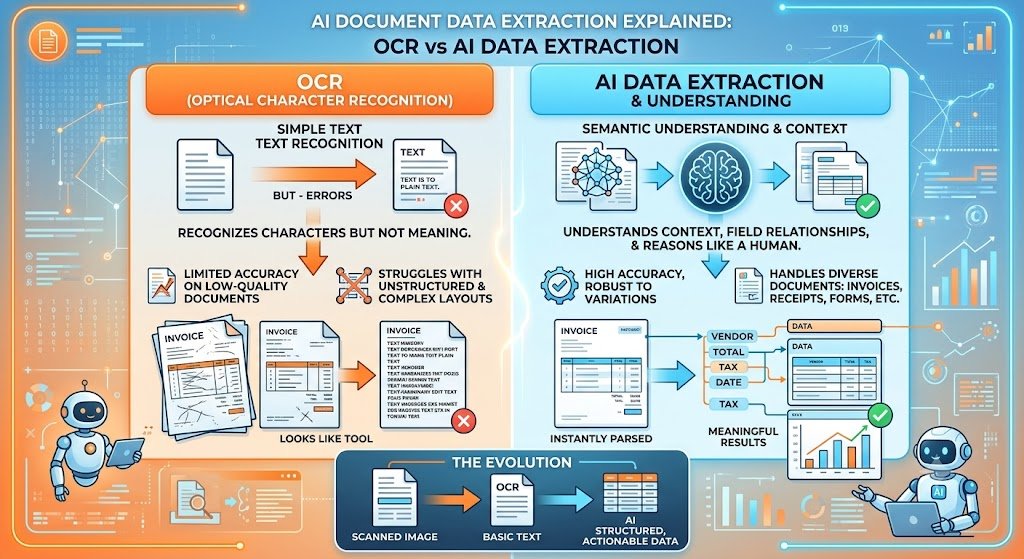
OCR and AI document data extraction are often discussed as if they were the same thing. They are not.
Traditional OCR reads characters. Give it an image of text, and it returns the text. That is all it does. It does not know what the text means, which parts matter, or how the information is structured.
AI document data extraction understands documents. It reads the text, but it also understands layout, identifies fields, extracts values, validates them against rules, and outputs structured data that systems can use.
The distinction matters because the outcomes are different. OCR gives you text you still have to process. AI extraction gives you data you can immediately use. For business automation, that difference is everything.
This guide explains AI document data extraction, how it differs from traditional OCR, when each applies, and what it costs in India in 2026.
For organisations evaluating document automation, Innovative AI Solutions provides specialised AI development services and document automation solutions.
What Traditional OCR Does
The Capability
Traditional OCR converts images of text into machine-readable text.
| Input | Output |
|---|---|
| Image of printed text | Text characters |
| Scanned document | Text content |
| Photo of document | Text content |
What OCR Returns
text Input: Scanned invoice image
OCR Output:
"ABC Supplies Pvt Ltd
Invoice No: INV-2026-1234
Date: 15/01/2026
GSTIN: 07AABCU9603R1ZM
Item Qty Rate Amount
Widget A 10 3000 30000
Widget B 5 3000 15000
Subtotal: 45000
GST @ 18%: 8100
Total: 53100"
This is text. Useful, but not directly usable by business systems.
OCR Limitations
| Limitation | Impact |
|---|---|
| No field identification | Does not know which text is the invoice number |
| No validation | Does not check if data is correct |
| No structure | Text is not structured into fields |
| Layout blind | Does not understand document structure |
| No system integration | Text must be manually processed |
What AI Document Data Extraction Does
The Capability
AI document data extraction understands documents and outputs structured data.
| Input | Output |
|---|---|
| Invoice PDF | Structured invoice data |
| KYC document | Structured identity data |
| Form scan | Structured form fields |
| Contract | Structured terms |
What AI Extraction Returns
text Input: Scanned invoice image
AI Extraction Output: { "vendor": { "name": "ABC Supplies Pvt Ltd", "gstin": "07AABCU9603R1ZM" }, "invoice": { "number": "INV-2026-1234", "date": "2026-01-15" }, "line_items": [ {"item": "Widget A", "qty": 10, "rate": 3000, "amount": 30000}, {"item": "Widget B", "qty": 5, "rate": 3000, "amount": 15000} ], "totals": { "subtotal": 45000, "gst_rate": 18, "gst_amount": 8100, "total": 53100 }, "validation": { "line_items_sum": 45000, "subtotal_match": true, "gst_calculation": true } } This is data. Directly usable by business systems.
What AI Extraction Adds
| Capability | What It Does |
|---|---|
| Field identification | Knows which text is which field |
| Layout understanding | Understands document structure |
| Data validation | Checks data correctness |
| Structured output | Produces usable data |
| System integration | Pushes data to systems |
| Learning | Improves with more documents |
The Technical Difference
Traditional OCR Pipeline
text
Image
↓
Preprocessing
↓ Text detection ↓ Character recognition ↓ Text output
AI Document Data Extraction Pipeline
text
Document
↓ Document classification ↓ OCR (text extraction) ↓ Layout analysis ↓ Field identification (AI model) ↓ Value extraction ↓
Validation
↓ Structured output ↓ System integration
The AI Components
| Component | What It Does |
|---|---|
| Document classification | Identifies document type |
| Layout understanding | Models document structure |
| Field detection | Identifies field locations |
| Value extraction | Extracts field values |
| Validation | Checks data correctness |
| Confidence scoring | Assesses reliability |
When Each Applies
Traditional OCR Is Sufficient When
| Situation | Why OCR Works |
|---|---|
| Simple text extraction | Just need the text |
| Archive digitisation | Text for search |
| One-time processing | No automation needed |
| Manual review follows | Human processes the text |
| Full-text search | Text search sufficient |
AI Extraction Is Needed When
| Situation | Why AI Extraction Works |
|---|---|
| Structured data needed | Fields, not just text |
| Automation required | Data must flow to systems |
| High volume | Manual processing not viable |
| Validation required | Data must be checked |
| Multiple document types | Layout variation |
The Decision Matrix
| Requirement | OCR | AI Extraction |
|---|---|---|
| Text extraction | ✓ | ✓ |
| Field extraction | ✗ | ✓ |
| Structured output | ✗ | ✓ |
| Validation | ✗ | ✓ |
| System integration | ✗ | ✓ |
| Layout understanding | ✗ | ✓ |
| Multi-document types | ✗ | ✓ |
Accuracy Comparison
Accuracy by Task
| Task | Traditional OCR | AI Extraction |
|---|---|---|
| Character accuracy | 98–99.5% | 98–99.5% |
| Field accuracy | N/A | 95–99% |
| Document accuracy | N/A | 90–98% |
| With validation | N/A | 98–99.5% |
What Accuracy Means
| Metric | What It Measures |
|---|---|
| Character accuracy | Percentage of characters correct |
| Field accuracy | Percentage of fields correctly extracted |
| Document accuracy | Percentage of documents fully correct |
For business processing, field and document accuracy matter most.
Accuracy by Document Type
| Document Type | AI Extraction Accuracy |
|---|---|
| Standard invoices | 95–99% |
| Bank statements | 95–99% |
| KYC documents | 95–99% |
| Printed forms | 92–97% |
| Handwritten forms | 80–95% |
| Contracts | 90–97% |
Cost Comparison
Implementation Costs
| Scope | Traditional OCR | AI Extraction |
|---|---|---|
| Basic integration | ₹1,50,000–₹4,00,000 | ₹3,00,000–₹8,00,000 |
| Document pipeline | ₹3,00,000–₹8,00,000 | ₹8,00,000–₹20,00,000 |
| With validation | N/A | ₹10,00,000–₹25,00,000 |
| Enterprise platform | ₹10,00,000–₹25,00,000 | ₹25,00,000–₹60,00,000+ |
AI extraction costs more to implement because it does more.
Ongoing Costs
| Cost Category | Traditional OCR | AI Extraction |
|---|---|---|
| API/software | ₹5,000–₹40,000/month | ₹10,000–₹80,000/month |
| Infrastructure | ₹5,000–₹30,000/month | ₹10,000–₹50,000/month |
| Human review | High (manual processing) | Low (exceptions only) |
| Maintenance | ₹5,000–₹25,000/month | ₹15,000–₹75,000/month |
Cost Per Document
| Document Type | OCR + Manual | AI Extraction |
|---|---|---|
| Simple invoice | ₹30–₹80 | ₹2–₹8 |
| Complex form | ₹50–₹150 | ₹5–₹20 |
| KYC document | ₹40–₹100 | ₹3–₹12 |
| Contract | ₹200–₹500 | ₹15–₹50 |
The ROI Difference
| Factor | OCR + Manual | AI Extraction |
|---|---|---|
| Cost per document | ₹50 | ₹5 |
| Volume | 10,000/month | 10,000/month |
| Monthly cost | ₹5,00,000 | ₹50,000 |
| Annual saving | — | ₹54,00,000 |
| Payback period | — | Under 2 months |
The ROI of AI extraction comes from eliminating manual processing, not just OCR costs.
Use Cases by Technology
Traditional OCR Use Cases
| Use Case | Why OCR |
|---|---|
| Archive digitisation | Searchable text |
| Full-text search | Text indexing |
| Basic digitisation | Text extraction |
| Document preview | Text display |
AI Extraction Use Cases
| Use Case | Why AI Extraction |
|---|---|
| Invoice processing | Structured data for ERP |
| KYC automation | Structured data for onboarding |
| Claims processing | Structured data for settlement |
| Form digitisation | Structured data for systems |
| Contract analysis | Structured terms for review |
| Bank statement processing | Structured transactions for reconciliation |
India-Specific Considerations
Common Indian Use Cases
| Industry | Document Type | Extraction Need |
|---|---|---|
| Banking | Cheques, KYC | Structured data |
| Insurance | Claims, policies | Structured data |
| Healthcare | Prescriptions, records | Structured data |
| Logistics | Shipping, e-way bills | Structured data |
| Retail | Invoices, POs | Structured data |
| Government | Applications | Structured data |
Indian Language Support
| Language | OCR | AI Extraction |
|---|---|---|
| English | Excellent | Excellent |
| Hindi | Good | Good |
| Hinglish | Moderate | Moderate |
| Regional languages | Variable | Variable |
Indian Document Types
| Document | Extraction Consideration |
|---|---|
| GST invoices | Specific fields, validation |
| E-way bills | Standardised format |
| Aadhaar/PAN | Standard fields |
| Cheques | MICR, handwritten amount |
| Bank statements | Varied formats |
DPDPA Compliance
| Requirement | Implementation |
|---|---|
| Consent | For personal data processing |
| Data minimisation | Extract only required fields |
| Security | Encryption, access control |
| Audit trails | Log all processing |
| Data residency | Where processing happens |
Decision Framework
Technology Selection
| Your Need | Recommendation |
|---|---|
| Just text | Traditional OCR |
| Structured data | AI extraction |
| Automation | AI extraction |
| Search | Traditional OCR |
| Validation | AI extraction |
| System integration | AI extraction |
| Mixed documents | AI extraction |
Readiness Scorecard
| Criteria | Weight | Score (1–5) | Weighted Score |
|---|---|---|---|
| Volume justifies automation | 25% | ||
| Structured data needed | 20% | ||
| Document standardisation | 20% | ||
| System integration needs | 15% | ||
| Budget | 10% | ||
| Compliance requirements | 10% | ||
| Total | 100% | /5 |
Implementation Roadmap
| Phase | What to Build | Timeline |
|---|---|---|
| Phase 1 | OCR and basic extraction | 4–8 weeks |
| Phase 2 | Field identification and validation | 4–6 weeks |
| Phase 3 | Exception handling | 3–5 weeks |
| Phase 4 | System integration | 4–6 weeks |
Frequently Asked Questions
1. What is AI document data extraction?
AI document data extraction — also called Intelligent Document Processing (IDP) — uses AI to understand documents and extract structured data. It identifies fields, extracts values, validates data, and outputs structured information systems can use.
2. How is AI extraction different from OCR?
OCR extracts text from documents. AI extraction goes further: it understands layout, identifies fields, extracts values, validates data, and outputs structured data. OCR is a component of AI extraction.
3. When should I use OCR vs AI extraction?
Use OCR when you just need text (search, archive). Use AI extraction when you need structured data, automation, validation, or system integration.
4. Is AI extraction more accurate than OCR?
For text extraction, both achieve similar accuracy (98–99.5%). For field extraction and structured data, AI extraction is the only option. With validation, AI extraction achieves 98–99.5% field accuracy.
5. How much does AI document data extraction cost in India?
Implementation costs ₹3,00,000–₹60,00,000+ ($3,600–$72,000+) depending on scope. Cost per document ranges from ₹2 for simple invoices to ₹50 for contracts. The ROI comes from eliminating manual processing.
6. What documents can AI extraction process?
Invoices, purchase orders, KYC documents, bank statements, contracts, claim forms, shipping documents, and any document with structured information.
7. Can AI extraction handle handwritten documents?
Yes, AI extraction handles handwritten documents at 80–95% accuracy depending on legibility. With validation and human review, effective accuracy reaches 90–97%.
8. Can AI extraction handle Indian languages?
English is excellent. Hindi is good. Hinglish is moderate. Regional language support varies. Verify capability for your specific documents.
9. How does DPDPA affect AI document extraction?
DPDPA requires consent, data minimisation, security safeguards, audit trails, and potentially data residency. For sensitive documents, on-premise processing may be required.
10. What is the ROI of AI document extraction?
For 10,000 documents monthly, AI extraction saves ₹54,00,000 annually after implementation costs. Payback periods are typically under 2 months.
11. Do I need AI extraction or is OCR enough?
If you need structured data that flows into systems automatically, you need AI extraction. If you just need text for search or manual review, OCR may suffice.
12. How can Innovative AI Solutions help?
Innovative AI Solutions is a Delhi-based AI development company specialising in document data extraction. We build extraction pipelines with AI-powered field identification, validation, and system integration — designed for Indian document types and DPDPA compliance. Explore our AI development services to accelerate your document automation.
Contact Innovative AI Solutions
Ready to extract structured data from your documents?
We help Indian businesses build AI document data extraction pipelines with validation and system integration.
Contact Information
Innovative AI Solutions
📍 Netaji Subhash Place, Pitampura, Delhi – 110034
🌐 Website: https://innovativeais.com 📧 Email: info@innovativeais.com
📞 Phone: +91 7464 099 059 / +91 96899 67356
Business Services
• AI Automation • AI Development • AI Consulting • Machine Learning Solutions • Deep Learning Solutions • Generative AI Services • NLP Solutions • AI Agents • AI Chatbots • Voice AI • CRM Development • Custom Software Development • Website Development • Mobile App Development
About the Author
Abhishek Kumar
Founder & CEO, Innovative AI Solutions
5+ years building production AI systems for Indian businesses. Based in Delhi, serving clients across India.
Ready to build AI solutions for your business?
Innovative AI Solutions — Delhi's leading AI development company. Free consultation available.
Get Free Consultation →
A complete 2026 guide to AI document data extraction vs traditional OCR — how each works, accuracy, use cases, costs, and India-specific considerations.
#AIDocumentDataExtraction #OCR #2026 #IntelligentDocumentProcessing #IDP #DocumentAI #DataExtraction #MachineLearning #DocumentUnderstanding #InvoiceProcessing #KYCAutomation #Accuracy #Validation #Automation #India #DelhiNCRTech #EnterpriseApps #BusinessAutomation #TechIndia #DigitalProducts #DocumentProcessing #AIExtraction #ProcessAutomation #DataQuality #InnovativeAISolutions
Copyright © 2015–2026 Innovative AI Solutions. All Rights Reserved. | Privacy Policy | Terms & Conditions


