



The Agentic Shift: From Chatbots That Answer to Agents That Act Something fundamental changed in enterprise AI between 2024 and 2026. Chatbots that answered questions became agents that complete tasks. Systems that generated text became systems that execute workflows.
The prototypes are working. The demos are impressive. And now comes the harder question: How do we ship this?
AI agents have moved from "interesting research concept" to "thing my team is actually building". The past year marked a clear shift toward production-grade enterprise AI agents, enabled by multi-agent orchestration, memory and state management, skill-based architectures, and deeper integration with enterprise data and workflow platforms.
For Indian businesses, this creates both opportunity and urgency. Agents can automate processes that previously required human judgment — customer support, lead qualification, financial reconciliation, compliance monitoring. But they also introduce new challenges: security risks, governance requirements, cost management, and the need for different engineering practices.
This guide covers what AI agent development actually means in 2026 — the architecture, frameworks, orchestration patterns, costs, governance requirements, and production deployment strategies for building autonomous AI agents that work in real business environments.
What Is an AI Agent?
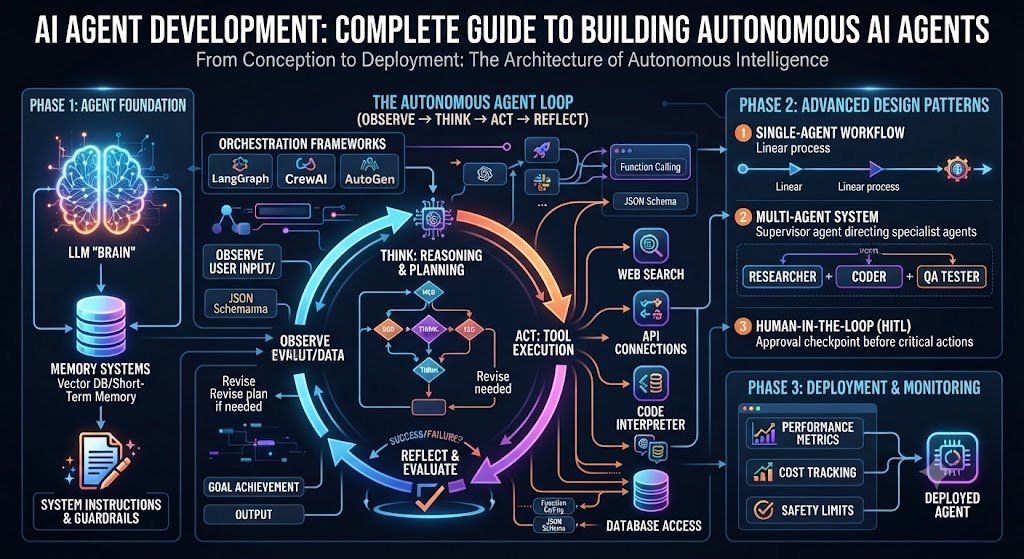
At its core, an agent is an autonomous entity that reasons, takes action, and improves over time. The agent's brain is a large language model — a cognitive engine that understands tasks, generates responses, and makes decisions based on context. Unlike a static tool, an agent adapts as it works. It follows a recursive loop: Think, then Act, then Observe. Each cycle moves the agent forward, refining its approach as it goes.
An agent is a software system that uses an LLM as its reasoning engine to autonomously pursue a goal across multiple steps. It relies on tool use — the ability to invoke external functions such as APIs, database queries, or code execution sandboxes. Before invoking tools, the agent performs planning: decomposing a high-level goal into sub-tasks. After each action, reflection evaluates intermediate results and adjusts strategy. Across steps and sessions, memory persists information the agent needs to stay coherent.
AI Agent vs. Traditional Automation vs. Chatbot
| Dimension | Chatbot | Traditional Automation | AI Agent |
|---|---|---|---|
| Control flow | Single prompt-response | Developer-defined sequence | Agent determines next steps |
| Error handling | Retry or fail | Per-step retry | Autonomous recovery |
| Tool use | None or fixed | Pre-programmed | Dynamic selection |
| Memory | None | None | Short-term and long-term |
| Autonomy | None | Low | High |
| Planning | None | None | Goal decomposition |
| Adaptability | None | Rigid | Adaptive |
The distinction is not merely one of complexity but of control flow architecture. Traditional automation follows fixed rules. Agents reason within guardrails.
The Agent Architecture: Core Components
The Reasoning Loop
The foundation of every agent is the reasoning loop — the cycle of thinking, acting, and observing that moves the agent toward its goal.
Think: The LLM analyzes the current state, available tools, and goal. It plans the next action.
Act: The agent invokes a tool — API call, database query, code execution, search.
Observe: The agent receives the result and updates its understanding of the state.
Reflect: The agent evaluates progress and decides whether to continue, adjust, or stop.
This loop repeats until the goal is met or a termination condition triggers.
Memory Architecture
Agents need memory to maintain coherence across steps and sessions.
| Memory Type | Purpose | Implementation |
|---|---|---|
| Short-term (Session State) | Immediate recall within a conversation | In-memory store, context window |
| Long-term (Memory Service) | Retaining past interactions | Vector database, structured store |
| Episodic | Specific past experiences | Vector database with metadata |
| Semantic | General knowledge | RAG, knowledge base |
Industry assessment shows memory is immature everywhere — no framework has production-grade long-term memory with semantic search and pruning. This is an active area of development and a critical consideration for production agents.
Tool Use and Interoperability
For agents to be useful, they need to interact with tools, data sources, and other agents.
Model Context Protocol (MCP): Anthropic's MCP gives agents a standardized way to connect with external data sources and stateless tools. Instead of building custom integrations for every service, developers can use MCP's standardized interface to simplify development and improve interoperability. MCP hit 97 million monthly downloads by March 2026.
Agent2Agent Protocol (A2A): Google's A2A protocol enables agents to communicate directly with each other, regardless of their underlying frameworks. Agents using A2A can discover each other's capabilities, negotiate how they'll interact, and collaborate on tasks through a secure and structured exchange of messages.
MCP and A2A are now under Linux Foundation governance, signaling industry convergence on interoperability standards.
Multi-Agent Orchestration
Trying to prompt a single, massive LLM to handle intent extraction, database retrieval, and stylistic reasoning all at once is a fast track to hallucinations and latency spikes. To scale, treat agents like microservices. Decompose complex problems into specialized sub-agents with tightly scoped prompts, managed by a supervisor agent that routes the traffic.
Supervisor Agent: Routes requests to specialized sub-agents, manages state, and coordinates multi-step workflows.
Specialized Sub-Agents: Each handles a tightly scoped task — intent classification, data retrieval, validation, response generation, escalation.
Shared Tools and Memory: Agents access common tools and persistent memory for context.
Guardrails: Deterministic rules, confidence thresholds, and human escalation protocols prevent runaway behavior.
This architecture delivered 6x processing time reduction (from 1 hour to 10 minutes) in production deployments.
AI Agent Frameworks: The 2026 Landscape
As of 2026, four frameworks dominate Python-based multi-agent orchestration: Microsoft Semantic Kernel (accessed through the Microsoft Agent Framework in Microsoft Foundry), LangGraph (part of the LangChain ecosystem), AutoGen (from Microsoft Research), and CrewAI. Each framework embodies a different mental model for how agents compose and coordinate.
Framework Comparison
| Framework | Best For | Mental Model | Production Readiness |
|---|---|---|---|
| LangGraph | Complex stateful production agents | Graph-based state machines | Highest |
| CrewAI | Fast prototyping with role-based agents | Role-playing teams | Moderate |
| Microsoft Agent Framework | Azure ecosystem integration | Data-flow workflows | High |
| AutoGen | Conversational multi-agent patterns | Conversational agents | Maintenance mode |
Framework Selection Criteria
| Criteria | What to Evaluate |
|---|---|
| Team expertise | Framework familiarity and learning curve |
| Integration needs | Azure, AWS, or on-premises connectivity |
| Control flow | Explicit graph vs. implicit conversation |
| Governance requirements | Audit trails, approval gates, policy control |
| Portability | Lock-in risk across model providers |
| Support and community | Documentation, community size, commercial support |
No framework wins on all axes. LangGraph leads production readiness, Google ADK leads protocol completeness, CrewAI leads approachability. The choice depends on your specific requirements.
Enterprise Platforms for AI Agent Development
Beyond open-source frameworks, enterprise platforms provide managed infrastructure for agent development and deployment.
Microsoft Copilot Studio: A low-code platform for building, deploying, and managing AI agents. Users can build full-scale business applications using natural language, connected to enterprise data and systems while operating under the Microsoft security umbrella.
Google Gemini Enterprise Agent Platform: Combines Vertex AI, Agent Studio, and Agent Development Kit (ADK) with governance tools. Provides architectural guidance and code samples for production-ready agent infrastructure.
OpenAI Agent Platform: Managed agent API that allows developers to run agents in OpenAI-managed sandbox environments or on their own infrastructure through supported third-party sandbox providers.
Azure AI Foundry: Enterprise platform for professional developers building multi-agent systems with strong governance and compliance features.
AI Agent Development Costs in India: 2026 Benchmarks
AI agent development in India runs ₹1.5 to 25 lakh+ depending on tools, integrations, and autonomy. A typical build costs ₹4 to 12 lakh.
Cost Bands by Complexity
| Band | Scope | Cost (INR) | Cost (USD) |
|---|---|---|---|
| Entry / Basic | 1-2 tools, light integration, human review on every action | ₹1.5–4 lakhs | $1,800–$4,800 |
| Typical Build | Multiple tools, API integrations, memory, guardrails, logging, evaluation | ₹4–12 lakhs | $4,800–$14,400 |
| Advanced / Enterprise | Multi-agent systems, deep operational integration, high safety and observability | ₹12–25 lakhs+ | $14,400–$30,000+ |
What Drives the Cost
The biggest cost factor is integration complexity. Connecting agents with CRM, ticketing, ERP, and internal APIs takes most engineering effort. Each system the agent reads or writes adds build and testing cost.
Autonomy level: Human-in-the-loop is cheaper to trust; full autonomy needs far more guardrails and evaluation.
Data readiness: Clean, accessible data is fast; messy data is usually the real bottleneck, not the AI.
Run cost (LLM API + infra): Ongoing operating expense that scales with usage, budget it separately from the build.
Ongoing Costs
| Cost Component | Monthly Range (INR) | Monthly Range (USD) |
|---|---|---|
| LLM API calls | ₹10,000–₹2,00,000+ | $120–$2,400+ |
| Cloud infrastructure | ₹5,000–₹50,000 | $60–$600 |
| Vector database | ₹3,000–₹30,000 | $36–$360 |
| Monitoring and evaluation | ₹10,000–₹50,000 | $120–$600 |
| Maintenance and updates | ₹15,000–₹75,000 | $180–$900 |
The AI Agent Development Lifecycle
Phase 1: Use Case Definition (Weeks 1–2)
Define the agent's goal, scope, tools, and success metrics. Write the single workflow and the number it should move — hours saved, errors cut, revenue recovered.
Phase 2: Architecture Design (Weeks 2–4)
Choose framework, define agent topology (single vs. multi-agent), plan memory architecture, and design tool integration points.
Phase 3: Prototype (Weeks 4–8)
Build a working prototype with real tools and test data. Validate the reasoning loop, tool calls, and memory.
Phase 4: Evaluation and Hardening (Weeks 8–12)
Build golden datasets, calibrate LLM-as-judge systems, create regression gates before deployment. Test for prompt injection, data leakage, and adversarial attacks.
Phase 5: Production Deployment (Weeks 12–20)
Deploy in sandboxed environments, implement canary rollout, establish rollback procedures, and set up monitoring.
Phase 6: Operations and Optimization (Ongoing)
Monitor agent performance, update tools and prompts, manage model routing, and optimize token costs.
Production Deployment: What Separates Demos from Reliable Agents
Google's 20-Question Framework for Agent Deployment
Google published a framework of 20 questions for companies building and deploying AI agents. Key recommendations include:
Deploy agents in managed serverless environments that can expand with demand
Support low-latency interactions, private networking, and packaged software dependencies
Match model selection to task complexity rather than using the most advanced model for every request
Implement observability, evaluation, and deployment discipline from day one
Security Requirements for Production Agents
Deploying AI agents securely in an enterprise means controlling what each agent can access, execute, change, and retain. The security boundary extends beyond the model to the agent's identity, tools, execution environment, data, network paths, and route to production.
Security checklist:
□ Classify each agent by its actions and potential impact □ Give agents task-specific identities and short-lived, scoped credentials □ Mediate tool calls and isolate generated or untrusted code □ Separate data, networks, and environments □ Add approval gates for high-impact actions □ Correlate agent traces with platform audit logs □ Use customer-controlled infrastructure when required OWASP's Top 10 for Agentic Applications 2026 identifies critical risks across agent goals, tools, identity, memory, and multi-agent systems. NIST's May 2026 analysis found broad agreement that existing cybersecurity practices must be adapted for agent-specific threats.
Deployment Patterns
| Pattern | Description | Best For |
|---|---|---|
| Staging | Production-like environment for release checks | All agents |
| Canary | Rollout to a small percentage first | High-risk changes |
| Blue-green | Two identical environments for zero-downtime | Critical agents |
| Rollback | One-click return to previous version | All agents |
Get a real staging environment, not just a sandbox check. Add canary rollout so no change hits everyone at once. Make rollback a one-click certainty, not a fire drill.
Multi-Agent Systems: The Next Phase of Enterprise Automation
The next phase of enterprise automation will be defined by multi-agent systems: distributed networks of intelligent agents that go beyond just executing tasks, operating with autonomy, coordination, and governance to deliver outcomes.
Why Single Agents Fail at Scale
Existing multi-agent systems largely assume discrete request-response workflows and remain underexplored at enterprise scale. The limits of single agents have pushed the field toward multi-agent architectures.
Multi-Agent Orchestration Patterns
| Pattern | Description | Use Case |
|---|---|---|
| Supervisor | Central agent routes to specialists | Customer support, operations |
| Choreography | Agents coordinate through events | Distributed workflows |
| Swarm | Decentralized agents self-organize | Research, exploration |
| Plan-and-Execute | Planner agent with executor agents | Complex multi-step tasks |
Schneider Electric runs an internal AI Hub of 350 people supporting more than 60 agents across critical infrastructure, with an LLMOps discipline built around observability, evaluation, and deployment.
Governance and Compliance: Building AI Agents Responsibly in India
DPDPA Requirements for AI Agents
The Digital Personal Data Protection Act, 2023 establishes a comprehensive framework governing the collection, processing, and storage of personal data in India. The DPDP Rules, 2025 create specific obligations for AI agents processing personal data.
| Requirement | What It Means for AI Agents |
|---|---|
| Data Minimisation | Collect only data necessary for the agent's task |
| Purpose Limitation | Use data only for disclosed purposes |
| Consent | Obtain consent before processing personal data |
| Storage Limitation | Delete data when purpose is fulfilled |
| Security Safeguards | Implement reasonable security measures |
| Grievance Redressal | Provide mechanisms for complaints |
Under Section 5 of the DPDP Act, personal data must be processed only for the specific purpose for which user consent has been obtained. Data collected during one interaction cannot be repurposed for other uses without separate and explicit consent.
IndiaAI Governance Guidelines
MeitY's seven principles (Sutras) apply to AI agent development: Trust, People First, Innovation over Restraint, Fairness & Equity, Accountability, Understandable by Design, Safety, Resilience & Sustainability.
India has outlined a new approach to AI governance with the release of a white paper titled "Strengthening AI Governance Through Techno-Legal Framework," published by the Office of the Principal Scientific Adviser (OPSA) in January 2026.
Agentic AI and Enterprise Governance
Indian companies are prioritizing domestic, industry-specific guidelines and regulatory compliance over global frameworks. A majority of enterprises are implementing stronger controls around ethics, identity management, and privacy in step with the wider deployment of agentic AI.
RBI's Framework for Responsible and Ethical Enablement of AI (FREE-AI) is considered a starting point for responsible, comprehensive, scalable and ethical deployment. Banks are investing in AI governance layers to ensure that in scaled AI scenarios they don't lose sight of essential guardrails.
Governance Questions for Every AI Agent
What data does the agent access? Is it DPDPA-compliant?
Who is accountable for agent decisions?
How are agent updates governed and approved?
What audit trails exist for agent actions?
How does the agent escalate to humans?
What happens when the agent produces incorrect outputs?
How is agent bias tested and mitigated?
Common Mistakes in AI Agent Development
Mistake 1: Starting with a "do everything" agent. Building a general agent when a narrow, reliable one would have paid back in a month. Scope the smallest agent that moves the metric.
Mistake 2: Overbuilding orchestration before proving workflow value. Build the simplest agent that works, then expand.
Mistake 3: Ignoring memory architecture. No framework has production-grade long-term memory. Plan for this limitation.
Mistake 4: Skipping evaluation. Without golden datasets and regression gates, agent updates become risky.
Mistake 5: Underestimating token costs. Agentic workflows consume more tokens than single-prompt interactions. Budget and monitor.
Mistake 6: Treating agents as a replacement for engineering discipline. Agentic development requires more rigorous engineering, not less.
Mistake 7: Ignoring security. A prompt injection can become a tool call. An over-permissioned connector can widen impact across systems.
Mistake 8: No governance framework. DPDPA and MeitY guidelines are not optional.
Frequently Asked Questions
1. What is an AI agent?
An AI agent is a software system that uses an LLM as its reasoning engine to autonomously pursue a goal across multiple steps. It uses tools, plans actions, reflects on results, and maintains memory.
2. How is an AI agent different from a chatbot?
A chatbot answers questions. An agent reasons, plans, and acts. It decides which tools to use, executes multi-step workflows, and adapts based on results.
3. What is multi-agent orchestration?
Multi-agent orchestration coordinates multiple specialized agents under a supervisor or through choreography. It decomposes complex problems into tightly scoped tasks handled by different agents.
4. What frameworks are used for AI agent development in 2026?
Four frameworks dominate: LangGraph (production readiness), CrewAI (prototyping), Microsoft Agent Framework (Azure integration), and AutoGen (conversational patterns).
5. How much does AI agent development cost in India?
Entry builds start at ₹1.5–4 lakhs ($1,800–$4,800). Typical production agents cost ₹4–12 lakhs ($4,800–$14,400). Enterprise multi-agent systems run ₹12–25 lakhs+ ($14,400–$30,000+).
6. What is the biggest cost driver for AI agents?
Integration complexity. Each system the agent reads or writes adds build and testing cost. Autonomy level and data readiness also significantly impact cost.
7. What is MCP?
Model Context Protocol (MCP) is a standardized way for agents to connect with external data sources and tools. It hit 97 million monthly downloads by March 2026.
8. What is A2A?
Agent2Agent (A2A) is a protocol that enables agents to communicate directly with each other, regardless of their underlying frameworks. It allows agents to discover capabilities and collaborate on tasks.
9. How do I ensure AI agents are secure?
Classify agents by risk, give them scoped credentials, mediate tool calls, isolate untrusted code, add approval gates for high-impact actions, and correlate agent traces with audit logs.
10. What governance is required for AI agents in India?
DPDPA requires data minimisation, consent, purpose limitation, and security safeguards. MeitY's IndiaAI Governance Guidelines provide seven principles for responsible AI.
11. How long does it take to build an AI agent?
A focused pilot takes 8–12 weeks. Production deployment with multi-system integration takes 12–20 weeks. Enterprise multi-agent systems take 20+ weeks.
12. How can Innovative AI Solutions help?
Innovative AI Solutions is a Delhi-based AI development company specialising in production-grade AI agents for Indian businesses. We help you architect, build, and deploy autonomous agents with proper governance, security, and ROI. Our approach begins with a structured assessment and pilot. Learn more at https://innovativeais.com.
Contact Innovative AI Solutions
Ready to build autonomous AI agents that work in production?
We help Indian businesses architect, develop, and deploy intelligent agents with the right frameworks, security, and governance.
Contact Information
Innovative AI Solutions
📍 Netaji Subhash Place, Pitampura, Delhi – 110034
🌐 Website: https://innovativeais.com 📧 Email: info@innovativeais.com
📞 Phone: +91 7464 099 059 / +91 96899 67356
Business Services
• AI Automation
• AI Development
• AI Consulting
• Machine Learning Solutions
• Deep Learning Solutions
• Generative AI Services
• NLP Solutions
• AI Agents
• AI Chatbots
• Voice AI
• CRM Development
• Custom Software Development
• Website Development
• Mobile App Development
About the Author
Abhishek Kumar
Founder & CEO, Innovative AI Solutions
5+ years building production AI systems for Indian businesses. Based in Delhi, serving clients across India.
Ready to build AI solutions for your business?
Innovative AI Solutions — Delhi's leading AI development company. Free consultation available.
Get Free Consultation →
A complete 2026 guide for Indian businesses building autonomous AI agents — covering architecture, frameworks, orchestration, costs, and governance.
#AIAgentDevelopment #AutonomousAgents #AgenticAI #MultiAgentSystems #AIarchitecture #LangGraph #CrewAI #AIframeworks #AIgovernance #DPDPA #MCPProtocol #A2AProtocol #AIagents #EnterpriseAI #AIorchestration #AIproduction #AgenticAutomation #AIsecurity #AIevaluation #AIcostIndia #AIdevelopmentDelhi #AIagentsIndia #GenerativeAI #AItransformation #InnovativeAISolutions
Copyright ©️ 2015–2026 Innovative AI Solutions. All Rights Reserved. | Privacy Policy | Terms & Conditions


