



The Hiring Reflex: Why Growing Businesses Add People Before Fixing Processes When work piles up, the default response is hiring. More orders? Hire order processors. More customer queries? Hire support staff. More invoices? Hire accounts executives.
This reflex feels safe. It's familiar. It produces immediate visible action.
But hiring is expensive, slow, and often the wrong first move.
Consider the real cost of a single mid-level hire in Delhi NCR in 2026:
| Cost Component | Annual Amount (INR) | Annual Amount (USD) |
|---|---|---|
| Salary | ₹4,00,000–₹8,00,000 | $4,800–$9,600 |
| Recruitment | ₹25,000–₹75,000 | $300–$900 |
| Training and onboarding | ₹30,000–₹60,000 | $360–$720 |
| Benefits and compliance | ₹50,000–₹1,00,000 | $600–$1,200 |
| Management overhead | ₹40,000–₹80,000 | $480–$960 |
| Total Year 1 | ₹5,45,000–₹11,15,000 | $6,540–$13,380 |
And that's for one person. A growing business adding five people spends ₹27–55 lakhs in year one alone.
Now consider what those five people will actually do. Industry studies consistently show that 40–60% of time in operations, support, and admin roles goes to repetitive, rule-based tasks. Work that doesn't require human judgment. Work that AI can handle.
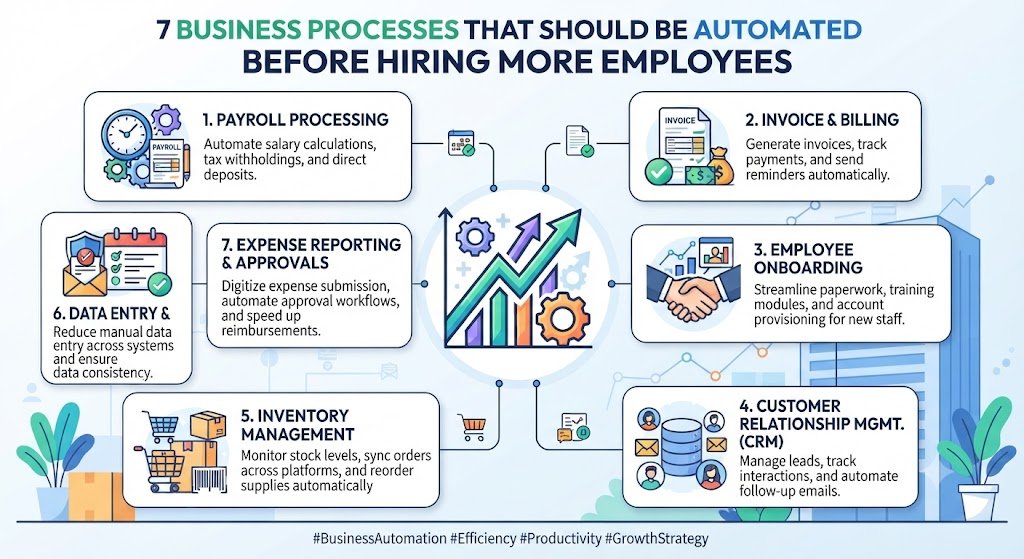
This guide identifies the 7 business processes that should be automated before hiring more employees — with realistic Indian pricing, ROI timelines, and implementation steps for 2026.
Why Automate Before Hiring: The Strategic Case
The Compounding Cost of Headcount
Hiring is not a one-time expense. It compounds.
Salaries increase annually with inflation and appraisals
Management layers grow as teams expand
Coordination overhead multiplies with every new person
Attrition risk means repeating recruitment and training
Office space and infrastructure add fixed costs
Automation, by contrast, scales without proportional cost increases. A well-designed AI system handling 1,000 tasks daily can handle 10,000 tasks with marginal additional cost.
The Speed Advantage
Hiring takes time. Recruiting, interviewing, onboarding, and training a new employee takes 6–12 weeks before they're fully productive. A pilot AI automation can be live in 3–6 weeks.
The Capacity Multiplication Effect
AI doesn't just replace manual work. It multiplies existing team capacity. A support team of five handling 500 tickets daily can handle 1,200 tickets with AI assistance — without adding a single person.
When Hiring Is Still the Right Answer
Automation is not always the answer. Hire when:
The work requires nuanced human judgment
Relationship building is central to the role
Creative problem-solving is needed daily
The task volume doesn't justify automation investment
Exception handling dominates the workload
The goal is not avoiding hiring. It is ensuring you hire for work that genuinely requires humans.
How to Decide: Automation vs. Hiring Scorecard
Before automating or hiring, score the process.
| Criteria | Weight | Score 1–5 | Weighted Score |
|---|---|---|---|
| Task volume (higher = better automation candidate) | 25% | ||
| Repetitiveness (higher = better candidate) | 20% | ||
| Rule-based nature (higher = easier to automate) | 15% | ||
| Error cost (higher = more benefit from automation) | 15% | ||
| Data availability (higher = easier to train AI) | 10% | ||
| Human judgment required (lower = better candidate) | 10% | ||
| Integration complexity (lower = easier) | 5% | ||
| Total | 100% | /5 |
A score above 3.5 indicates strong automation potential. Below 2.5 suggests hiring or process redesign first.
The 7 Business Processes to Automate Before Hiring
Process 1: Lead Capture and Qualification
What it looks like manually:
Leads arrive from multiple channels — website forms, WhatsApp, IndiaMART, phone calls, social media. A sales representative manually reads each inquiry, responds, asks qualifying questions, enters details into CRM, and assigns follow-up. After-hours leads wait until morning. Weekends pile up. Response time stretches to hours.
What AI automation does:
An AI lead qualification agent engages every inquiry instantly across WhatsApp, website, and email. It asks pre-set qualifying questions — budget, timeline, service need, location — scores the lead, and routes qualified prospects to the right salesperson with full conversation context. CRM entry happens automatically. After-hours leads receive immediate responses.
Typical results:
| Metric | Before AI | After AI |
|---|---|---|
| Response time | 2–4 hours | Under 60 seconds |
| After-hours capture | 0% | 100% |
| Sales time on qualification | 10–15 min/lead | 1–2 min/lead |
| CRM data entry | Manual | Automatic |
Investment range:
Implementation: ₹1,50,000–₹5,00,000 ($1,800–$6,000)
Ongoing: ₹5,000–₹25,000/month ($60–$300)
Hiring alternative: One sales development representative costs ₹4–8 lakhs annually. AI handles qualification for a fraction — and never sleeps.
Process 2: Customer Support and Routine Inquiries
What it looks like manually:
Support teams answer the same questions repeatedly. Order status. Pricing. Availability. Business hours. Return policy. Each query takes 5–8 minutes. Volume spikes create backlogs. Response times stretch. Customers repeat themselves when escalated.
What AI automation does:
An AI support assistant trained on your knowledge base handles routine queries instantly. It connects to order management systems to provide real-time status. Complex issues route to human agents with full context. The AI operates 24/7 across WhatsApp, website chat, and email.
Typical results:
| Metric | Before AI | After AI |
|---|---|---|
| First response time | 2–6 hours | Instant |
| Routine query handling | 100% human | 60–80% AI |
| Support capacity | 500 tickets/day | 1,200 tickets/day |
| Customer satisfaction | Variable | Consistent |
Investment range:
Implementation: ₹2,00,000–₹6,00,000 ($2,400–$7,200)
Ongoing: ₹15,000–₹50,000/month ($180–$600)
Hiring alternative: Two support executives cost ₹6–12 lakhs annually. AI handles routine volume while your team focuses on complex, high-value interactions.
Process 3: Appointment Scheduling and Reminders
What it looks like manually:
Back-and-forth messages to find a suitable time. Manual calendar checks. Confirmation messages. Reminder calls. No-show follow-ups. Rescheduling requests. For service businesses — clinics, salons, consultancies, repair services — this consumes hours daily.
What AI automation does:
An AI scheduling assistant integrates with your calendar and communicates via WhatsApp or SMS. Customers request appointments in natural language. The AI checks availability, books the slot, sends confirmations, delivers reminders, and handles rescheduling. No human involvement for routine bookings.
Typical results:
| Metric | Before AI | After AI |
|---|---|---|
| Scheduling time | 8–10 min/booking | Under 1 min/booking |
| No-show rate | 20–30% | 10–15% |
| After-hours bookings | 0% | 100% |
| Staff time on scheduling | 2–3 hours/day | 15–30 min/day |
Investment range:
Implementation: ₹1,00,000–₹3,00,000 ($1,200–$3,600)
Ongoing: ₹5,000–₹20,000/month ($60–$240)
Hiring alternative: A front-desk executive or scheduling coordinator costs ₹2.5–5 lakhs annually. AI handles the routine 80% of scheduling.
Process 4: Invoice Processing and Financial Administration
What it looks like manually:
Invoices arrive as PDFs, images, and paper. Accounts staff manually read each one, extract vendor details, amounts, GST numbers, and line items. They enter data into accounting software, match against purchase orders, flag discrepancies, and process payments. Month-end closing becomes a scramble.
What AI automation does:
AI-powered invoice processing extracts data from any format — PDF, image, scanned paper — validates against business rules, matches with purchase orders, flags exceptions, and syncs with accounting software. Payment reminders and reconciliation happen automatically.
Typical results:
| Metric | Before AI | After AI |
|---|---|---|
| Data entry time | 4–6 min/invoice | 20–30 sec/invoice |
| Error rate | 3–5% | Under 1% |
| Month-end closing | 5–7 days | 2–3 days |
| Staff time on AP/AR | 4–6 hours/day | 1–2 hours/day |
Investment range:
Implementation: ₹2,00,000–₹6,00,000 ($2,400–$7,200)
Ongoing: ₹15,000–₹40,000/month ($180–$480)
Hiring alternative: An accounts executive costs ₹3–6 lakhs annually. AI handles the data entry and matching, freeing your finance team for analysis and strategy.
Process 5: Order Processing and Inventory Updates
What it looks like manually:
Orders arrive through WhatsApp, email, phone calls, and marketplaces. Staff manually read each order, enter it into the ERP or order management system, update inventory, generate shipping labels, and send confirmations. During peak periods, orders pile up. Errors increase. Customers complain.
What AI automation does:
AI extracts order details from any channel — text, email, voice, image — creates orders in your system, syncs inventory in real time, generates shipping labels, and sends automated confirmations. Inventory reconciliation happens continuously.
Typical results:
| Metric | Before AI | After AI |
|---|---|---|
| Order entry time | 5–8 min/order | 30–60 sec/order |
| Inventory accuracy | 85–90% | 98–99% |
| Order processing capacity | 200 orders/day | 800+ orders/day |
| Peak period backlog | Severe | Minimal |
Investment range:
Implementation: ₹2,50,000–₹8,00,000 ($3,000–$9,600)
Ongoing: ₹20,000–₹60,000/month ($240–$720)
Hiring alternative: Two order processing executives cost ₹5–10 lakhs annually. AI handles volume spikes without adding headcount.
Process 6: Employee Onboarding and HR Administration
What it looks like manually:
New hire paperwork. Document collection. Form filling. Payroll setup. Leave tracking. Employee queries about policies, payslips, and benefits. HR spends hours on repetitive administration instead of strategic people work.
What AI automation does:
AI extracts data from onboarding documents, creates employee records, triggers payroll setup, schedules training, and answers routine HR queries through a chatbot. Leave requests, policy questions, and document requests are handled automatically.
Typical results:
| Metric | Before AI | After AI |
|---|---|---|
| Onboarding admin time | 3–5 hours/employee | 30–60 min/employee |
| HR query handling | 10–15 min/query | 1–2 min/query |
| Document collection | Manual follow-up | Automated reminders |
| Payroll input accuracy | 95–97% | 99%+ |
Investment range:
Implementation: ₹1,50,000–₹4,00,000 ($1,800–$4,800)
Ongoing: ₹10,000–₹30,000/month ($120–$360)
Hiring alternative: An HR executive costs ₹3–6 lakhs annually. AI handles administration while your HR team focuses on culture, retention, and growth.
Process 7: Reporting, Analytics, and Management Dashboards
What it looks like manually:
Every week, someone pulls data from multiple systems. Sales from CRM. Orders from ERP. Support tickets from helpdesk. Finance from accounting software. They paste into Excel, build charts, format reports, and email to management. The process takes hours. By the time reports are ready, data is already stale.
What AI automation does:
AI connects to all your systems, pulls data automatically, generates reports on schedule, and delivers them to the right people. Natural language queries allow anyone to ask questions like "What were last month's sales by region?" and get instant answers. Anomaly detection flags issues before they become problems.
Typical results:
| Metric | Before AI | After AI |
|---|---|---|
| Report preparation | 4–8 hours/week | 15–30 min/week |
| Data freshness | Weekly | Real-time |
| Ad-hoc data requests | 2–3 hours each | Instant self-service |
| Decision speed | Delayed | Immediate |
Investment range:
Implementation: ₹2,00,000–₹6,00,000 ($2,400–$7,200)
Ongoing: ₹15,000–₹50,000/month ($180–$600)
Hiring alternative: A data analyst costs ₹4–8 lakhs annually. AI handles routine reporting, freeing analysts for deeper strategic work.
Hiring vs. Automation: Side-by-Side Comparison
| Factor | Hiring an Employee | AI Automation |
|---|---|---|
| Time to productivity | 6–12 weeks | 3–8 weeks |
| Year 1 cost | ₹5.5–11 lakhs | ₹3–8 lakhs |
| Scaling cost | Linear | Marginal |
| Availability | 8–10 hours/day | 24/7 |
| Error rate | 3–5% | Under 1% |
| Training required | Ongoing | Initial setup |
| Attrition risk | High | None |
| Management overhead | Significant | Minimal |
| Best for | Judgment, relationships, creativity | Repetition, volume, rules |
Implementation Roadmap: From Audit to Automation
Phase 1: Process Audit (Weeks 1–2)
Document every manual process in your business. For each, record:
Volume (daily/weekly/monthly)
Time per task
Who performs it
Error frequency
Tools involved
Integration points
Phase 2: Prioritisation (Weeks 2–3)
Score each process using the automation vs. hiring scorecard. Prioritise processes with:
High volume
High repetitiveness
Clear rules
Available data
Low integration complexity
Phase 3: Vendor Selection (Weeks 3–4)
Evaluate AI automation vendors on:
Production deployments (not just demos)
Integration experience with your systems
Pilot willingness
Governance framework
Ongoing support model
Phase 4: Pilot (Weeks 4–8)
Run a 3–6 week paid pilot on one high-priority process. Define success metrics upfront. Measure actual time savings, error reduction, and team adoption.
Pilot investment: ₹75,000–₹3,00,000 ($900–$3,600)
Phase 5: Production Deployment (Weeks 8–16)
Roll out gradually. Start with 20% of volume. Maintain human oversight. Track errors. Train the team. Document workflows.
Phase 6: Expand and Optimise (Ongoing)
Add adjacent processes. Optimise based on usage patterns. Build internal monitoring capability. Expand to other departments.
Cost Benchmarks: AI Automation vs. Hiring in India
| Process | AI Implementation | AI Monthly | Hiring Annual Cost | Break-Even |
|---|---|---|---|---|
| Lead qualification | ₹1.5–5 lakhs | ₹5–25k | ₹4–8 lakhs | 4–8 months |
| Customer support | ₹2–6 lakhs | ₹15–50k | ₹6–12 lakhs | 5–10 months |
| Appointment scheduling | ₹1–3 lakhs | ₹5–20k | ₹2.5–5 lakhs | 3–6 months |
| Invoice processing | ₹2–6 lakhs | ₹15–40k | ₹3–6 lakhs | 4–8 months |
| Order processing | ₹2.5–8 lakhs | ₹20–60k | ₹5–10 lakhs | 5–10 months |
| HR administration | ₹1.5–4 lakhs | ₹10–30k | ₹3–6 lakhs | 4–8 months |
| Reporting | ₹2–6 lakhs | ₹15–50k | ₹4–8 lakhs | 5–10 months |
Governance and Compliance: The Non-Negotiable Framework
DPDPA Requirements
The Digital Personal Data Protection Rules, 2025 apply to AI systems processing personal data. Before automating any process involving customer or employee data:
Implement data minimisation
Obtain consent for data processing
Provide clear purpose disclosure
Enable data deletion on request
Implement security safeguards
IndiaAI Governance Guidelines
MeitY's seven principles (Sutras) — Trust, People First, Innovation over Restraint, Fairness & Equity, Accountability, Understandable by Design, Safety — apply to business AI automation. Ensure your systems are transparent, accountable, and safe.
Questions to Ask Every AI Vendor
How does the system handle personal data under DPDPA?
What audit trails exist for automated decisions?
How does the system escalate to humans?
What happens when AI produces incorrect outputs?
How are model updates governed?
Common Mistakes to Avoid
Mistake 1: Automating a broken process. Fix the process first, then automate.
Mistake 2: Expecting 100% automation immediately. Plan for 70–90% automation with human handling for exceptions.
Mistake 3: Ignoring integration complexity. AI that doesn't connect to your systems creates new manual work.
Mistake 4: Skipping the pilot. Pilots reveal real-world performance that demos hide.
Mistake 5: Underestimating change management. Involve your team in design and rollout.
Mistake 6: Choosing the cheapest vendor. The lowest quote often delivers the highest long-term cost.
Frequently Asked Questions
1. Should I always automate before hiring?
No. Automate processes that are high-volume, repetitive, and rule-based. Hire for work requiring judgment, relationships, and creativity. Use the scorecard in this guide to decide.
2. How much can I save by automating instead of hiring?
A single hire costs ₹5.5–11 lakhs in year one. AI automation for one process typically costs ₹3–8 lakhs in year one, with lower ongoing costs and 24/7 operation. Savings compound as volume grows.
3. What is the minimum investment for AI automation?
A focused pilot starts at ₹75,000–₹1,50,000 ($900–$1,800). Production deployment for one process typically begins at ₹1,50,000–₹3,00,000 ($1,800–$3,600).
4. How long does it take to automate a business process?
Pilot: 3–6 weeks. Production deployment: 6–16 weeks depending on complexity. Most businesses see measurable results within the first month of production use.
5. Will AI automation replace my existing employees?
AI reduces manual work, not headcount. Growing businesses typically redeploy team members to higher-value activities rather than reducing staff.
6. What if my process is too complex to automate?
Start with the routine 70–80% of the process. Leave complex exceptions for humans. Most processes have a large automatable core.
7. Can AI handle Indian languages and local context?
Yes. Modern AI systems support Hindi, Bengali, Tamil, Telugu, and other Indian languages. IndiaMART's VANI handles mixed Hindi-English conversations in production.
8. How do I choose between multiple AI vendors?
Ask for production case studies, direct client references, and a paid pilot on your data. Vendors who can't provide all three are selling marketing, not engineering.
9. What ongoing costs should I expect?
Budget 15–30% of initial implementation cost annually for monitoring, maintenance, updates, and infrastructure.
10. How does DPDPA affect AI automation?
DPDPA requires data minimisation, consent, purpose limitation, and security safeguards. Your AI vendor must implement these from day one.
11. Can AI automation work with my existing software?
Yes, modern AI systems integrate with common platforms (Zoho, Tally, SAP, custom ERPs) through APIs. Verify integration experience during vendor evaluation.
12. How can Innovative AI Solutions help?
Innovative AI Solutions is a Delhi-based AI development company specialising in production automation systems for Indian businesses. We help growing companies identify which processes to automate before hiring, implement AI systems with proven ROI, and provide ongoing support. Our approach begins with a structured audit and pilot. Learn more at https://innovativeais.com.
Contact Innovative AI Solutions
Ready to automate before you hire?
We help Indian businesses reduce manual work, scale efficiently, and grow without proportional headcount increases.
Contact Information
Innovative AI Solutions
📍 Netaji Subhash Place, Pitampura, Delhi – 110034
🌐 Website: https://innovativeais.com 📧 Email: info@innovativeais.com
📞 Phone: +91 7464 099 059 / +91 96899 67356
Business Services
• AI Automation
• AI Development
• AI Consulting
• Machine Learning Solutions
• Deep Learning Solutions
• Generative AI Services
• NLP Solutions
• AI Agents
• AI Chatbots
• Voice AI
• CRM Development
• Custom Software Development
• Website Development
• Mobile App Development
About the Author
Abhishek Kumar
Founder & CEO, Innovative AI Solutions
5+ years building production AI systems for Indian businesses. Based in Delhi, serving clients across India.
Ready to build AI solutions for your business?
Innovative AI Solutions — Delhi's leading AI development company. Free consultation available.
Get Free Consultation →
A practical 2026 guide for Indian businesses on the 7 processes to automate before hiring more employees — with costs, ROI, and implementation steps.
#AutomateBeforeHiring #BusinessAutomation #AIforSMEs #GrowingBusiness #WorkflowAutomation #DelhiNCRTech #ReduceManualWork #ScaleWithAI #ProcessAutomation #HiringVsAutomation #AIProductivity #AutomationROI #AIimplementation #DigitalTransformation #IndianBusiness #TechAutomation #SmartHiring #EfficiencyAI #DelhiBusiness #AIAdoption #FutureOfWork #BusinessGrowth #CostOptimization #InnovativeAISolutions
Copyright ©️ 2015–2026 Innovative AI Solutions. All Rights Reserved. | Privacy Policy | Terms & Conditions


